



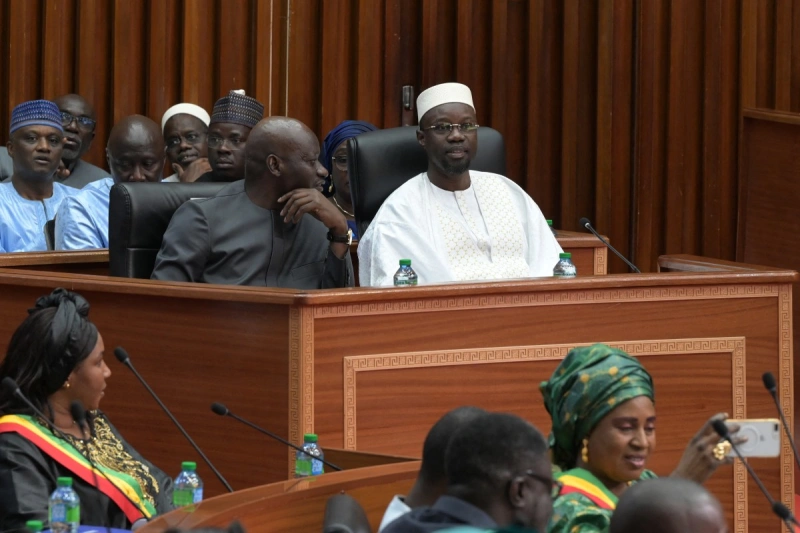

Senegal’s prime minister, Ahmadou Al Aminou Lô, stands before the National Assembly in Dakar today. He is due to deliver his general policy statement at 10am, a constitutional exercise that sets out a government’s road map.
Lawmakers had already rearranged the calendar once. The sitting was fixed, according to the state news agency APS, under articles 22 and 77 of the Assembly’s internal rules. An earlier date of 1 September had fallen through.
This is Lô’s first general policy statement as head of government. He was appointed on 25 May by President Bassirou Diomaye Faye, replacing Ousmane Sonko. Sonko now chairs the very chamber his successor must address.
That pairing gives today’s general policy statement an unusual charge. A former prime minister will preside over the man who took his job.
Lô is a trained economist rather than a career politician. He spent years at the Central Bank of West African States before joining government in April 2024. He later oversaw the Senegal 2050 transformation agenda.
That background matters for this general policy statement. Much of the anticipation centres on numbers, not rhetoric.
The numbers are grim. Public debt was revised sharply upward after auditors found that deficits under the previous administration had been understated for years.
Senegal has spent much of 2026 trying to rebuild credibility with lenders. Talks with the International Monetary Fund produced a staff level agreement on 1 September. It covers roughly 2.2 billion dollars in financing across 2026 to 2029. The deal still needs approval from the Fund’s board and stops short of formal debt restructuring.
Ordinary households are not waiting for that approval to feel the strain. Hundreds of people marched through Dakar last Saturday carrying empty baskets and bowls. The protest, organised under the banner “30 Jours Pour Le Juste Prix”, targeted the cost of basic goods.
France 24 reported that the price of a kilo of meat has jumped by roughly 30 per cent over the past year. That has pushed the cost of thieboudienne, a staple family dish, close to 10,000 CFA francs for its ingredients alone. One demonstrator told reporters she had gone four months without eating meat.
That anger sits close to the surface of this general policy statement. Public sector unions signed a three year National Pact for Social Stability in May 2025. It covers everything from housing allowances to salary scales.
A review of the pact’s first year found progress on paper. Strikes never fully stopped in education and health. Workers in those sectors want something firmer than reassurance today.
Ahead of the address, Lô reportedly told his own team to prioritise clearing domestic payment arrears. He asked for particular attention to small and medium sized businesses still owed money by the state. Better targeted subsidies and stronger social protection were also flagged as priorities.
A revised 2026 budget is expected to reflect the terms of the Fund agreement. A fresh 2027 budget must reach cabinet by 30 September.
Politically, the arithmetic is not comfortable for the government. The ruling PASTEF party controls 130 of the Assembly’s 165 seats. That gives Sonko’s allies the numbers to make life difficult if they judge the general policy statement wanting.
A formal no confidence vote is not automatic after such an address. But the mood in the chamber will be watched closely all the same.
Recent power cuts in parts of Dakar have added to a sense of a government under strain on several fronts at once.
Whether this general policy statement marks a genuine reset or merely a holding pattern is not yet clear. That answer will emerge once lawmakers, unions and ordinary Senegalese have had time to react to what Lô actually says.


