



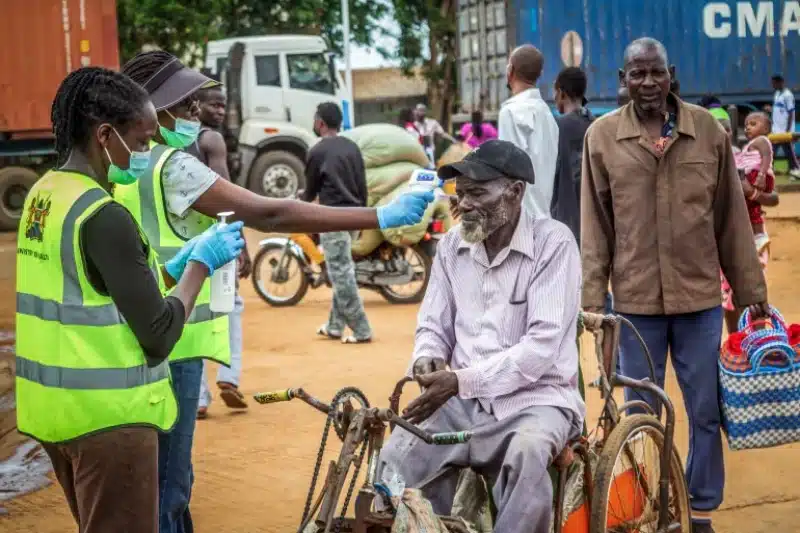

She had spent ten days in quarantine, with her temperature checked daily, when she developed symptoms of Ebola.
On Friday, Kenya’s Ministry of Health confirmed that the 65-year-old woman is the country’s third Ebola patient. It means Ebola in Kenya is no longer the story of one man who flew home and died.
She is a close relative of the first two patients. The ministry said in its statement that she developed a fever, a sore throat and malaise. She then tested positive at two laboratories, the National Virology Reference Laboratory and the Kenya Medical Research Institute.
She is now receiving supportive care in a designated treatment unit, the World Health Organization said. The second patient, a 39-year-old man from the same family, is stable and responding well.
Go back 13 days and the chain begins with a single passenger. A 40-year-old Kenyan businessman had lived in the Democratic Republic of Congo for seven years, The Standard reported. He travelled overland to Kampala and flew into Nairobi on 3 October. He died two days later.
Health Cabinet Secretary Aden Duale announced the case on 6 October. It marked the arrival of Ebola in Kenya, a first for the country.
A 39-year-old relative fell ill on 13 October and tested positive the next day. The woman followed on 16 October. Both were already in quarantine when they became sick.
That is not how it looked before the second case surfaced. The Standard had quoted pathologist Dr Ahmed Kalebi as saying Kenya may have “dodged the bullet”, though he stressed nobody could say so for certain. The caution has aged quickly, and Ebola in Kenya has gained two patients since.
The strongest sign of progress is the ministry’s contact-tracing record. Of 130 people listed, it said, 127 have been traced and quarantined. That is 97.7 per cent, which the ministry described as above the 85 per cent benchmark needed to break a chain of transmission.
Two days earlier the figure was weaker. The ministry’s Wednesday update had 108 of 128 listed contacts in quarantine.
Three people are still missing from the list. Until they are found, nobody can say Ebola in Kenya has been fenced in.
Early detection is the best argument for how Ebola in Kenya is being handled. WHO said both new patients were caught quickly because they were already under daily checks, and that a person with Ebola cannot pass it on before symptoms begin. Dr Patrick Amoth, the ministry’s director general for health, called it “the response working as designed”.
Yet the ministry itself has warned that more cases among quarantined contacts are possible until monitoring ends, WHO noted. For people quarantined on 6 October, day 21 falls on 27 October. But the clock runs from each person’s last exposure, and anyone who was near the third patient before she was isolated starts a fresh one.
The Standard reported that investigators must now establish her exposure history and whether the contact network captures everyone at risk. So when the ministry says public risk “remains low” and sees no community transmission, that line has to be read next to this warning. Ebola in Kenya is still being watched day by day.
Ebola in Kenya did not arrive unannounced. The country has been preparing since May, when Congo declared its outbreak. WHO says nearly 5,000 health workers have been trained, and it has handed over protective equipment, test kits and thermometers worth about US$70,000.
Before the second case, the ministry had also screened more than 667,000 travellers at 26 points of entry, The Standard said. The country remains open, with no restrictions on travel, trade or public gatherings. WHO advises against closing borders.
The reason for the vigilance sits across the region. WHO’s Disease Outbreak News of 8 October recorded 8,728 confirmed cases and 4,205 deaths in Congo, a fatality ratio of 48.2 per cent, and called it the largest Ebola outbreak the country has ever recorded.
By 15 October, the European Centre for Disease Prevention and Control counted 9,277 confirmed cases and 4,478 deaths. It said 65 new cases were reported in a single day.
Set against that, Ebola in Kenya means three patients and one death. But the Bundibugyo strain has no licensed vaccine and no specific treatment, WHO says, although trials are under way in Congo. Early supportive care improves survival. It is all doctors have.
Three patients caught early is something Kenya can fairly be proud of. But with three contacts still untraced and the monitoring period not yet over, the real test is whether the response can prevent further transmission of Ebola in Kenya.


