



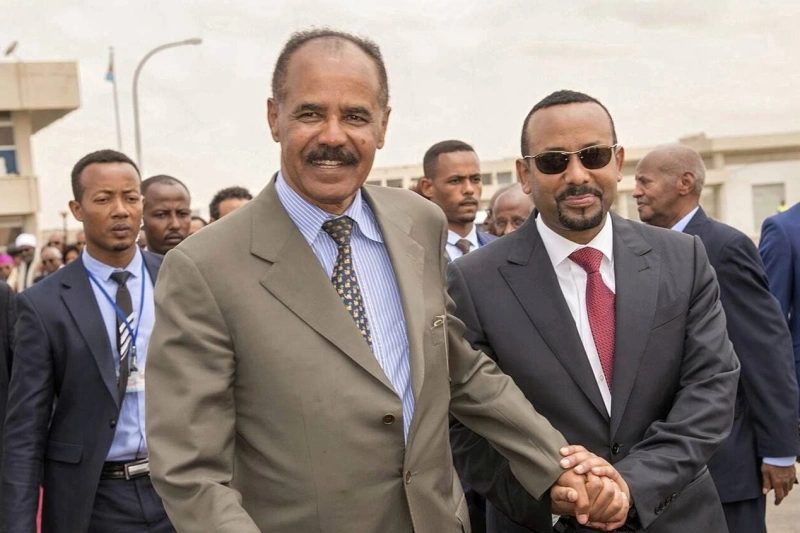

Eight years after a Nobel-winning handshake, two embassies stand empty in the Horn of Africa.
On Thursday, Eritrea formally ended its diplomatic ties with Ethiopia. The announcement came hours after Addis Ababa closed its embassy in Asmara and ordered 10 Eritrean diplomats to leave within 48 hours.
Ethiopia’s foreign ministry said the closure answered “direct and indirect acts of hostility and belligerence”. It declared the diplomats persona non grata, accusing them of activities that threaten national security.
Asmara hit back fast. Its foreign ministry said it had “no option but to reciprocate in kind”, and cut all diplomatic ties with Ethiopia.
Eritrea also said the ten expelled included its chargé d’affaires and diplomats accredited to the African Union.
It accused Addis Ababa of hosting, training and arming Eritrean opposition groups to push for regime change. That claim is Asmara’s own and has not been independently verified.
So why did it unravel in a single day? Thursday’s break followed a week of escalating tensions.
Fighting has raged in northern Ethiopia since last week between federal troops and an opposition alliance led by the Tigray People’s Liberation Front. Reuters reports that Addis Ababa accuses Eritrea, Sudan and Egypt of backing that alliance. Eritrea denies it.
Then came the blasts. Overnight, explosions rattled the capital.
A source linked to the alliance told Reuters it had carried out drone strikes, including on military headquarters. The Associated Press said it was unclear whether the blasts were an attack or military training. The intelligence service had banned drones over the city only hours earlier.
The speed of the break tells its own story. Eritrea took only hours to end diplomatic ties with Ethiopia, and there was no cooling-off period.
It was not meant to end like this. In 2018, Abiy Ahmed and Isaias Afwerki signed a peace deal that closed two decades of hostility after the 1998 to 2000 border war. That deal restored diplomatic ties with Ethiopia, reopened embassies and brought Abiy a Nobel Peace Prize.
Then the Tigray war arrived. Eritrean troops fought alongside Ethiopian federal forces from 2020 to 2022, in a conflict the African Union says killed an estimated 600,000 people. The friendship did not survive the peace that followed.
A long-running dispute over Red Sea access has also strained relations, and that explains why diplomatic ties with Ethiopia were fraying long before this week.
Ethiopia has been landlocked since Eritrea became independent in 1993. Analysts at the Atlantic Council estimate it pays roughly $1.5 billion a year to Djibouti for port access.
Abiy has called Ethiopia’s claim to sea access irreversible. Earlier this year he told parliament that the Red Sea and Ethiopia “cannot remain separated forever”. In March he insisted Ethiopia would not fire a single bullet at Eritrea.
Asmara hears something else. It says Addis Ababa covets Assab, the Red Sea port about 70 kilometres from the Ethiopian border.
Two leaders say they want peace. Both act as if they expect a fight. Any repair of diplomatic ties with Ethiopia would have to start with that suspicion.
Here is what the closed embassies change in practice. Diplomats are the people you ring when a drone crosses a line or troops move near a border. Without diplomatic ties with Ethiopia, Asmara has no open channel to ask what a move means. Addis Ababa has none either.
Third parties will have to carry the messages. Abiy himself asked last October for mediation from the United States, China, Russia, the African Union and the European Union.
He may soon find out whether any of them can still make the phone ring in Asmara. Restoring diplomatic ties with Ethiopia will now need an outside mediator and a willing Asmara.
Meanwhile, the cost is already counted in Tigray.
A resident of the Hitsats camp, home to about 16,000 displaced people, told the Associated Press that “drones hover in the sky every day. Many there fear being uprooted a second time.
Embassies are where angry countries keep talking. This week, two of them switched off the room.


