



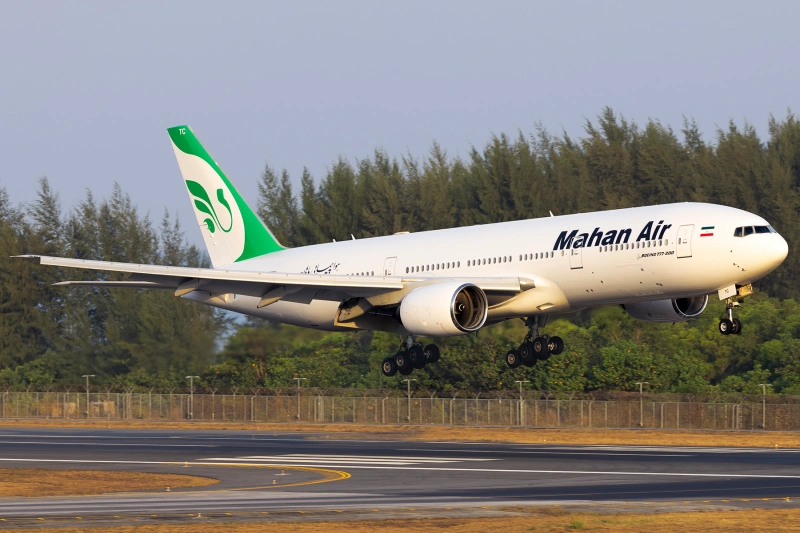

Thirty three people and companies walked into a courtroom in Antananarivo on Tuesday as the Madagascar Boeing 777 scandal finally reached a judge. By the afternoon, the case against them had been pushed back more than a month.
That is the short version of how the Madagascar Boeing 777 scandal landed in court this week. The longer version explains why a hearing about five aircraft took eighteen months to reach a judge, and why it still has not properly started.
At the heart of the Madagascar Boeing 777 scandal are five Boeing 777s that once flew for Singapore Airlines and were given temporary Malagasy registration in January 2025, on paperwork saying they were going to Kenya for maintenance. The civil aviation authority issued provisional registration and airworthiness certificates for the aircraft that January, under a project put forward by a company called Udaan Aviation, covering ferry flights scheduled between 17 and 21 April that never actually took place.
For months, the registrations attracted little attention. That changed in July when the aircraft finally began moving.
Cambodian officials alerted Madagascar’s aviation authority on 20 June 2025 about suspicious documents involving three of the planes, after discovering that a certificate’s validity date had been altered without authorisation and extended to 12 July. The warning came too late. The aircraft moved that July, after the original documents had already expired, and all five left Cambodia on 15 July, still carrying their Malagasy tail numbers.
The jets had not come from Cambodia alone. Records show they passed through Lanzhou in China between December 2023 and March 2024, then through Jakarta in Indonesia between May and July 2025, before the final leg out of Cambodia. Once inside Iranian airspace, one aircraft landed at Mashhad, two at Zahedan and two more at Chabahar, an airport normally used for logistics and military flights. All five had their temporary registrations stripped within hours of arrival.
A central question in the Madagascar Boeing 777 scandal is how six months after that provisional Malagasy paperwork was issued, the planes landed in Tehran. They are now flying for Mahan Air, the Iranian carrier the United States has sanctioned since 2018 for ferrying weapons and personnel for the Revolutionary Guard.
A small island nation’s civil aviation stamp had, in effect, helped a sanctioned airline take delivery of five wide-body jets. Madagascar’s own regulator did not dispute that something had gone wrong. The authority said afterwards that its authorisations had lapsed and that the documents used to move the aircraft had been falsified.
The political fallout from the events now being examined in the Madagascar Boeing 777 scandal came fast. Transport minister Valéry Ramonjavelo was sacked days after the story broke, and specialists from the American FBI helped the Malagasy investigation that followed.
That investigation is what brought the Madagascar Boeing 777 scandal to court on Tuesday. It barely got started. The anti-corruption court, known as the PAC, said the case was being pushed back to 27 October because it was still waiting on a response from Madagascar’s civil aviation authority, a reply from businessman Mamy Ravatomanga, and the results of what it called “a digital investigation,” without giving further detail. Six of those charged were granted provisional release before the court adjourned.
Ravatomanga’s absence sits at the centre of the Madagascar Boeing 777 scandal delay. He is one of Madagascar’s wealthiest businessmen, ranked among the country’s ten richest people by Forbes in 2017, and was close to Andry Rajoelina, the president the army removed in October 2025. A Malagasy court issued a warrant for his arrest on money laundering charges on 16 October, days after that change of government, and Madagascar asked Interpol for a red notice. He was already in Mauritius by then.
Mauritian authorities froze his assets, and the country’s Financial Crimes Commission arrested him in November at a clinic in Phoenix. He faces a provisional charge of conspiracy there and two counts of money laundering, and his lawyers have told the court he is medically unfit to travel. He has not been convicted of anything in either country. Malagasy newspapers have reported that Udaan Aviation, the company behind the original registration, was linked to Sodiat, the conglomerate Ravatomanga owns.
A billionaire once close enough to the presidency to shape how business got done in Antananarivo is now a fugitive his own government wants extradited, arguing through lawyers in Mauritius that he is too unwell to face the court that wants to hear from him. The allegation remains unproven, but his absence continues to hang over the Madagascar Boeing 777 scandal as investigators wait for answers.
For now, the Madagascar Boeing 777 scandal remains focused on how five Boeing 777s that used to belong to Singapore’s flag carrier ended up in Iran, flying routes for an airline Washington will not let near a dollar. The paperwork that got them there took eighteen months to reach a Malagasy courtroom, and less than a day to be sent back out again.


