



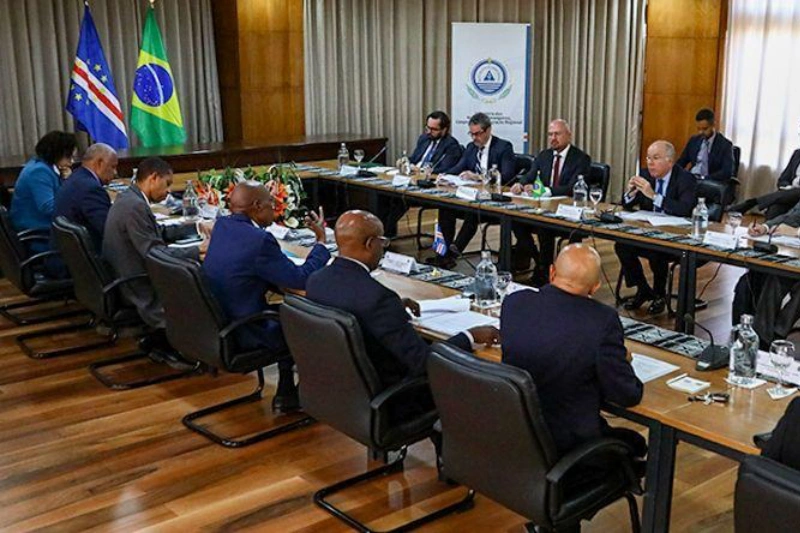

According to Lusa, the businesspeople pointed to technology, tourism and energy as the sectors most likely to benefit first, arguing that Cabo Verde already sits at a useful crossing point between Africa, Europe and South America.
Gildo Batista, president of Brazil’s Teletur Group, told the forum his company already treats the islands as an investment platform for remote work and digital services. He said Teletur plans to launch a project called Teleport in Cabo Verde within the week, built to attract technology firms serving the archipelago, the rest of Africa and international remote workers.
It would be Teletur’s fourth business mission to Cabo Verde, and Batista pushed for the return of direct flights between the two countries, calling them essential to keeping the relationship active rather than occasional.
Batista argued that Africa’s needs go beyond money. Investment only works, he said, when it arrives with technology, knowledge and management skill, so that natural resources turn into industry, jobs and wealth rather than raw exports shipped elsewhere.
He named the blue economy, renewable energy, logistics and connectivity as the areas where Cabo Verde could make that shift, all of which fit neatly into the country’s pitch as an investment platform rather than a tourist stop alone.
Portuguese businessman Pedroso Leal set out where his country’s firms are looking. He listed tourism, construction, new technology and digital security as active interests, alongside a push into alternative energy that would help Cabo Verde build its own power supply.
He called the islands a window of opportunity built on shared technology and on Europe’s proximity, adding that Portuguese and Cabo Verdean firms stand to gain from working the investment platform together rather than separately.
João Fidalgo, who chairs Cabo Verde’s Sovereign Fund for Private Investment Guarantee, said the fund exists to build bridges between local needs and foreign capital. He named transport as the country’s biggest constraint on scaling up any investment platform ambitions, even as its location keeps drawing outside interest.
Government minister José Carlos Varela pushed the three countries to turn centuries of shared history into something concrete, namely a working space for investment, technology transfer and jobs. He listed water, agriculture, renewable energy, the blue and digital economies, tourism, industry, transport and logistics as priority areas.
Varela insisted that capital coming into the country must also strengthen local firms and create better jobs for young Cabo Verdeans, not just extract resources and move on.
The forum did not happen in isolation. It sits inside the Lusophone Compact, a partnership the African Development Bank Group runs together with Portugal and the Portuguese-speaking African states, recently widened to include Brazil as its eighth member.
The African Development Bank Group has said the Compact carries investment projects worth close to seven and a half billion US dollars across six PALOP countries, and its guarantee programme recently backed its first transaction, an expansion of Cabo Verde’s Cabeólica wind farm.
Cabo Verde’s own pitch as an investment platform rests on more than goodwill. Corporate tax in its special technology zone can fall to as low as 2.5 per cent, the escudo has been pegged to the euro since 1998, and membership of ECOWAS gives visa-free access to fifteen West African markets.
A submarine cable, EllaLink, already links Brazil to Europe through the islands, and a technology park in Praia and Mindelo is being built to house hundreds of tech workers under the country’s digital economy strategy.
None of that solves the transport bottleneck Fidalgo flagged. Flights between Praia and Brazilian cities remain limited despite Friday’s talk of renewed connections, and that gap could slow how fast the investment platform idea turns into signed contracts.
Whether the pledges made in Praia become real projects will depend on how quickly Brazilian and Portuguese firms move past forums and mission trips into work on the ground.
For now, the message from every speaker in Praia stayed consistent. Cabo Verde wants to be treated as a genuine investment platform for Africa, not a stopover between bigger markets in Europe, the Americas and West Africa.


