




Niger has signed a $1.9 billion Dosso refinery deal with Canadian company Zimar Group. It is one of the largest energy investments in the Sahel this decade.
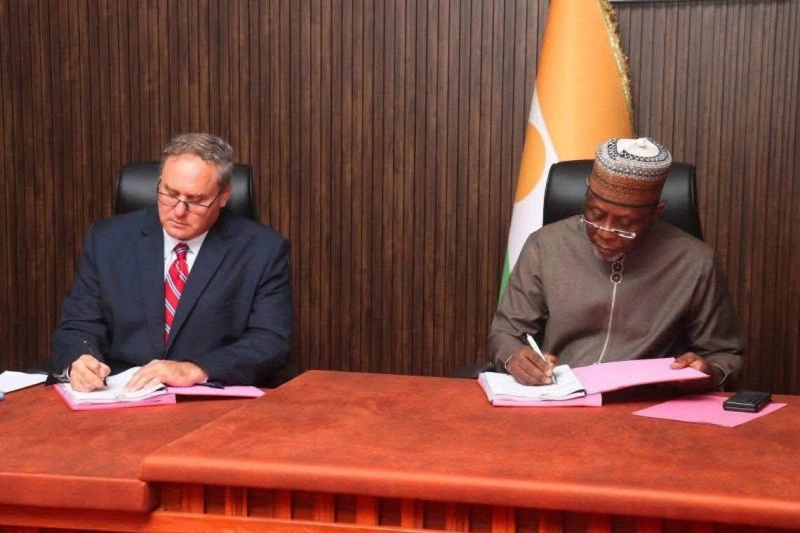
The Dosso refinery deal was signed in Niamey on 15 August. It covers a 100,000-barrel-per-day refinery and petrochemical complex in the southwestern city of Dosso, according to Niger’s official press agency, ANP.
Zimar Group and its US partner, High Tech, will finance, design and build the facility. The Dosso refinery deal follows a build-operate-transfer structure.
Construction is expected to take three years. Operation runs for a further thirteen, after which ownership transfers to the Nigerien state, Foreign Minister Bakary Yaou Sangare said at the signing.
Sangare signed on behalf of the government. Zimar Group and High Tech chief executive Benjamin Day Marok represented the consortium.
Once complete, the refinery would process five times more crude than Niger’s existing Zinder plant. That facility, built with Chinese investment, produces just 20,000 barrels a day and was commissioned in 2011.
The Dosso refinery would also rank among West Africa’s largest. Only Nigeria’s 700,000-barrel-per-day Dangote refinery and Ghana’s 120,000-barrel-per-day Sentuo facility would sit ahead of it, the Hydrocarbon Processing trade journal reported.
For landlocked Niger, this refinery deal carries strategic weight beyond economics.
The country currently exports crude through a Chinese-built pipeline running nearly 2,000 kilometres to the Beninese port of Cotonou. That route has stalled repeatedly, hit by border disputes with Benin and rebel attacks on the pipeline itself.
A working refinery at home changes that picture. It reduces Niger’s exposure to one vulnerable export corridor, and to the price swings that come with selling unprocessed crude abroad.
Sangare said the Dosso refinery deal would end Niger’s dependence on imported fuel. He added that it could eventually let Niger supply neighbouring Sahelian states too.
This is not the first signing of the Dosso refinery deal. Niger and Zimar agreed initial terms back in October 2024, but Niamey ordered a review and demanded revisions before finalising the Dosso refinery deal this month.
A Nigerien civic organisation had also raised questions about Zimar’s financial and technical capacity. It urged the government to carry out further due diligence before proceeding.
The government has now given the consortium four months to secure financing and finish detailed engineering work. Financial close is targeted within a year, according to the Oil and Gas Journal.
Plans call for three production trains. One would process 30,000 barrels a day, with two further trains handling 35,000 barrels each. Pipelines, storage tanks and a wider petrochemical complex are also included.
Timing matters here. Niger’s military government, in power since the July 2023 coup, has leaned heavily on oil revenue to stay afloat as Western financing dried up and regional sanctions bit.
A rebel group calling itself the Patriotic Movement for Freedom and Justice has attacked the Benin export pipeline more than once. Its stated aim is to choke off the junta’s oil income.
A domestic refinery gives Niamey a revenue stream that sits outside that risk. Fuel refined and sold within Niger, or to neighbouring markets, does not depend on the same vulnerable corridor.
Whether the Dosso refinery deal survives its own four-month financing deadline is still an open question. The project has an uneven history, and security risks across Niger’s wider energy sector have not gone away.
For now, the signing gives Niger’s junta a visible symbol of an energy strategy built on processing its own crude, rather than shipping it out unrefined.


