



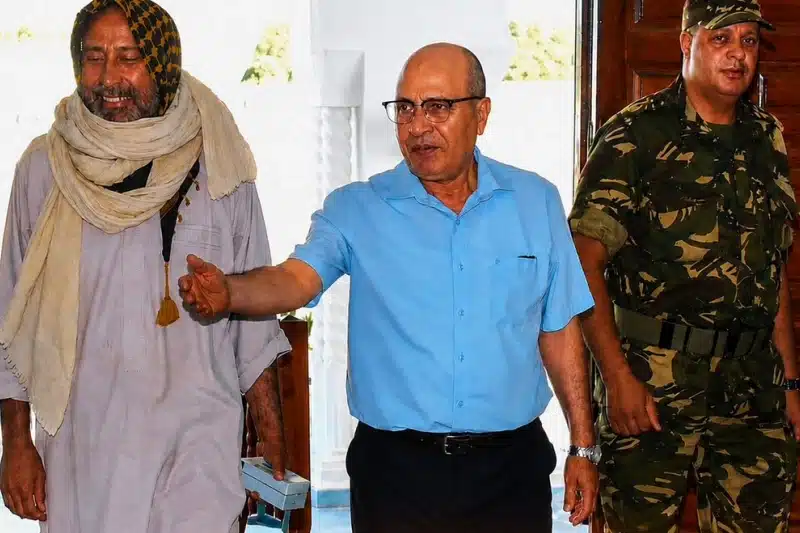

Algeria has secured the release of a German hostage in Niger, ending more than a fortnight of captivity for Sinan Ulumaskan, a German national of Turkish descent who was seized by an armed criminal group in the country’s centre.
Algeria’s Ministry of National Defence said the army’s security services received Ulumaskan on the evening of Friday, 7 August, after he was recovered from Nigerien territory close to the border. The ministry described him as being in good health.
According to the ministry’s statement, the German hostage in Niger was abducted on 26 July in the Tahoua region, in the centre of the country. No group has come forward to claim responsibility for the kidnapping, and Algerian authorities have not disclosed how the operation to bring him out was carried out.
Ulumaskan later described his ordeal to Algerian officials. He said he spent his first four days in the desert with an initial band of captors before being handed to a second group, who held him for around twelve to thirteen days in conditions he called very poor.
Once in Algerian hands, the German hostage in Niger was flown from the military’s forward base at In Guezzam, near the Nigerien border in the far south of the country, to Boufarik Air Base south of Algiers. Before boarding, Ulumaskan thanked the Algerian authorities for their hospitality and for the care he received during his time with them.
He also expressed gratitude to Algeria’s president, Abdelmadjid Tebboune, who serves as supreme commander of the armed forces, and to the Minister of National Defence, for what he called their efforts in securing his safe return, the ministry said.
One Algerian commentary outlet, Algérie Patriotique, has speculated that Ulumaskan runs a metals trading firm in Hamburg and suggested, that his presence in Niger was tied to unlicensed mineral dealing. Neither Algeria’s Defence Ministry nor German authorities have commented on his reasons for being in the country, and the claim has not been corroborated by other outlets.
On Monday, 10 August, Algeria formally handed the German hostage in Niger over to German officials at the headquarters of the Ministry of Foreign Affairs, National Community Abroad and African Affairs in Algiers, according to Algérie Presse Service, the state news agency. The handover brought a swift conclusion to a case that had drawn attention across the Sahel since the kidnapping first came to light.
The release of the hostage fits a pattern Algeria has built up in the wider Sahel region, where its forces have stepped in before to bring foreign nationals kidnapped across the border home safely. In January 2025, Algeria helped secure the release of Gilbert Navarro, a Spanish national who had been captured in the south of the country and later moved into Mali before his eventual release.
Niger has struggled with instability, armed groups linked to Al Qaeda and Daesh have carried out attacks across large parts of the country. Kidnapping for ransom has emerged as a persistent threat to foreign workers and travellers moving through its remote northern and central regions. It is against this backdrop that the case of the German hostage in Niger unfolded.
Two other foreign hostages remain in captivity in Niger. Austrian national Eva Gretzmacher and Swiss national Claudia Abbt were both abducted in the north of the country in 2025, and neither has yet been freed. Their captors have not been identified publicly, and their cases have received far less international attention than Ulumaskan’s.
Algeria’s security cooperation with Niger has continued alongside the hostage release. Its defence ministry announced on 9 August that it had donated four helicopters and related military equipment to Nigerien forces, a move it described as part of deepening bilateral defence ties between the two neighbours.
For Ulumaskan’s family and for German diplomats who had been tracking the case, the safe return of the German hostage in Niger marks a rare piece of good news from a region where kidnappings often drag on for months or longer. His transfer to German custody in Algiers closes an ordeal that began on a stretch of road in Tahoua just over two weeks earlier.


