



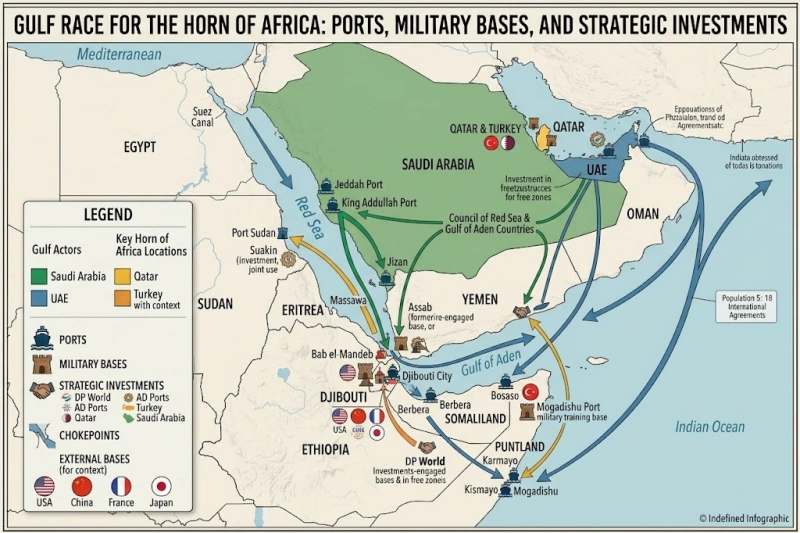

A quiet contest for Red Sea real estate is reshaping the Horn of Africa. Most of it happens away from summits and communiqués. The Gulf race for the Horn of Africa is playing out in port concessions, farmland leases and military basing deals.
Four outside powers sit at the centre of it. The United Arab Emirates, Saudi Arabia, Qatar and Turkey have each built a distinct footprint across Eritrea, Somaliland, Somalia and Sudan. The Gulf race for the Horn of Africa overlaps in places and collides badly in others.
Start with the ports, because that is where the Gulf race for the Horn of Africa is easiest to see. Dubai’s DP World won a thirty-year concession to run Berbera port in Somaliland in 2016. It followed that with a twenty-five-year military lease over the port’s old airbase a year later, according to research published by The Century Foundation.
The runway at Berbera stretches four kilometres. That is long enough to receive heavy transport aircraft. Britain’s own development finance arm later bought into the port too, sitting alongside DP World and the Somaliland government as minority partners.
A similar pattern unfolded further along the coast in Bosaso, the commercial capital of Somalia’s Puntland region. DP World’s subsidiary, P&O Ports, secured a thirty-year concession there in 2017. It was worth roughly 336 million dollars, a sum that dwarfs Puntland’s own annual government budget.
In Djibouti, the same company lost ground instead. Djibouti’s government seized DP World’s Doraleh Container Terminal in 2018 after a long legal fight. It is a reminder that the Gulf race for the Horn of Africa does not always end well for Abu Dhabi.
Turkey has taken a different route into the Gulf race for the Horn of Africa. Ankara leans on military training rather than terminal contracts. Camp TURKSOM in Mogadishu opened in 2017 at a cost of fifty million dollars. It remains Turkey’s largest overseas military facility anywhere in the world.
Turkish officers there have trained more than fifteen thousand Somali soldiers, according to figures reported this year by the outlet Nordic Monitor. That includes the elite Gorgor commando brigades now central to Mogadishu’s internal security disputes.
Turkish firms also run Mogadishu’s port and airport. Ankara has since expanded into hydrocarbons exploration off the Somali coast. Construction has begun on a satellite launch and testing site near Kismayo, spread across roughly nine hundred square kilometres. It is another stake in the Gulf race for the Horn of Africa.
Each new project deepens Mogadishu’s dependence on a single foreign patron. That is the wider story of the Gulf race for the Horn of Africa. Military training becomes political leverage over time.
Saudi Arabia has pursued a quieter but far larger strategy in the Gulf race for the Horn of Africa. It is built on land rather than ports. Riyadh’s Saudi Star Agricultural Development company committed 2.5 billion dollars to Ethiopian agribusiness from 2011. It leased ten thousand hectares in the Gambella region for rice farming, with an option on nearly three hundred thousand more.
Sudan’s parliament went further still in 2016. It granted Saudi investors the right to cultivate roughly 420,000 hectares of Sudanese farmland for ninety-nine years. Few Sudanese smallholders had any say in the matter.
The scale of that appetite becomes clearer in the Land Matrix database, which tracks cross-border land deals. It shows Gulf states acquiring more than two million hectares of African farmland between 2000 and 2022. Over a third of it sits in other Arab countries.
Saudi Arabia, the UAE, Qatar and Kuwait together hold roughly half a million hectares in Sudan alone. That land produces wheat, rice and livestock destined mostly for Gulf markets, not for communities facing their own food shortages nearby.
Riyadh has since layered military and diplomatic weight onto that agricultural base. It signed a security pact with Djibouti to build a naval base there, countering Iranian influence along the Bab al Mandeb strait. Saudi Arabia also chairs the Red Sea Council, a body meant to steady the Gulf race for the Horn of Africa. Critics note it still excludes Ethiopia, Israel and, pointedly, the UAE.
That gap leaves the council unable to mediate the very disputes shaping the Gulf race for the Horn of Africa. A body meant to police the waterway cannot easily referee its most active players.
Qatar has carved out a smaller niche in the Gulf race for the Horn of Africa. It acts as mediator and financier rather than garrison power. Doha brokered the 2010 Doha Agreement between Sudan and Chad. It separately negotiated a ceasefire between Djibouti and Eritrea the same year, deploying peacekeepers to the disputed Dumeira mountain border.
That mediating role collapsed in 2017. The Gulf blockade of Qatar pushed Eritrea and Djibouti to sever ties with Doha. Qatari troops abruptly withdrew from the border they had been sent to watch.
Qatar has since rebuilt some of that ground. Its sovereign fund vehicle, Hassad Food, pledged half a billion dollars toward Sudanese agriculture. Diplomats from Doha met Eritrean counterparts again in May, according to regional reporting. Analysts call it a cautious reset rather than a full return.
The pattern across all four capitals is similar. Aid, land and infrastructure money buy access, and access eventually buys political leverage over fragile governments. That is the basic mechanics of the Gulf race for the Horn of Africa.
Nowhere has the Gulf race for the Horn of Africa turned more destructive than in Sudan. The UAE stands accused of arming one side of a civil war that United Nations investigators say has produced genocide. A UN Panel of Experts report first flagged in January 2024 pointed to weapons moving from the UAE to the paramilitary Rapid Support Forces.
Those weapons reportedly moved through an airstrip at Amdjarass in neighbouring Chad, roughly fifty kilometres from the Sudanese border. Flight-tracking data cited by Reuters recorded at least eighty-six UAE-origin cargo flights into that airstrip between April 2023 and December 2024 alone.
Sudan’s own army says it has recovered Emirati-marked ammunition and vehicles from captured Rapid Support Forces positions. That included a warehouse full of Emirati-labelled boxes filmed in Wad Madani in January 2025. The UAE has consistently denied the allegations.
An Emirati official has said the country does not take sides in the conflict. It has sent only humanitarian aid, the official said, including a field hospital built at Amdjarass for wounded civilians and fighters alike.
The stakes rose sharply after the Rapid Support Forces seized El Fasher in North Darfur in October 2025, following an eighteen-month siege. The United Nations human rights office documented thousands of killings in the days that followed the city’s fall.
In February 2026 the UN Independent Fact-Finding Mission for Sudan went further. It concluded that Rapid Support Forces fighters had committed acts of genocide against the Zaghawa and Fur communities. Researchers at the Conflict Insights Group have since traced Colombian mercenaries through Emirati-linked staging points toward the drone hubs that supported the assault. Human Rights Watch corroborated that claim separately in May 2026.
Eritrea’s port of Assab tells its own version of the same story, only in reverse. The UAE built a naval and air base there from 2015 to support its intervention in Yemen’s war. It began dismantling that base in 2021, once Emirati troops withdrew from the Yemen conflict.
Satellite imagery analysed at the time showed barracks torn down and equipment shipped out within months. It is a clear sign of how quickly commitments inside the Gulf race for the Horn of Africa can be switched on and off. The interests behind that switch often have little to do with the host country itself.
Regional diplomats now speak of a possible revival of the Assab facility, this time under a Saudi-led banner. Tensions between Ethiopia and Eritrea are simmering, and Red Sea security concerns have mounted following Houthi attacks on shipping. Whether that revival happens or not, the episode captures the essential pattern running through the entire Gulf race for the Horn of Africa.
African coastlines function here as strategic real estate. They can be occupied, abandoned and reoccupied as Gulf calculations shift. Local governments rarely hold real veto power over that process.
That imbalance was on full display in December 2025. Israel became the first country to recognise Somaliland’s independence. Many in the region read it as Emirati-aligned diplomacy testing the ground in the Gulf race for the Horn of Africa. Somalia, Egypt, Turkey and Djibouti jointly condemned the recognition within hours.
Qatar and Sudan issued separate rejections of their own. Turkey’s president warned the move risked destabilising the entire Horn of Africa. A single diplomatic gesture in Hargeisa realigned an entire regional bloc almost overnight.
What emerges from the ports, the farmland and the arms flows is a contest African governments did not start. It sits at the heart of the Gulf race for the Horn of Africa. Puntland’s port concession alone is worth more than its entire annual budget. Somalia’s army trains almost exclusively under one foreign flag.
Sudan’s civil war has become, in significant part, a proxy fight over Gulf patronage. Djibouti has learned the hard way that hosting foreign bases cuts both ways. It seized one Emirati terminal outright while still leasing land to several other foreign militaries at once.
None of this is unique to any single Gulf capital. Abu Dhabi, Riyadh, Doha and Ankara are each pursuing legitimate interests in food security, trade routes and regional standing. Horn of Africa governments have willingly signed most of the deals in question, often citing urgently needed investment.
The difficulty lies elsewhere. The terms of that investment are rarely made public, and the leverage runs almost entirely one way. Regional bodies, from the African Union to the Red Sea Council itself, have struggled to referee a contest fought largely on African soil.
That contest is decided, more often than not, in Gulf capitals far from the coastline it is reshaping. The Gulf race for the Horn of Africa shows little sign of slowing down in the months ahead.


