



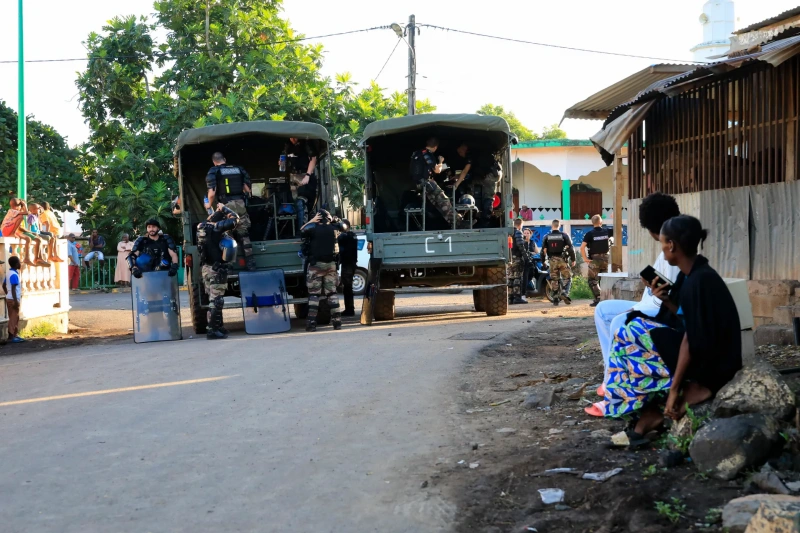

The Mayotte security crackdown is entering a new phase as France turns the archipelago into a more heavily monitored frontier amid deepening tensions with Comoros over migration, sovereignty and the future of the Indian Ocean territory.
New radar systems, long-range drones and an expanded fleet of interceptor vessels are being deployed to monitor the migration corridor linking Mayotte to the Comoros.
French Prime Minister Sébastien Lecornu visited the archipelago on 26 August. Flanked by his defence and interior ministers, he announced a change of scale in the Mayotte security crackdown against irregular crossings. Smuggling networks “adapt and mutate”, he said, according to remarks carried by InfoMigrants. Paris, he added, must respond in kind.
The Mayotte security crackdown now rests on a technological overhaul. Four existing radar stations will be renewed. They will be paired with long-endurance drones, shipborne drones and tethered surveillance balloons, InfoMigrants reported. Artificial intelligence will help track vessel movements across the Mozambique Channel. A permanent forward military post is also planned for M’tsamboro, on the archipelago’s northern coast.
Maritime deployment figures show how far the operation has escalated. French interceptor vessels patrolling the strait grew from four in 2017 to nine this year. Thirteen are targeted by 2028, figures cited by AllAfrica show. Days spent at sea by security forces will rise to roughly 191 in 2026, up from 137 the year before.
Removals have climbed alongside the expansion of surveillance and maritime enforcement. Around 16,000 to 16,500 people were expelled from Mayotte in the first half of 2026 alone. That is a rise of about 21 per cent on the same period last year, according to figures relayed by AllAfrica. Most of those removed are Comorian nationals. Arrivals from the Great Lakes region, including the Democratic Republic of Congo, Rwanda and Burundi, are reportedly growing too.
Lecornu paired the military expansion with a diplomatic lever. Development aid to the Comoros and seven other African states will now be tied to migration cooperation. Burundi, Tanzania, the DRC, Rwanda, Somalia and Kenya are also covered. New “bonus-malus” criteria will weigh prevented departures and the issuing of travel papers for deportees.
But the dispute is not simply about migration. Comoros has repeatedly rejected the premise of the Mayotte security crackdown. Moroni refused to accept deportees during earlier phases of the operation. Maritime links to the nearby island of Anjouan were briefly severed. Comoros has previously accused Paris of acting unilaterally rather than negotiating jointly on migration. French officials, for their part, have accused Comorian authorities of tacitly encouraging departures. Those remarks drew a sharp rebuke from Moroni.
Analysts who study the Mozambique Channel argue the dispute runs deeper than migration policy. Comoros has long objected to France’s military presence on Mayotte, which Moroni continues to claim as part of its territory. Mayotte sits on shipping lanes carrying fuel and cargo between the Middle East, Asia and the African coast. That strategic position predates the current crackdown by decades.
The Mayotte security crackdown did not begin this year. It traces back to Operation Wuambushu, launched in 2023 to dismantle shanty settlements known locally as bangas. These once housed close to 40 per cent of the archipelago’s population. A second phase followed in 2024. A further operation, named Kingia, opened in April 2026 with a promise from the local prefect of a “security shock”.
Displacement has followed each wave of demolitions. A 2018 housing law gave prefects in Mayotte and French Guiana the power to order demolitions without judicial review. Since then, at least 3,500 homes have been destroyed. Around 14,500 residents have been put onto the street, according to figures cited in French parliamentary records. Rents have climbed sharply as a result.
Emergency housing has struggled to keep pace with the losses. UNICEF found that of 701 tin-roofed bangas torn down in 2023, fewer than half of the displaced were given temporary shelter. Children left without parents during raids were among the concerns the agency raised. Families were also separated during demolitions.
Healthcare workers on the archipelago have pushed back against the security operation too. Medical staff wrote to island authorities warning of the sanitary fallout from mass demolitions. They cited restricted access to treatment and the risk of infectious outbreaks in makeshift emergency camps. Mayotte’s emergency services had already stopped operating overnight in parts of the island by December 2023, citing safety concerns for crews.
Vigilantism has taken root as trust in official policing has frayed. Residents in several Mamoudzou neighbourhoods have organised self-defence militias. Mayotte’s homicide rate averaged 5.7 per 100,000 people between 2021 and 2024. That is roughly five times the rate recorded in mainland France over the same period, according to interior ministry statistics submitted to the National Assembly.
Infrastructure strain has grown as the Mayotte security crackdown pulls in more reinforcements from the mainland. Hundreds of gendarmes, riot police and specialist units have been rotated through the archipelago since 2023. This adds pressure to a territory that remains France’s poorest department, with roughly 80 per cent of residents living below the poverty line.
For residents of the bangas, the latest expansion of the Mayotte security crackdown offers little reassurance. Comorian families with relatives on both sides of the strait feel much the same. Drones and interceptor boats may slow the kwassa-kwassa crossings that have claimed hundreds of lives. The underlying poverty, housing shortage and regional inequality pushing people towards Mayotte remain largely unaddressed.


