



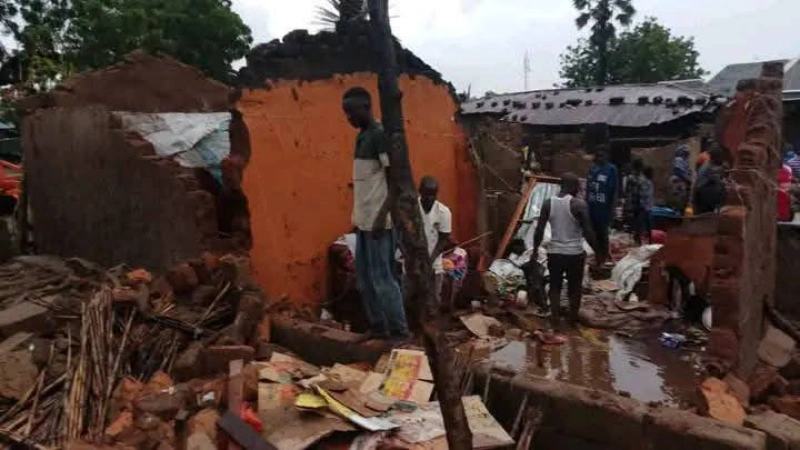

A wave of violent storms has left more than 300 houses in ruins across two Nigerian states, killing one child, injuring dozens and displacing hundreds of families in what emergency officials say is one of the worst weather events to strike the affected communities in recent memory.
The storms hit Zamfara and Plateau states on Sunday, and where the rainstorm destroys homes, it has also erased the little security that many low-income and vulnerable families had built over years.
Zamfara: a village reduced to open ground
In Bela village, Bungudu Local Government Area of Zamfara State, resident Malam Barau said the storm began late on Sunday evening and lasted for more than an hour, preceded by heavy rainfall and hailstones so intense they blanketed the entire village within minutes.
“The incident is unimaginable. Nobody can adequately describe the extent of the losses caused by the destruction,” Barau said.
He described watching trees wrenched from the ground as a powerful wind swept in from the western part of the village. More than 200 houses collapsed or were badly damaged, representing at least one-third of the entire settlement.
Every time a rainstorm destroys homes on this scale, officials confirm, it is the most defenceless residents who are hardest hit. Resident Abdullahi Suleiman Bela said those worst affected in Bela village were orphans and newly married couples.
“The windstorm approached the village like wildfire. People were terrified. Some victims sustained various degrees of injuries, while others are still in shock,” Suleiman said.
One boy died in the disaster. More than 20 people sustained injuries, and around seven livestock were also killed.
Isaka Haske Bela confirmed the storm tore through Rugar Kaya, Anguwar Marafa, the main town of Bela and the palace of the district head of Rugar Kaya Bela. Newer settlements, including Sabon Gari Bela and the old cemetery area, also suffered extensive damage.
Haske said many victims were sheltering in structures built from guinea corn stalks, with more than ten families crowded into a single room in some cases.
“Some may never recover fully from what they have lost,” he said.
The Bela disaster shows how quickly rainstorm destroys homes and livelihoods in rural communities, leaving families without shelter and forcing many to depend on relatives and emergency assistance.
The member representing Maru/Bungudu Federal Constituency, Hon. Abdulmalik Zubairu, confirmed the incident on Facebook and expressed sympathy for the victims.
The Executive Secretary of the Zamfara State Emergency Management Agency, Ambassador Bala Gusau, directed the agency’s Director of Disaster Management, Hassan Dauran, to respond to the situation.
Dauran confirmed the scale of destruction and said the agency had forwarded details to the National Emergency Management Agency, whose team was expected for a joint assessment.
“We are expecting their team tomorrow for a joint assessment and evaluation of the affected areas,” Dauran said.
Plateau: Rainstorm Destroys Homes, Clinics and Churches
Hundreds of kilometres south, the same Sunday night saw a rainstorm destroy homes, health facilities and places of worship in Tom Gangare community, Sopp Ward, Riyom Local Government Area of Plateau State.
Community member Bot Felix said property worth millions of naira was damaged, with uprooted trees falling directly onto residential buildings and compounding the destruction.
Community stakeholder Hon. Dung Danboyi said no lives were lost in Plateau, but confirmed the disaster had stripped many households of shelter and their means of livelihood.
“The level of destruction is overwhelming. Many families have lost their homes and means of livelihood,” Danboyi said, calling on state and federal agencies as well as humanitarian organisations to act without delay.
Each time a rainstorm destroys homes in communities like Tom Gangare, Danboyi said, the absence of immediate government response deepens the hardship for families who have nothing to fall back on.
Councillor Gwong Ibrahim, who represents Sopp Ward, urged relevant authorities to intervene urgently, noting that affected families were struggling to secure temporary shelter and basic necessities.
The Chairman of Riyom Local Government Council, Hon. Sati Bature Shuwa, visited the community, assured residents that a comprehensive assessment would be conducted and pledged to facilitate government support for those affected.
Officials warned that when rainstorm destroys homes during the peak rainy season, vulnerable families often face prolonged displacement, especially in rural communities where access to emergency shelter and recovery assistance is limited.
Residents in both states are calling for immediate relief as Nigeria’s rainy season, which typically intensifies between June and September across the north-west and middle belt, raises the risk of further destruction in communities where housing stock remains fragile.
Meteorologists have warned that conditions remain favourable for severe weather events, which could trigger further incidents under headlines such as “rainstorm destroys homes” across vulnerable settlements.


