



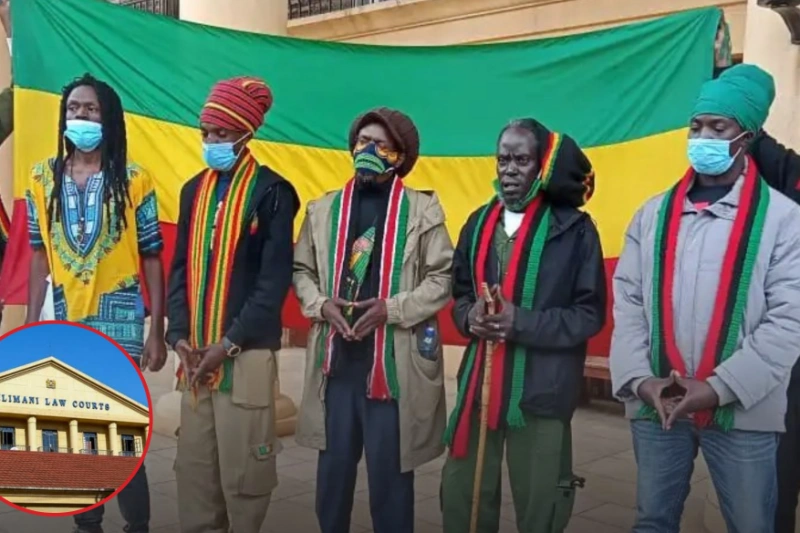

Kenya’s High Court has dismissed the Rastafari cannabis petition that sought to legalise possession, cultivation and private use of the plant for religious worship, ruling that the community failed to prove marijuana is essential to their faith.
Justice Bahati Mwamuye delivered the judgment on Wednesday at the Milimani Law Courts in Nairobi, closing a case first filed by Rastafari Society of Kenya in 2021. The petition, brought by the society alongside its spokesperson Mwendwa Wambua, also known as Ras Prophet, named the interior ministry and other state agencies as respondents. Court records show the Rastafari cannabis petition had already survived one procedural battle earlier this year, when police blocked a member from bringing bhang seeds into the courtroom as evidence.
According to Justice Mwamuye, the Rastafari cannabis petition collapsed on the strength of its own evidence. He noted that witnesses called by the petitioners admitted cannabis use is not compulsory within their faith and that some Rastafari never touch it at all. That admission, the judge said, showed cannabis functions as a preferred mode of worship rather than a religious requirement protected under the constitution.
The Rastafari cannabis petition had argued that provisions of the Narcotic Drugs and Psychotropic Substances (Control) Act violate their rights to freedom of religion, privacy, dignity and equality. They were not asking for blanket decriminalisation, only an exemption covering private worship and designated places of worship. Justice Mwamuye found the case premature regardless, ruling that the group had bypassed existing licensing and exemption mechanisms under the law before rushing to court for constitutional relief.
Kenya’s cannabis laws date back to 1994 and remain among the region’s strictest. Possession still carries a penalty of up to ten years in prison, while unlicensed cultivation can attract up to twenty years, both with fines attached. Those penalties stay fully in force following the ruling, and the Rastafari cannabis petition has not altered the legal exposure Rastafari worshippers face under routine policing. NACADA, the state agency tasked with drug enforcement, had sought to join the case as an interested party while it moved through the courts.
Even so, the judgment was not a straightforward win for the state. Justice Mwamuye used part of his ruling to acknowledge that cannabis has become widely available outside any religious context, pointing to cannabinoid products sold openly in mainstream shops and supermarkets. He described products such as weed-infused cookies as freely marketed and consumed across the country, despite the criminal prohibition still on the books.
That contradiction, in the judge’s view, makes the current punitive approach difficult to sustain. He called for a national conversation on cannabis policy that moves beyond the courtroom, stating that Kenya ought to have frank conversations on the substance and which direction the country should take. He was careful to add that this call did not amount to a judicial endorsement of legalisation, but rather an invitation for society to re-examine whether the existing framework still works.
The case carries weight beyond the cannabis question itself, given Rastafari’s historical ties to Kenya. Dreadlocks, worn as an expression of Rastafari identity, were also worn by many Mau Mau fighters during independence struggle against British colonial rule in the 1950s and 1960s.
Kenyan courts effectively recognised the movement’s religious standing in 2019, ruling that expelling a schoolgirl over her dreadlocks had violated her religious rights. That precedent gave the Rastafari Society some basis for optimism heading into the Rastafari cannabis petition, though Wednesday’s outcome shows courts are treating cannabis itself as a separate and higher evidentiary bar.
Rastafari numbers in Kenya are not formally tracked, but the faith, which blends mysticism, Pan-Africanism and vegetarianism, is widely reported to be growing among younger Kenyans. Community members have long argued that the cannabis ban gives police a pretext to harass Rastafari worshippers regardless of whether they are actually breaking the law, a grievance the ruling does nothing to resolve.
With the Rastafari cannabis petition dismissed in its entirety and each party ordered to bear its own costs, the legal status of cannabis in Kenya remains unchanged for now. What Justice Mwamuye’s parting remarks do is put pressure back on parliament and the wider public to decide whether a law drafted three decades ago still matches how Kenyans actually behave.


