The Faye Sonko power struggle is now reshaping Senegal’s political landscape. The president who rose to power on his prime minister’s coattails is now drawing a very different map.
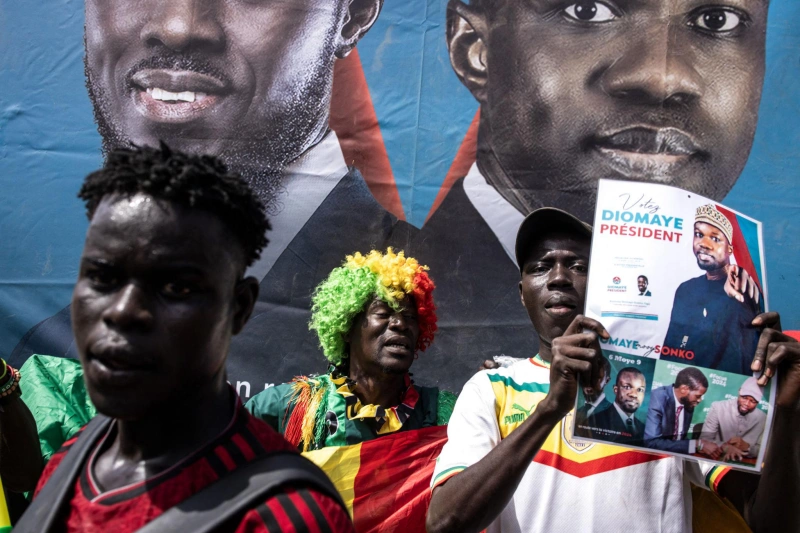
(SENEGAL) – Eighteen months ago, a simple phrase defined Senegalese politics: “Diomaye mooy Sonko” – Diomaye is Sonko. It was more than a campaign slogan. It was a declaration of unity between two men whose fates had become politically inseparable: Bassirou Diomaye Faye, the soft-spoken tax inspector who ran for president from a prison cell, and Ousmane Sonko, the firebrand opposition leader whose popular movement carried him there.
Today, those same streets in Dakar are echoing a different refrain. “Diomaye du Sonko” – Diomaye is not Sonko.
The Faye Sonko power struggle, long simmering beneath the surface of Senegal’s new governing order, broke fully into public view on Saturday, 2 May, when President Faye sat before television cameras and said what no one in the ruling PASTEF party had yet dared to say aloud.
What the president actually said
In a televised address, Faye issued a direct warning about the direction of the party that brought him to power.
“PASTEF isn’t just Ousmane and me,” he told viewers, cautioning that the movement risked “collapse” and “downfall” if it remained built around individual personalities rather than institutional principles.
He went further. Faye reminded both the public and, pointedly, his prime minister, that Sonko holds his position because the president retains “confidence” in him, confidence that, he made clear, could be withdrawn at any moment.
The message was not subtle. A president who owes his electoral breakthrough to Sonko’s political organisation was now asserting, publicly, that the presidency answers to the state and not to the party.
Local media in Dakar received the remarks as anything but routine. In Senegalese political culture, as analysts there have noted, language of this kind from a sitting president is rarely accidental. It is almost always a signal of something being negotiated or contested, behind closed doors. The remarks marked a turning point in the Faye Sonko power struggle.
How the Faye Sonko power struggle took root
To understand the depth of the current tension, it helps to recall how Faye reached the presidency in the first place.
Sonko, a former customs inspector turned opposition politician, built PASTEF into one of West Africa’s most energised political movements, drawing heavily on young, urban Senegalese who felt shut out of the country’s economic gains. When Sonko faced repeated legal battles, including a conviction that initially barred him from the 2024 presidential race, Faye stood in as the party’s candidate.
The plan worked. Faye won decisively in the first round of voting in March 2024, and Sonko was appointed prime minister. The arrangement was understood, at least publicly, as a continuation of a shared project. Sonko would remain the ideological engine; Faye would govern.
What has emerged instead is something far more complicated.
The faultlines beneath the alliance
The Faye Sonko power struggle is not merely a question of personality. It reflects genuine differences in how each man views Senegal’s future, particularly on the economy.
Senegal is managing a debt burden of approximately seven billion dollars, and the path forward has exposed sharp disagreements at the very top of government. Faye has moved towards a pragmatic engagement with international creditors, seeking to reassure markets while navigating a difficult fiscal position.
Sonko, by contrast, has taken what observers describe as a sovereigntist line, pushing back against conditions he regards as infringements on national economic independence. These economic differences have deepened the Faye Sonko power struggle.
The divergence is not theoretical. It has turned into visible friction over appointments, policy direction, and the question of who, in practice, controls the machinery of government.
Faye has moved to strengthen his own political network, appointing allies including Aminata Touré to positions of influence. Sonko, for his part, retains the loyalty of PASTEF’s grassroots base, particularly the party’s youth wing, and has not ruled out returning the movement to opposition if he deems it necessary.
The 2029 question
Hovering over all of this is a question that neither man has yet answered publicly, but which political observers in Dakar regard as central to understanding the current manoeuvring.
Faye, still in the early portion of his first term, is widely expected to seek re-election in 2029. Sonko, recently cleared of eligibility concerns that had previously complicated his own presidential ambitions, is equally expected to want the presidency for himself.
Two men, one party, one presidency to be contested. The arithmetic is not straightforward. The 2029 election could ultimately decide the outcome of the Faye Sonko power struggle.
As one reading of the current dynamic goes: the Faye Sonko power struggle is, at its heart, a contest over who owns the political project they built together, and who gets to carry it into the next chapter.
A wider African pattern
Senegal is not the first African democracy to encounter this particular tension. The history of the continent is replete with examples of opposition movements that successfully unseated incumbents, only to fracture once they arrived in government. The shift from mobilisation to administration has proved one of the most treacherous transitions in African politics.
What makes the Senegalese case notable is the country’s established democratic reputation. Senegal has undergone multiple peaceful transfers of power and is regarded, regionally, as a model of political stability. How this rift is managed will be watched closely by observers across the continent.
Where things stand
There are, broadly, three directions the current situation could take.
In the most stable scenario, Faye and Sonko quietly redistribute their spheres of influence, maintaining the outward appearance of unity while each consolidates a distinct base. In a more turbulent reading, PASTEF fragments along factional lines, slowing governance at a moment when Senegal can ill afford distraction: the war in Iran has pushed oil prices higher, complicating the country’s economic forecasts.
The most assertive outcome would see Faye break decisively from the party framework, positioning himself as a national president rather than a partisan one, a move that could broaden his coalition but hollow out the base that gave him his mandate.
None of these paths has yet been chosen. But in Senegal’s political culture, a president who tells the nation that the prime minister serves at his pleasure has already chosen a direction. The next move belongs to Sonko.
And that next move will determine how the Faye Sonko power struggle reshapes Senegal’s future.