




KuGompo holds a fragile calm as divisions deepen amid xenophobic violence in Eastern Cape
A town under watch
A heavy, uneasy calm has settled over KuGompo, the township formerly known as East London, where the aftershocks of xenophobic violence in Eastern Cape continue to shape daily life. Police vehicles now idle along Buffalo and Albany streets, their presence a visible attempt to contain tensions that, while no longer erupting into open clashes, have not fully eased.
Behind shuttered storefronts and locked metal gates, many traders remain out of sight. Nigerian-owned shops, alongside those run by Somali, Ethiopian and Pakistani nationals, have either closed entirely or are operating cautiously. Residents speak in lowered tones of uncertainty, wary that the unrest linked to recent developments could return with little warning.
The spark that lit the unrest
At the centre of the crisis is the controversial installation of Solomon Ogbonna Eziko as “Igwe Ndigbo”, a title rooted in Igbo cultural tradition but one that has been rejected by South African authorities and local traditional leaders. What began as a dispute over meaning and legitimacy has since widened into tensions now associated with xenophobic violence in Eastern Cape.
The unrest gathered pace between March 30 and March 31, when demonstrations organised by political and civic groups, including ActionSA and the vigilante-aligned March and March movement, drew crowds into the streets. Initially framed as opposition to what protesters described as an unlawful and disrespectful claim to kingship, the gatherings soon lost cohesion. As tensions escalated, confrontation overtook protest, fuelling a wider cycle of xenophobic violence in Eastern Cape.
When protest turned violent
Information from the scene suggests the protest turned violent after reports of an injury to a local protester during a confrontation, though accounts of what happened remain disputed. The incident appears to have triggered a wave of retaliation. Within hours, parts of Buffalo Street and surrounding areas descended into chaos.
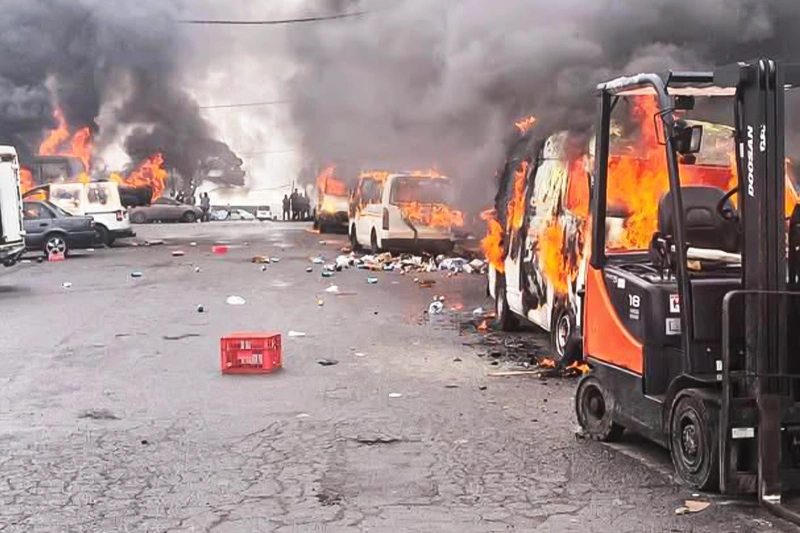
At least 26 people were injured, many requiring hospital treatment. One individual was reportedly run over during the disorder, while others were caught in stampedes as crowds surged and scattered. Vehicles were set alight, with several reported destroyed across affected areas, as groups broke away from the main protest and began targeting businesses in what residents describe as coordinated xenophobic violence in Eastern Cape.
Livelihoods caught in the crossfire
What followed bore the hallmarks of previous unrest in similar contexts across South Africa. Shops were forced open, goods taken, and livelihoods disrupted in a matter of hours. Those affected found it difficult to process the speed at which a public protest shifted to looting and destruction.
A Nigerian trader on Buffalo Street described how the focus changed almost instantly.
“They used the coronation as an excuse,” he said. “They were not asking about any king. They were just taking what they could and telling us to go home.”
Such accounts have deepened a sense within the Nigerian community that the unrest was not solely about the disputed title, but also reflects longer-standing tensions. Since the incident, many have stayed indoors, keeping away from public spaces, as others describe strained relationships and a growing unease in everyday interactions.
A community divided within
Within the same community, there is also a quieter reflection. While many insist the event was cultural rather than political, others acknowledge that the timing may have been misjudged.
In a region already grappling with unemployment and periodic anti-immigrant sentiment, the symbolism of installing an “Igwe” may have carried unintended consequences.
Sovereignty, identity and anger
For local protesters, the issue is framed as one of principle. The idea of a king being installed within South African territory has been interpreted as a challenge to established systems of traditional authority. In the Eastern Cape, where recognised kingdoms such as the amaRharhabe hold deep cultural significance, the notion of parallel leadership structures has provoked strong reactions.
“You cannot have a king inside another king’s land,” one protest participant said. “It is about respect for our traditions.”
A clash of meanings
This divergence in interpretation lies at the heart of the crisis. Within Igbo diaspora communities, titles such as “Igwe” or “Eze” are often used to designate cultural leaders who organise community life and maintain traditions. They do not necessarily imply territorial authority.
In South Africa, however, traditional leadership institutions are regulated under national law and tied to land and governance structures. On that basis, even symbolic claims to kingship are readily perceived as political, particularly in a climate already marked by recurring tensions in Eastern Cape.
Government response and its limits
Authorities have clarified that the title holds no legal standing. The Eastern Cape House of Traditional Leaders dismissed the title, while government officials reiterated that traditional authority cannot be established outside recognised frameworks. At the same time, the South African Police Service has stepped up its presence and launched investigations into incidents linked to the Xenophobic Violence in Eastern Cape.
Even so, the official response has done little to restore confidence. For some, the rejection of the coronation has appeared to reinforce public anger, while doing little to calm the situation. For others, the focus on the title has drawn attention away from the scale of the disruption.
A fragile pause, not a resolution
The Nigerian High Commission to South Africa has emphasised that no sovereign claim was intended while urging calm. These messages come as residents and traders continue to adjust following recent developments.
In KuGompo, a tentative calm has taken hold. Activity has resumed in parts, though the area has yet to fully return to normal. Confidence is gradually rebuilding, while longer-term pressures, including economic strain and competition in local trade, continue to shape the mood.
The past week has shown how quickly local disputes can widen in scope, and how their effects can extend beyond the initial trigger. In Eastern Cape, attention is now turning to whether the underlying issues identified in recent days will be addressed in a lasting way or remain unresolved.


