From AfricanQuarters Newsdesk
GWOZA, BORNO STATE – There was little warning before the blast.
At about 4:00 AM, along the Ngoshe-Pulka road in Borno State, a group of civilians moving at first light ran into an improvised explosive device. By the time the dust settled, four people were dead and at least 24 others injured.
They were not traders or commuters in the usual sense. Most were returnees, people trying, once again, to settle back into communities they had fled years earlier.
The incident has quickly come to define what security analysts now describe as a Borno resettlement security crisis, one that is unfolding quietly across rural corridors rather than in headline-grabbing urban attacks.
A road that no longer guarantees passage
On paper, the Ngoshe-Pulka stretch is part of a recovery route. In practice, it has become something else entirely.
The road cuts through terrain shaped by the Mandara Mountains, where visibility is limited and movement is difficult to monitor. This gap has become a defining feature of the Borno resettlement security crisis.
Armed groups have operated in and around these highlands for years, using them as both a shield and an escape route.
Violence that follows a pattern
What happened this week did not occur in isolation.
In early March, Ngoshe itself came under heavy attack. Residents spoke of abductions and chaos, while a nearby military position was briefly overwhelmed before control was restored. Days later, explosions in Maiduguri unsettled a city that had, for some time, felt removed from the worst of the conflict.
Now, attention has shifted back to the roads.
Improvised explosive devices, long a feature of insurgent tactics linked to Boko Haram and Islamic State West Africa Province, are again being used to dictate where people can and cannot move.
It is a quieter form of control, but no less effective. They also reinforce the wider Borno resettlement security crisis.
Why returnees keep getting hit
There is a reason these attacks keep involving the same category of victims.
Returnees carry meaning beyond their numbers. Their movement signals that normal life is resuming, that displacement is easing, that state authority is gradually taking hold again.
That is precisely what insurgent groups seek to disrupt.
Striking at returnees sends a message that travels faster than any official statement: the area is not yet secure. For families weighing whether to come back, that message can be decisive.
This is where the Borno resettlement security crisis becomes most visible, not in policy documents, but in the choices people make about whether to stay or flee.
Holding towns, losing the roads
The resettlement push under Babagana Umara Zulum has been one of the most ambitious efforts to close displacement camps and rebuild local economies.
But the situation on the Ngoshe-Pulka axis points to a harder truth.
Towns may be retaken and held but roads are different.
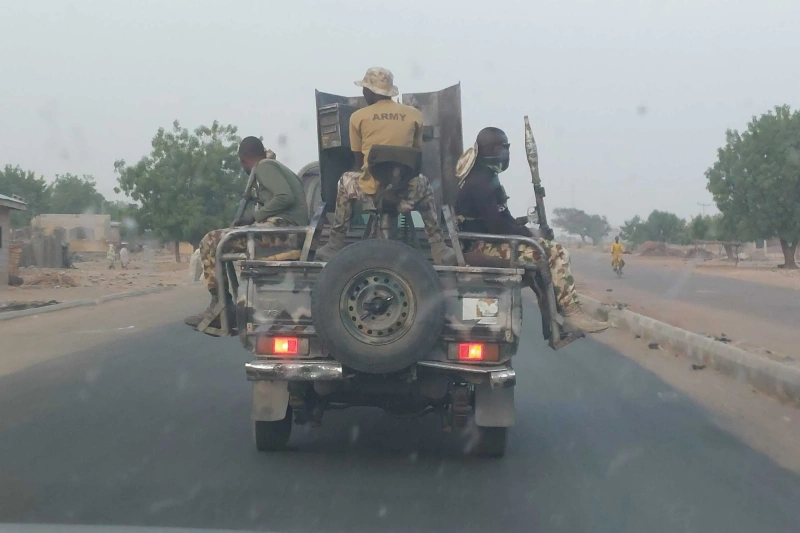
They stretch across open ground, through farmland and difficult terrain, often without constant surveillance. Securing them requires time, manpower and coordination that are not always available.
This gap between control and mobility continues to shape the Borno resettlement security crisis.
Trust, suspicion and the “hybrid” concern
Another layer of complexity has emerged in recent weeks.
Some residents, speaking after earlier attacks, have raised concerns about the presence of former fighters who were resettled after going through rehabilitation programmes. Allegations that such individuals may have provided information to armed groups remain unverified, but the suspicion alone is enough to cause tension.
Communities already dealing with trauma now find themselves questioning who can be trusted.
For any recovery effort, that is a difficult environment to stabilise.
Displacement that keeps repeating
The immediate human impact is already visible.
Following the March violence, thousands of people moved back towards Pulka, effectively undoing recent resettlement efforts. It is a pattern that has repeated itself in parts of Borno: return, attack, retreat.
Each cycle places additional strain on families and on humanitarian support systems. It also reinforces the instability at the heart of the Borno resettlement security crisis.
For families involved, it is simply exhausting.
No clear line between war and recovery
The latest attack does not suggest a complete breakdown of security across Borno State. But it does show how uneven the situation remains.
In some areas, life is gradually returning. In others, especially along rural corridors, the risks are still immediate.
For those living near the Mandara highlands, the signs are hard to ignore. Movement is cautious. Travel is calculated. And the sense of uncertainty lingers.
The phrase Borno resettlement security crisis may sound technical, but on the ground it comes down to something simpler: whether people can move, settle and live without fear.
For now, along the Ngoshe–Pulka road, that question does not yet have a confident answer.