



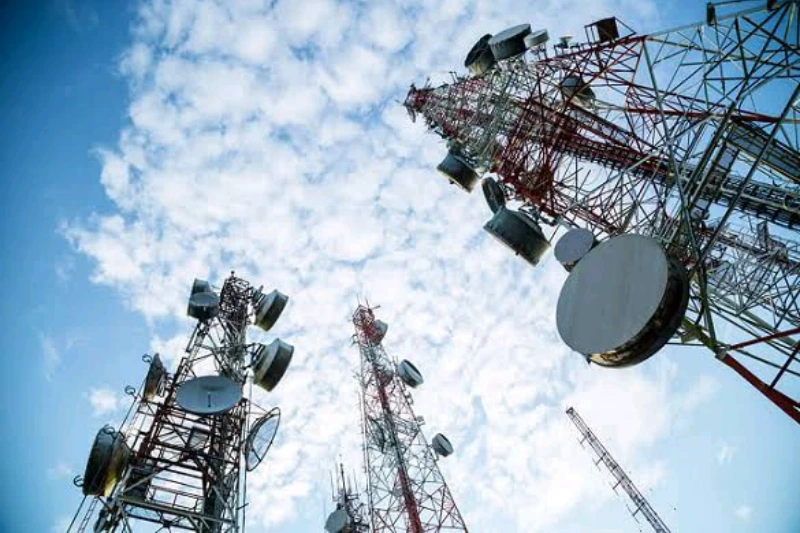

The United States government has taken a concrete step to challenge China’s grip on telecommunications across West Africa, funding a plan that could see 1,500 American-made mobile base stations deployed across Nigeria, Ghana, Benin, and Côte d’Ivoire.
The move centres on US wireless infrastructure in West Africa and what Washington has openly described as an attempt to offer “trusted” alternatives to Chinese-built systems that currently power a majority of the region’s mobile networks.
US wireless infrastructure in West Africa begins with a feasibility study
The U.S. Trade and Development Agency announced funding for a feasibility study to install approximately 1,500 turnkey mobile communications base stations from Massachusetts-based Vanu Inc. across Benin, Côte d’Ivoire, Ghana and Nigeria.
The announcement is significant, but it is worth being precise about what has actually been committed. Washington has not yet funded the towers themselves. The feasibility study will assess regulations, infrastructure and financing options for the rollout across the four countries.
The study will examine the commercial viability of deploying the wireless infrastructure on a large scale across the four countries. It will also assess existing telecommunications networks, market conditions, legal and regulatory environments, as well as develop financing strategies for implementation.
The USTDA describes itself as the US government’s first mover on critical infrastructure development in emerging markets.
Why Vanu and why now
The chosen company is not a household name, but it has a track record in precisely the kind of markets this project targets. Vanu has an explicit market strategy not to compete head-to-head with vendors like Ericsson and Huawei, which have effective solutions for urban markets. Instead, it identifies markets that are not well served by current technology and develops solutions to address those unique requirements.
These tactical procedure, positions Vanu, to play a central role in expanding US wireless infrastructure in West Africa, particularly in underserved rural markets.
The company has previously deployed off-grid wireless solutions in Nigeria’s Edo and Delta states, as well as in Benin, Ghana and Côte d’Ivoire. Vanu chief executive Andrew Beard has previously described Nigeria as “a really exciting place to operate” with a population he said was “right in the sweet spot” for mobile connectivity adoption.
Beard said the USTDA study would help catalyse new investment, expand US exports, and accelerate deployment of trusted, secure digital infrastructure to connect people worldwide.
Georgia-based Vernonburg Group LLC has been brought in to conduct the assessment, which will cover commercial viability, regulatory frameworks, and financing structures across all four countries.
The Huawei factor
The USTDA’s own announcement frames US wireless infrastructure in West Africa as a direct counter to Chinese dominance. The agency said it is accelerating the deployment of trusted US-made wireless infrastructure in a region dominated by Chinese-made wireless systems.
That description is accurate. Huawei alone has constructed up to 70 per cent of Africa’s 4G backbone, integrating itself into the very sinews of African communications. Together, Huawei and ZTE have delivered more than 40 national networks across over 30 African states.
According to the Atlantic Council, Chinese technology investments and contracts in sub-Saharan Africa totalled $7.19 billion between 2005 and 2020, with Huawei and ZTE establishing more than 40 3G networks in more than 30 African countries.
Chinese firms built that position through competitive pricing, government-backed financing, and speed of deployment. The emergence of US wireless infrastructure in West Africa represents Washington’s most visible attempt yet to challenge that dominance. The US, which has raised security concerns about Chinese telecom systems across Europe, Southeast Asia, and Latin America, is now applying the same competitive logic to Africa.
USTDA Deputy Director Thomas R. Hardy put the strategic intent plainly. “By helping American companies compete in these critical markets, we are offering an alternative to insecure infrastructure while creating export opportunities that make America more prosperous,” he said.
Nigeria: the largest prize
Of the four countries involved, Nigeria carries the greatest weight for US wireless infrastructure in West Africa, both in population and in the scale of the connectivity problem.
As of January 2025, Nigeria had 128.3 million people unconnected to the internet, over 54 per cent of the population, ranking it fourth globally among countries with the highest number of unconnected individuals.
The National Broadband Plan had projected 70 per cent broadband penetration by 2025, but as of early 2025, penetration still hovered below 50 per cent according to the Nigerian Communications Commission. The shortfall is concentrated in rural areas, where Vanu’s solar-powered, low-maintenance systems are specifically designed to operate.
A 2024 GSMA report on Nigeria’s Universal Service Provision Fund estimated that the country needs about $461 million in investment to achieve 96 per cent mobile broadband coverage by 2030.
The road ahead
The feasibility study is the first step in what would be a lengthy and capital-intensive process. Financing remains the biggest hurdle facing US wireless infrastructure in West Africa, as the deployment phase has not yet been funded.
Deploying 1,500 base stations across four countries with different licensing regimes, spectrum rules, and local content requirements will require substantial financing that has not yet been secured.
Major operators already active in these markets, including MTN, Airtel, and Orange, would likely need to be brought in as partners rather than bypassed. Satellite providers including Starlink are also expanding across the region, though terrestrial mobile networks remain more cost-effective for high-density rural usage.
The broader story is one of escalating competition. The USTDA initiative is part of a pattern of American-backed investments in African digital infrastructure over recent years, spanning data centres, fibre networks, and now mobile connectivity.
For communities in rural Nigeria, Ghana, Benin, and Côte d’Ivoire that remain on 2G or entirely offline, the question is not which superpower’s equipment carries the signal. It is whether the signal arrives at all. US wireless infrastructure in West Africa may represent the beginning of an answer, but only if the study converts into steel in the ground.


