




In Kenya, the date marks Saba Saba, the anniversary of the 1990s struggle that eventually forced the country into multiparty democracy. In Tanzania, the same date marks 72 years since the founding of what became the ruling party, though this year’s planned demonstrations had nothing to do with that history.
In Nairobi, police cordoned off parliament with barbed wire and shut down major roads leading into the capital, according to AP. Businesses closed early. Plain-clothed officers dragged at least three people into unmarked vehicles in the city centre, AFP reported. One protester, Collins Otieno, asked why security forces needed to respond this way to citizens exercising a constitutional right.
Opposition politician James Orengo did not mince words. He described the scale of the deployment as resembling a police state, AP reported. His comment reflects a growing frustration among Kenyan opposition figures who accuse President William Ruto’s government of using security operations to intimidate rather than protect.
This is not an isolated episode. At least 127 Kenyans died during protests over economic hardship, corruption and police brutality across June and July in both 2024 and 2025, a police watchdog has confirmed. The pattern suggests that heavy security deployment has become a recurring government response whenever citizens attempt to organise against it, and it explains why so many now approach protests in Kenya and Tanzania with visible caution rather than confidence.
Human rights organisations argue that protests in Kenya and Tanzania increasingly reflect broader public frustration over governance, economic hardship and restrictions on civic freedoms.
The Economic Justice Movement, one of the groups behind Tuesday’s planned march, said it wanted to draw attention to extrajudicial killings, enforced disappearances, arbitrary arrests and an escalating economic crisis affecting millions of young Kenyans, according to AFP. Rights group organiser Wanjira Wanjiru of the Mathare Social Justice Centre said many residents were simply too exhausted to keep showing up, a sentiment that has followed successive waves of protests in Kenya and Tanzania over the past two years.
President Ruto has grown increasingly combative towards his critics in recent months, including a public attack on The Standard newspaper over its coverage of his administration, AFP reported.
Across the border, Tanzania’s demonstrations were meant to call for democratic reforms after October’s disputed election and to demand the release of opposition leader Tundu Lissu, who remains jailed on treason charges, AP reported. Rights groups and opposition figures say thousands were killed by security forces during the unrest that followed that election, according to Arab News.
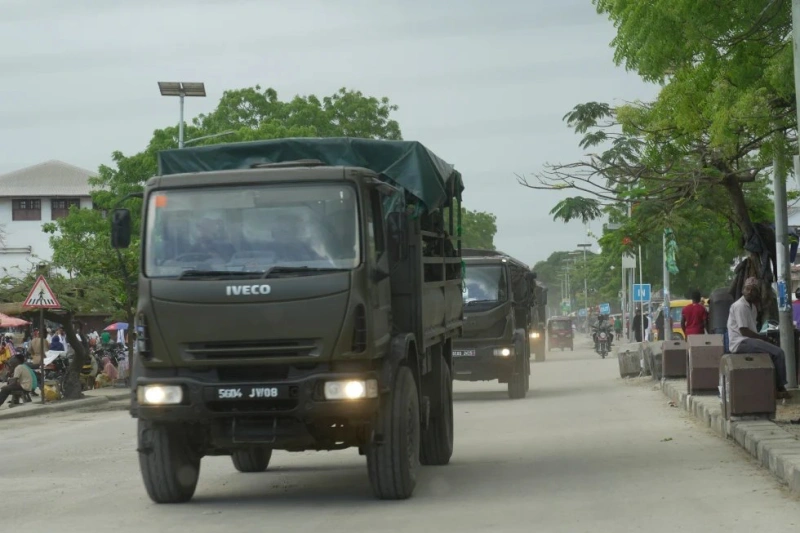
Dar es Salaam’s normally busy Kariakoo trading district stood largely deserted on Tuesday, with police and military personnel stationed across the city, AFP journalists observed. Resident Hussein Matimbwa told AFP he had wanted to join the protest but ultimately chose not to risk his life, citing the scale of killings recorded in October.
Tanzanian authorities have recently banned all political gatherings outright, while Kenyan police have refused to accept any formal notification of planned protests from rights organisations, according to AFP. Analysts say the coordinated clampdown in both countries signals a broader regional retreat from tolerance of dissent, even as governments insist their actions are aimed at preventing violence rather than democratic expression.
The heavy deployments seen in Nairobi and Dar es Salaam on Tuesday underscore how protests in Kenya and Tanzania are increasingly being treated as security threats rather than expressions of democratic dissent.
For citizens in both nations, protests in Kenya and Tanzania have increasingly become acts of considerable personal risk rather than routine democratic participation, and Tuesday’s near total absence of demonstrators on the streets of both capitals may say more about that fear than any official statement has.


