



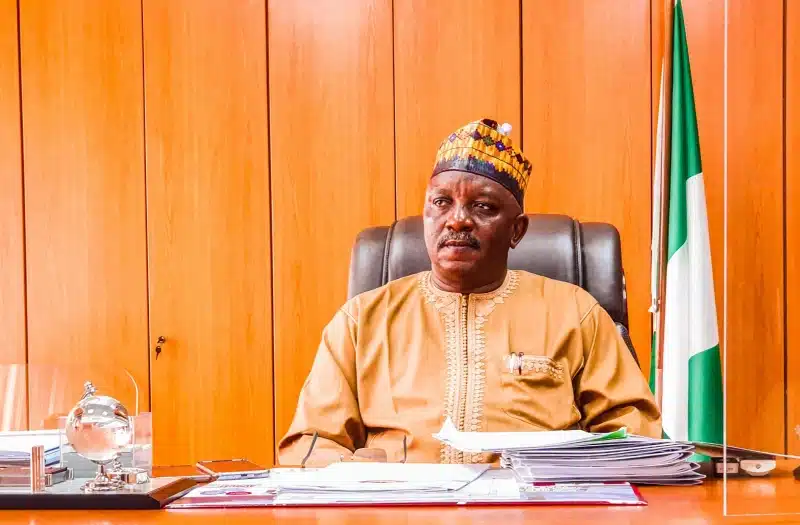

The Saleh Mamman conviction has sent a former minister from governorship ambitions to an Interpol fugitive list for looting funds meant to light up Nigeria.
The Verdict That Shook Abuja
Justice James Omotosho of the Federal High Court in Abuja delivered one of Nigeria’s most consequential anti-corruption rulings on Wednesday, 13 May 2026, when he sentenced former Power Minister Saleh Mamman to 75 years in prison for money laundering and fraud.
The Saleh Mamman conviction centres on ₦33.8 billion that the federal government had allocated to two of Nigeria’s most strategically important electricity projects: the Zungeru and Mambilla hydroelectric schemes, projects repeatedly presented to Nigerians as solutions to the country’s chronic power shortages.
The Economic and Financial Crimes Commission prosecuted the former minister on 12 counts, and Justice Omotosho found him guilty on every single count. He was sentenced to seven years each on ten counts, with three years and two years on counts four and five respectively. The judge ordered all terms to run consecutively, except count four, which carries the option of a ₦10 million fine in lieu.
He Was Not in Court
The case carried an extraordinary dramatic charge from the outset.
Mamman had been found guilty in absentia on 7 May, after which Justice Omotosho issued a warrant for his arrest and fixed 13 May for sentencing. His defence counsel, Mohammed Ahmed, told the court that his client’s whereabouts had been unknown since the previous Tuesday when notice of the judgment date was issued, and that Mamman’s personal assistant had suggested he was ill. When the judge demanded a medical report, the defence admitted that none was available.
Justice Omotosho then referenced media reports showing the defendant had recently purchased an All Progressives Congress governorship nomination form to contest the 2027 Taraba State election. EFCC counsel Rotimi Oyedepo (SAN) urged the court to proceed. The judge held that Mamman’s absence was a deliberate attempt to stop the wheel of justice, and that he could not claim to have suffered a miscarriage of justice.
Now a Fugitive Wanted by Interpol
Following the Saleh Mamman conviction, Justice Omotosho ordered all security agencies, including Interpol, to arrest the former minister wherever he is found and hand him over to the Nigerian Correctional Service. The jail term will begin running from the date of his arrest. Mohammed Ahmed told the court that calls placed to Mamman’s phone lines had failed to connect.
Nigeria is now conducting what amounts to an international manhunt for a man who, just weeks ago, was filling in forms to run for governor.
The Money and What It Was Meant For
The scale of what was stolen matters precisely because of where it was supposed to go.
Prosecutors established that Mamman, who served under former President Muhammadu Buhari from August 2019 until his removal in September 2021, conspired with ministry officials and private companies to divert funds from the Zungeru and Mambilla hydroelectric power projects. The EFCC presented 17 witnesses and 43 exhibits, including bank statements, internal ministry memos, and contractual documents, tracing the movement of the missing billions.
The court also found that Mamman made a cash payment of $655,700, equivalent to about ₦200 million, for a property in Abuja without using a financial institution, in breach of anti-money laundering laws. Justice Omotosho ordered the final forfeiture of recovered funds, foreign currencies, and Abuja properties linked to the convict, and directed Mamman to refund the outstanding balance from the ₦22 billion the prosecution established was diverted.
Projects Behind Saleh Mamman Conviction
To grasp the full weight of the Saleh Mamman conviction, it is necessary to understand what the two projects represent for Nigeria.
Zungeru is now operational. The 700-megawatt Zungeru Hydroelectric Power Station in Niger State is Nigeria’s second-largest hydroelectric facility, built at a cost of $1.3 billion with 75 per cent financing from the Exim Bank of China. Construction began in 2013, was completed in 2023, and the government concessioned the plant to Penstock Limited in February 2024.
GE Vernova, which supplied and commissioned the four 175MW Francis turbine units, estimated the station would meet roughly 10 per cent of Nigeria’s total domestic electricity needs annually. Yet analysts warn that the country’s dilapidated transmission infrastructure prevents the full 700MW from reaching consumers, a systemic problem that no single project can fix alone.
Mambilla remains a far harder story. First conceived in 1972 on the Mambilla Plateau in Taraba State near the Cameroonian border, the 3,050-megawatt project has been described as Nigeria’s answer to China’s Three Gorges Dam.
When completed, it is projected to generate approximately 4.7 billion kilowatt-hours of electricity annually, enough to cover roughly a quarter of Nigeria’s current demand. The total cost is budgeted at $5.8 billion, with China’s Exim Bank agreed in principle to lend 85 per cent and Nigeria committed to contributing the remaining 15 per cent.
Decades of contract disputes, administrative clashes, and allegations of elite corruption have kept it stalled. In 2003, the federal government awarded a $6 billion Build, Operate and Transfer contract to Sunrise Power and its Chinese partners.
In 2007, the government annulled the deal and signed an agreement with China Gezhouba Group Corporation, a breach Sunrise took to the International Chamber of Commerce. The ICC ruled against Nigeria’s objections in October 2022.
In August 2024, the government again awarded the Mambilla contract to CCECC, with a planned completion date of 2030. Analysts say the Saleh Mamman conviction could further complicate scrutiny around the stalled Mambilla project.
The Judge’s Words
Justice Omotosho did not confine himself to legal findings alone. As reported by Business Post Nigeria, the judge told the court: “Rather than creating a legacy to tackle the epileptic power supply in the country, the defendant was living large at the expense of ordinary citizens. Little wonder that Nigerians have remained in darkness till today.”
He added: “The evidence of the prosecution is overwhelming against the scanty and almost absent defence of the defendant. The defendant did not offer any credible evidence to rebut the prosecution’s case.”
A Second Fraud Case Still Running
The legal exposure does not stop at Wednesday’s ruling.
The FCT High Court in Maitama, Abuja has issued a separate arrest warrant after Mamman failed to appear for proceedings in a different ₦31 billion fraud trial. In that case, the EFCC has charged Mamman alongside seven co-defendants on nine counts of conspiracy, false pretence, and intent to defraud, again linked to alleged diversions from the Mambilla Power Project. The EFCC alleges that over ₦26 billion was diverted under Mamman’s instruction using bureau de change operators. Two separate Nigerian courts now want him in custody.
Why This Ruling Matters
The Saleh Mamman conviction lands during a period of acute public frustration over electricity. Nigeria’s power sector has received tens of billions of dollars in investment and reform packages over decades, yet the country remains among the most electricity-deprived in the world, with an estimated 86 million Nigerians lacking any access to the grid.
The Saleh Mamman conviction also raises broader questions about accountability in Nigeria’s power sector.
Corruption in infrastructure spending is widely cited as a structural reason why. The EFCC’s ability to take a case involving a cabinet-level official all the way through trial to guilty verdicts on all 12 counts strengthens the commission’s institutional credibility, particularly at a time when anti-graft agencies in Nigeria regularly face accusations of selective prosecution.
The ruling included both prison sentences and the forfeiture of assets linked to the case. For many Nigerians, the Saleh Mamman conviction represents a rare moment of accountability in a sector long associated with failed promises.
For now, the man at the centre of it all is somewhere unknown, wanted by Interpol, and judged to have plundered the foundations of Nigeria’s power future.


