



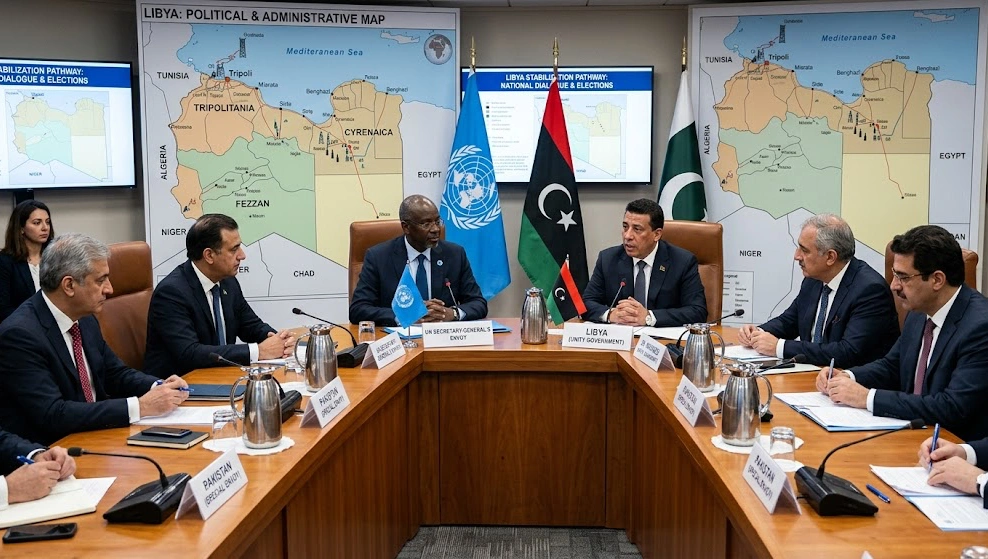

Libya political talks have taken a new turn, with Pakistan quietly stepping in as a mediator between the country’s rival eastern and western power centres, according to two Pakistani officials who spoke to Reuters this week.
The development marks the first confirmed Pakistani role in the long running Libya political talks, which have for years been dominated by the United States, the United Arab Emirates, Turkey and Egypt. Pakistan’s involvement follows months of a US led push to find a diplomatic solution in Libya, a country that has remained split between rival eastern and western administrations since a civil war broke out in the years after the 2011 NATO backed uprising.
Pakistan’s army chief, Asim Munir, met Saddam Haftar in Rawalpindi last month, a meeting followed days later by Haftar’s visit to Washington, where he held talks with US Secretary of State Marco Rubio. The State Department confirmed at the time that Rubio welcomed efforts by Libyan leaders to overcome their divisions.
Islamabad has maintained defence ties with the eastern based Libyan National Army, including discussions on the possible sale of JF-17 fighter jets, despite a UN arms embargo. The western based Government of National Unity has also recently sought direct talks with Pakistan, a sign that both sides now see value in Islamabad’s involvement in the Libya political talks.
Qatar and Turkey, among the biggest backers of the Government of National Unity, reportedly encouraged Pakistan to get involved in the mediation effort, according to Pakistani sources familiar with the matter.
A proposed framework seen by Reuters points to where these Libya political talks could eventually lead. A summary of a draft “Libya Reunification Plan” outlines a 36 month transitional power sharing arrangement under a body to be known as the Government of National Consensus and Presidential Council, with Abdulhamid Dbeibah remaining as prime minister and Saddam Haftar taking a senior role on the military side. One source cautioned that the details are still being worked out.
Analysts remain cautious about how far Pakistan’s role can shift the balance. Jalel Harchaoui, a contributor to Britain’s Royal United Services Institute, said the United States has been pushing hard in Libya, but that the format it is trying to impose remains loose and poorly defined.
The Pakistani effort runs alongside the formal United Nations track. Hanna Tetteh, the UN Secretary General’s Special Representative for Libya, has been leading Libya political talks through the UN Support Mission in Libya, known as UNSMIL. UNSMIL has been facilitating direct talks between the Government of National Unity and the LNA General Command, with both rival parliamentary chambers also taking part. Tetteh told the Security Council that discussions had been constructive, with agreement in principle on reconstituting the electoral commission and negotiations under way on electoral laws.
Even so, Tetteh has warned that time is running short. She told the Council that Libya now has a clearer set of political options but a narrowing window in which to act, adding that responsibility lies first with Libyan stakeholders themselves.
The current stalemate traces back to the collapse of Muammar Gaddafi led government in 2011, which shattered state institutions and triggered recurring struggles over legitimacy and power. The split deepened after elections planned for December 2021 were postponed indefinitely.
For African governments and businesses watching Libya from across the continent, the stakes go beyond diplomacy. The outcome of the Libya political talks could also shape future investment, energy production and regional security across North Africa.
Libya sits on the largest proven oil reserves in Africa, and continued instability has kept migration routes through the Sahara volatile, a concern shared by several West and Central African states with citizens working or transiting through Libyan territory.
Whether Pakistan’s quiet diplomacy complements or complicates the UN led process remains to be seen. What is clear is that Libya political talks now involve a wider circle of outside actors than at any point in recent years, each trying to shape how the country eventually reunifies its government.


