



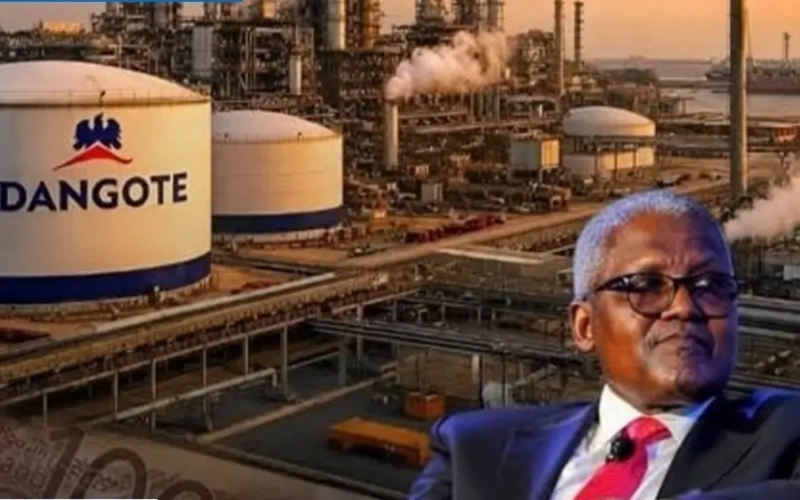

Aliko Dangote’s industrial group has confirmed that its planned Dangote refinery in Kenya will process 700,000 barrels of crude oil per day, marking one of the largest single industrial commitments ever made by a private African company in East Africa.
Dangote Industries Limited’s Group Vice President for Oil and Gas, Devakumar Edwin, disclosed the figure on 1 July while hosting a delegation from the Republic of the Congo’s national oil company, Société Nationale des Pétroles du Congo, at the group’s Lagos refinery, according to Tribune Online. Edwin said the Nigerian arm of the business will handle 1.4 million barrels a day, with the Dangote refinery in Kenya accounting for the remaining 700,000, bringing combined output to 2.1 million barrels daily.
The disclosure builds on months of shifting plans. Dangote had initially proposed anchoring an East African refinery at Tanga port in Tanzania before turning to Kenya, citing better infrastructure and stronger demand. He told the Financial Times, as cited by Accra Street Journal, that Mombasa carries a deeper port and a larger economy, adding that Kenyans consume more fuel.
Mombasa and Lamu remain the two contenders for the site of the Dangote refinery in Kenya, and a final decision is still pending. President William Ruto has said construction is expected to begin later in 2026, though the group has yet to confirm which port will host the plant, Nairobi Wire reported.
Ruto has repeatedly stated that Nairobi will not leave the investment entirely to Dangote. Speaking after signing the Finance Bill 2026 into law, he said seed capital had already been set aside for the project, according to People Daily. Kenya has earmarked Ksh21.5 billion in initial funding through the National Infrastructure Fund, a state vehicle designed to mobilise long-term financing for major infrastructure.
Ruto has framed the arrangement as a co-investment rather than a handout. During the African Forward Summit in Nairobi in May, he told investors that governments would share in future profits once the plant becomes operational, ChimpReports noted. He has also said Kenya will not dictate the final site, leaving that decision to Dangote and his project partners once feasibility studies are complete.
Estimates of the total cost vary. Business Daily Africa reported the project could cost between sixteen and twenty billion dollars, translating to roughly Ksh2.58 trillion, while other figures put the outlay closer to Ksh2.5 trillion. Either way, the scale places the Dangote refinery in Kenya among the most expensive single industrial ventures proposed anywhere on the continent.
Once complete, the facility is expected to supply Kenya, Uganda, Tanzania, South Sudan and eastern Democratic Republic of Congo, reducing East Africa’s long-standing dependence on imported refined fuel. The Dangote refinery in Kenya is expected to play a central role in strengthening regional energy security and lowering fuel import costs across East Africa.
Kenya’s own upstream sector is also advancing. Commercial oil production from the South Lokichar Basin in Turkana County is due to begin by the end of December 2026, giving the country a potential domestic crude source that could eventually feed the same refining network. The Dangote refinery in Kenya could become a major customer for locally produced crude if production targets are met.
The Kenya project sits within a wider $46 billion expansion programme Dangote Industries plans to roll out between 2026 and 2028 across refining, cement and fertiliser operations, according to Accra Street Journal. That spending follows the company’s success in raising output at its Lagos refinery, which recently exceeded its original nameplate capacity during performance testing.
For now, the Dangote refinery in Kenya remains at the planning stage. Site selection, financing structure and a firm construction timetable are still being finalised, but the confirmed 700,000 barrel-per-day capacity gives East African governments a clearer picture of what Dangote intends to build, and how deeply Kenya’s energy future could soon be tied to it.


