



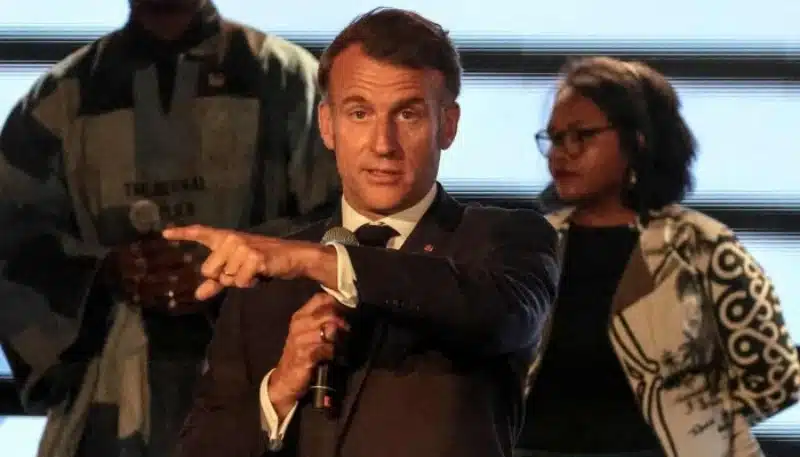

The French president’s interruption of a youth panel at the Africa Forward Summit on 11 May has mushroomed into something far larger than a conference dispute. Across African social media, political circles, and parts of the French political establishment itself. The incident is now being read as a live test of whether France has genuinely moved beyond Françafrique or merely dressed it in newer language.
What Sparked the Macron Françafrique Controversy
The session was titled “Africa Forward: Creation in Motion.” A panel of young African artists and entrepreneurs was on stage at the University of Nairobi, discussing culture and innovation, while Macron sat off-stage in the audience.
As noise from side conversations built in the auditorium, Macron stood up, walked onto the stage, and took the microphone from the moderator.
“I’m sorry, but it’s impossible to speak about culture with such noise,” he told the crowd, visibly irritated. “This is a total lack of respect. If you want to stay here, we listen to the people and we’re playing the same game, okay?”
Some sections of the audience applauded. The video, however, spread far faster than the applause. Within hours, it had reached audiences well beyond Kenya, and the interpretation attached to it had very little to do with conference etiquette.
Why the Macron Françafrique Backlash Cut So Deep
To understand why a tense moment in a Nairobi auditorium became an international flashpoint, it helps to understand what Françafrique actually means to the people reacting to this footage.
Françafrique is the term used to describe France’s post-independence network of political, military, and economic control over its former African colonies.
The system saw Paris cultivate personal relationships with African heads of state, station troops across the continent under bilateral defence agreements, and channel lucrative contracts to French companies. They do all these, while keeping former colonies financially tethered through the CFA franc, a currency still controlled by the French Treasury.
For many Africans, the word represents not history but an ongoing condition. Critics say the Macron Françafrique episode exposed lingering colonial attitudes in France’s Africa policy.
That context placed Macron’s behaviour under a very particular light. Senegalese student Thierno Mbaye told the Associated Press that Macron had acted “like a schoolteacher scolding children.” French left-wing lawmaker Danièle Obono went further, accusing him of behaving “like a colonizer.”
The criticism was not about noise levels. It was about who felt entitled to silence a room and on whose continent.
The Pan-Africanist Claim That Made It Worse
The optics deepened because of something Macron had said just before the incident. Earlier at the summit, he described himself and France as “true Pan-Africanists”, a claim that drew immediate and pointed pushback even before the microphone moment.
Togolese activist Farida Nabourema, a prominent critic of French policy in West Africa, responded directly, stating that Pan-Africanism was built against “slavery, colonialism and neocolonialism.” For her and many others, France’s historical role makes the Françafrique label far more applicable to Macron than any Pan-Africanist one.
When footage of the stage interruption followed shortly after, critics argued the sequence could not have been more telling.
A Strategic Summit, Now Overshadowed
The Africa Forward Summit was itself a deliberate act of repositioning. It was the first major France-Africa gathering held in an English-speaking country rather than a Francophone former colony, a clear signal that Paris is trying to rebuild influence beyond its traditional West African stronghold.
That pivot is not without urgency. Over the past several years, French troops have been expelled or withdrawn from Mali, Niger, and Burkina Faso. Anti-French sentiment has intensified across West and Central Africa.
Russia, China, Turkey, and Gulf states have moved aggressively to fill the space France is vacating. The growing Macron Françafrique controversy now threatens to complicate France’s attempt to rebuild influence through economic partnerships rather than military dominance.
Against that backdrop, Macron came to Nairobi carrying a significant economic offer. He announced a €23 billion investment initiative targeting artificial intelligence, green energy, agriculture, and infrastructure across the continent. The package was framed as a departure from aid dependency and a move towards what France describes as “co-investment” and partnership.
The announcement was designed to be the headline. The microphone clip became the headline instead.
Two Readings of the Same Moment
Defenders of Macron argue the room was genuinely disruptive and that the young panellists on stage deserved to be heard. Some pointed out that large sections of the audience actually welcomed the call for order. Others noted that any leader in a similarly chaotic setting might have intervened in much the same way.
Critics counter that the Macron Françafrique controversy is not really about what Macron intended, but what he projected. A head of state, at a forum explicitly designed to showcase equality between France and Africa, walked onto a stage in an African country and told the audience how to behave. Whether that reflects instinct or attitude, they argue, the effect is the same.
Geopolitical analysts broadly frame the episode as a costly unforced error. France entered the summit with a credibility problem already in hand, given the Françafrique record and recent expulsions from the Sahel. A €23 billion pledge was the tool chosen to begin repairing that problem. One unscripted minute complicated the repair considerably.
What It Reveals
The deepest reading of the Macron Françafrique controversy may be this: the language of France’s Africa policy has changed faster than the instincts behind it.
For younger African audiences, who are increasingly organised and vocal about sovereignty, even a call for silence can land as a statement of authority. When that call comes from a French president who arrived declaring himself a Pan-Africanist, the symbolism swallows the intention.
The summit was supposed to mark a new chapter in France-Africa relations, but the Macron Françafrique backlash ensured the old chapter remained firmly in view.
This report draws on footage and statements from the Africa Forward Summit, Nairobi, 11-12 May 2026, and statements reported by the Associated Press.


