



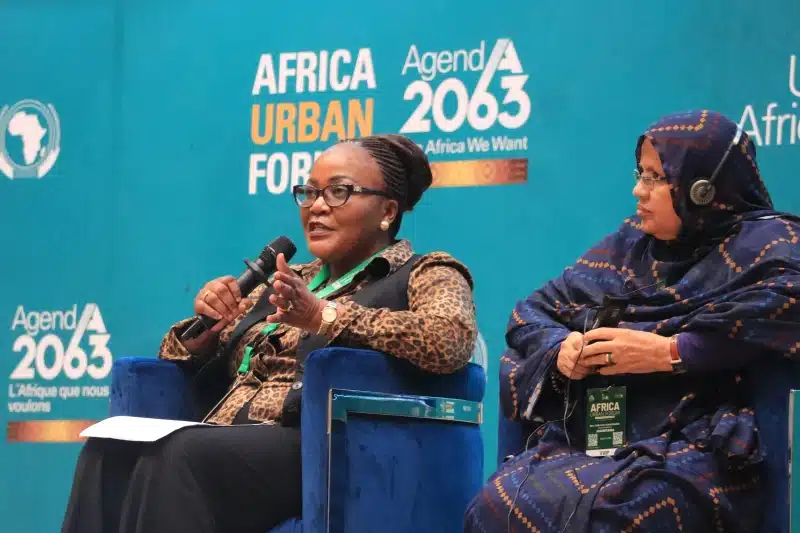

A meeting in Paris between Mahmoud Ali Youssouf and Khaled El-Enany is beginning to define how the continent intends to manage one of its most consequential transitions. Held at the headquarters of UNESCO on 13 April 2026, the discussion came just days after the conclusion of the Second Africa Urban Forum in Nairobi, and the timing was deliberate.
The forum produced the Nairobi Declaration, a framework that draws housing, education and governance into a single urban strategy. The Paris engagement represents an early and calculated effort to move that framework from agreement into implementation, a shift that points to a broader change within the African Union as it moves beyond agenda-setting towards delivery on Africa urban development commitments.
Reframing Africa Urban Development
Central to the discussions is a recognition that Africa urban development extends well beyond bricks and concrete. It is equally a question of people, systems and long-term capacity. A significant share of the continent’s urban workforce operates within the informal economy, frequently without access to structured skills training or stable income pathways.

The Nairobi Declaration links urban growth with education reform and practical training. It recognises a simple reality. If cities are only growing in size, they risk deepening inequality. Growth needs to translate into jobs, skills and participation in the urban economy.
Education and Knowledge as Urban Infrastructure
Bringing UNESCO into the conversation introduces a technical dimension that reinforces this direction. UNESCO’s work in education, data and cultural policy gives it a practical role in shaping how cities across the continent evolve.
Three areas of focus are emerging from the engagement. The first is workforce development, with an emphasis on vocational training calibrated to the realities of African urban economies.
The second area is capacity at city level, where local authorities are often dealing with rapid growth without enough technical support. The third is the growth of knowledge hubs, with Nairobi and similar cities acting as centres for shared learning and innovation in Africa urban development.
In this approach, knowledge is not treated as abstract. It becomes part of the infrastructure that shapes how cities function and compete.
Leadership and Strategic Direction
For Youssouf, who took office in February 2026, the meeting shows how he intends to lead. He is placing emphasis on delivery, particularly within Agenda 2063, where urbanisation and youth employment remain key priorities.
Working with UNESCO also shows how the AU is approaching partnerships. It combines African political leadership with external technical support, while keeping control of its priorities within the continent. This balance is likely to shape how future partnerships in Africa urban development are structured.
Youssouf’s wider participation in the AU-France Strategic Dialogue during the Paris visit further underlines his role as a principal diplomatic figure in the period following Moussa Faki. It signals continuity in external engagement alongside a sharpened focus on delivery.
Why This Moment Matters for Africa Urban Development
Africa’s urban population could reach about 1.4 billion by 2050. At the same time, cities are already facing housing shortages and growing pressure on infrastructure and public services. The Nairobi Declaration responds to those realities, but its significance lies in how it connects physical construction with education and governance in a single framework for Africa urban development.
There is a growing body of evidence that urban expansion without parallel investment in skills and institutional capacity tends to entrench inequality rather than reduce it. A coordinated approach that anchors knowledge within city planning holds the potential to convert demographic growth into sustained economic output, but only if that approach is supported by concrete financing and implementation structures.
What Comes Next
The immediate test is whether the Paris discussions produce structured cooperation. A formal AU-UNESCO framework would provide the institutional foundation for implementation, while early pilot programmes in priority cities could demonstrate practical returns.
Attention will also fall on financing, particularly for housing and urban infrastructure projects linked to the Nairobi Declaration. The ability to structure bankable proposals will be critical if the momentum generated in Nairobi and Paris is to translate into measurable progress on Africa urban development goals across the continent.
The Paris meeting does not resolve every question, but it does suggest that the people responsible for answering them are now working from the same page.


