




Guinea education funding got a major boost after the country secured a major financial deal, and the numbers are large enough to make anyone pause.
The National Agency for Education Financing, known locally as ANAFE, announced last Saturday in Conakry that it had mobilised €150 million for the country’s school system. LSI Africa broke the story on Monday.
The agreement, signed with WENDIT GmbH, a German infrastructure and engineering firm based in Regensburg, is meant to fund more than 400 public schools and roughly 3,000 classrooms. It also covers higher education and vocational training, two areas where education investment has historically lagged behind primary school spending.
ANAFE’s director general, Aboubacar Cissé, presented the plan as proof that Guinea can pull in resources beyond its own treasury. He called it, in comments carried by LSI Africa, a moment of satisfaction for an agency built to pursue both local and foreign Guinea education funding.
Wendit, for its part, says it already runs a subsidiary in Guinea and works across several African markets. The firm describes itself as a bridge between German and European industrial partners and projects on the continent.
That is the headline. What Guineans actually live with, after years of promised education investment that arrived slowly or not at all, is a different story. The history of Guinea education funding is littered with commitments whose impact has taken longer to reach families than the announcements suggested.
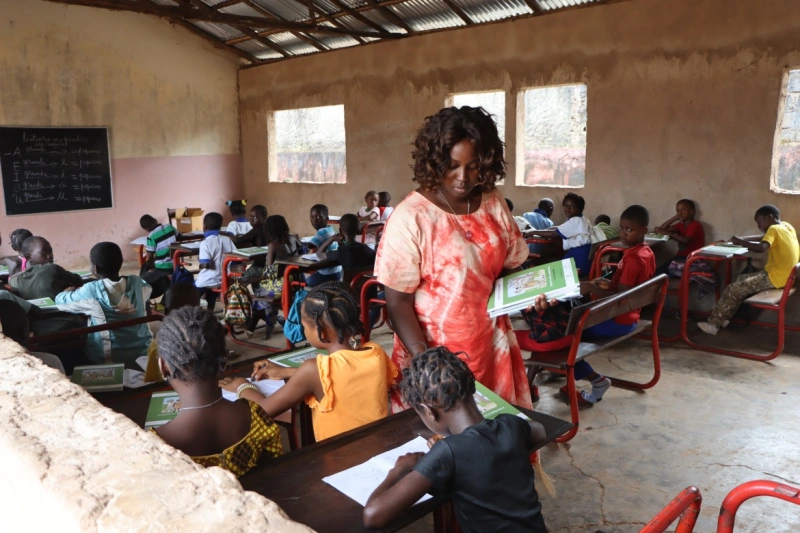
Guinea’s classrooms are among the most crowded in West Africa. National statistics put the pupil-teacher ratio at 43.3 on average. It climbs to 46.2 in public schools, where most families send their children.
UNESCO’s 2024 assessment found that 83 per cent of Guinean children still cannot read a simple text by the age of ten. Barely three in ten boys, and fewer girls still, finish lower secondary school. These are not abstract figures. They are the daily condition of a system that a new round of Guinea education funding, however welcome, cannot rewrite overnight.
Teachers know this better than anyone. A protocol signed between the government and an alliance of education unions in January 2026 promised swift movement on thousands of unresolved contracts. That is an important test for Guinea education funding, because new classrooms will need teachers to make them useful.
Seven months later, at a meeting at Conakry’s Bourse du Travail on 1 August, union leaders said almost nothing had moved. They gave the government an ultimatum ahead of the new school year. Without a response, they threatened an open-ended strike.
Civil society has been asking for something similar, just less loudly. The National Coalition for Education for All, a Guinean grouping that has spent two years working alongside the state on education reform, used a workshop in Conakry in late July to press for permanent dialogue.
Its chair, Fatoumata Dabo, wants gains that outlast a project’s funding, not ones that vanish once the money runs out.
This is the backdrop against which the ANAFE-Wendit announcement lands. Guinea’s education financing gaps have never really been about a shortage of ambition. Guinea education funding has repeatedly featured in government plans and development programmes, but the difficult part has been converting financial commitments into functioning infrastructure and better learning outcomes.
Governments here have announced sizeable programmes before, from a 2019 World Bank grant of similar scale to more recent commitments tied to the Simandou 2040 strategy. That plan earmarks a share of future mining revenue for schools over the next 25 years.
What has been harder to sustain is delivery on the ground, in classrooms that still hold far more children than they were built for.
Cissé’s agency says it intends to keep pursuing further Guinea education funding from other states and institutions, on top of what has already been secured with Wendit.
The scale of the latest commitment is significant. But money committed on paper is only the first test. Construction, teacher recruitment, equipment, maintenance and the quality of learning will determine whether the investment changes children’s lives. That is why the latest Guinea education funding commitment will ultimately be judged by what appears on the ground, rather than by the size of the announcement.
Whether the 400 schools and 3,000 classrooms materialise as promised matters more to Guinean families than the size of the figure announced in Conakry. So does the timeline attached to them.
For a country whose education financing announcements have so often outpaced delivery, that timeline is the part worth watching. If ANAFE and Wendit can turn the €150 million commitment into functioning schools and classrooms, the deal could mark a meaningful shift from promises to delivery.
For now, however, the question is straightforward: will the money reach the classroom?


