



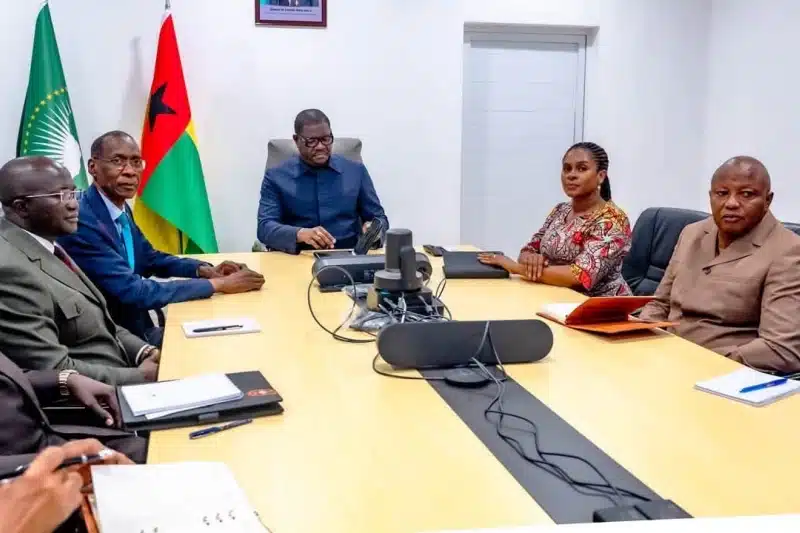

The delegation was led by Senegal’s Minister of African Integration and Foreign Affairs, Cheikh Niang, alongside Minister of Armed Forces Yankoba Diémé, according to the West African Voice Network. They met the Guinea-Bissau transition government’s foreign minister, Fatumata Jau, along with Prime Minister Ilídio Vieira Té and Transition President General Horta N’Tam.
Dakar takes up this role by virtue of its president, Bassirou Diomaye Faye, having assumed the ECOWAS chairmanship at the bloc’s 69th ordinary summit, held on 19 July in Freetown. Faye succeeded Sierra Leone’s Julius Maada Bio, whose one year term at the helm of the Authority of Heads of State and Government ended at that meeting, ECOWAS confirmed in its official summit communique. The gathering also appointed General Biram Diop, a former Senegalese defence minister, as the incoming president of the ECOWAS Commission from 1 September.
The Guinea-Bissau mediation mission grows out of a crisis that has gripped the small West African nation since late November 2025. Military officers seized power on 26 November, three days after a closely contested presidential election whose results had not yet been announced.
The Associated Press reported that the takeover happened as the two leading candidates each claimed victory, and that a subsequent ECOWAS delegation, led at the time by Bio, made no headway when it travelled to Bissau to press the coup leaders for a return to constitutional rule.
ECOWAS responded swiftly. Its Mediation and Security Council, convening under Bio’s chairmanship on 28 November, suspended Guinea-Bissau from all decision-making organs of the bloc and warned it reserved the right to impose sanctions on anyone found responsible for disrupting the country’s democratic process, the African Press Agency reported.
The council also directed the ECOWAS Stabilisation Support Mission already stationed in the country to keep protecting state institutions, and it instructed the army to return to barracks. The ECOWAS response shaped the framework that now guides the Guinea-Bissau mediation mission
Some doubt has trailed the official account of events. Former Nigerian president Goodluck Jonathan, who headed the ECOWAS observer team monitoring the November election, questioned whether the coup was genuine, suggesting instead that it may have been engineered by then president Umaro Sissoco Embaló to avoid conceding defeat, allAfrica reported.
Whatever its origins, the crisis now has a defined political horizon. Leaders at the Freetown summit noted ongoing efforts in Guinea-Bissau to conclude its transition through a constitutional referendum scheduled for 30 August, followed by general elections on 6 December, Per Second News reported.
The Authority also urged the transition government to guarantee human rights and judicial safeguards for all citizens, including those facing prosecution over last November’s events. Observers say the success of the Guinea-Bissau mediation mission will depend on broad political participation
That timetable now sits at the centre of what Dakar’s negotiators are pursuing through the Guinea-Bissau mediation mission. Senegal’s task, as laid out to the transition authorities this week, is to promote dialogue between the various parties and help create conditions for what the West African Voice Network described as a peaceful and rapid restoration of constitutional governance. The Bissau government, for its part, welcomed the initiative and pledged to cooperate with Dakar as the process unfolds.
The outcome of the Guinea-Bissau mediation mission goes beyond Guinea-Bissau’s borders. A 15 member bloc already diminished by the departure of Mali, Burkina Faso and Niger in January 2025 has little appetite for a further unravelling of democratic norms among its remaining members. How Senegal’s mediation fares over the coming weeks, particularly as the August referendum approaches, will offer an early signal of whether Faye’s chairmanship can hold that line.


