



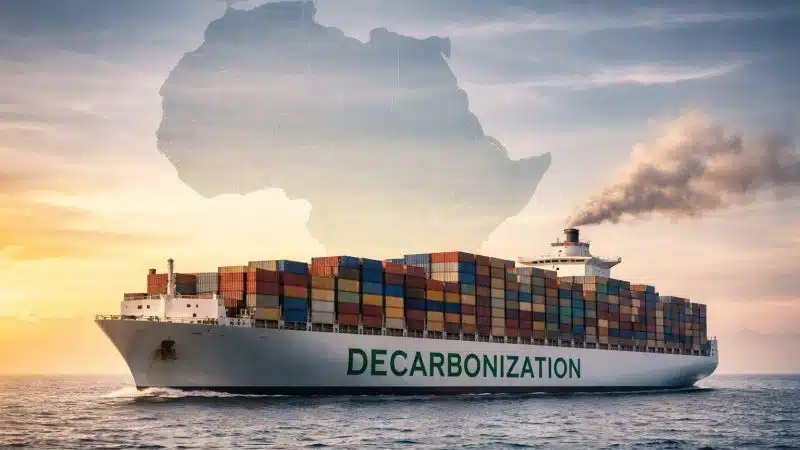

Abuja meeting on African green ports readiness shifts the focus from policy to urgency
The two-day workshop ending today in Abuja, convened by the Economic Community of West African States and the African Union, has moved beyond routine coordination into something more urgent. Officials are finalising a continental framework on green ports at a moment when global shipping rules are changing faster than most African infrastructure can adapt.
At the centre of the discussions is the validation of the “Handbook/Manual Guidelines on Green Ports in Africa.” The document is intended to provide a shared baseline for how ports across the continent begin to align with low-emission shipping standards, a shift that is beginning to expose gaps in African green ports readiness
This comes as the International Maritime Organisation continues to push its decarbonisation agenda, with member states negotiating pathways toward net-zero emissions by 2050. For African ports, which handle the bulk of external trade, the implications are immediate rather than long term.
The 75% gap in African green ports readiness
Data presented during the Abuja sessions has sharpened the conversation. Officials and technical partners estimate that around three-quarters of ports on the continent are not yet equipped to handle zero-carbon fuels such as ammonia or hydrogen.
The shortfall is visible at multiple levels. Only a limited number of ports can currently support alternative fuel bunkering, and even those tend to operate at a pilot or partial scale. Training is another constraint. Maritime agencies acknowledge that only a small share of personnel have been exposed to the safety and handling requirements tied to low-carbon fuels.
These gaps point to a deeper problem with African green ports readiness. The issue goes beyond switching fuels. It means reworking port systems that were designed for a very different shipping environment.
Infrastructure built for a different system
Most large ports across West, East, and Southern Africa still depend on diesel-powered cargo equipment and conventional marine fuel supply chains. Electrification, where it exists, is uneven and often tied to wider grid instability. That gap still shows in African green ports readiness.
Moving toward cleaner fuels will require new storage systems, upgraded terminals, and reliable energy supply. In practice, this means ports must begin to function as energy hubs rather than just logistics gateways.
That transition carries a cost. Port authorities and regional bodies have repeatedly pointed to financing constraints, especially in an environment where governments are balancing debt pressures with competing infrastructure needs.
Existing African Union infrastructure plans, including the Programme for Infrastructure Development in Africa (PIDA), are already stretched for funding. Adding port decarbonisation to that pipeline increases the pressure on limited resources.
Regulatory alignment and investor confidence
Another issue raised during the Abuja meeting is fragmentation. Ports operate under different national standards, with regional blocs often taking separate approaches to maritime regulation. For investors and shipping lines, that lack of consistency creates uncertainty.
The guidelines under discussion attempt to address this by promoting a more harmonised framework. Officials involved in the process say alignment is essential if African ports are to attract long-term capital and improve African green ports readiness.
There is also a legal dimension. The push to accelerate adoption of the Revised African Maritime Transport Charter has been framed as a way to give enforceable backing to environmental standards that are currently unevenly applied.
Trade risks under AfCFTA
Concerns raised at the summit are closely tied to the future of the African Continental Free Trade Area. The agreement depends on efficient and competitive logistics networks, with ports acting as critical nodes.
Shipping lines already prefer ports where environmental requirements are clear and easy to meet. If African green ports readiness does not improve, more traffic could drift toward those hubs. This could lead to traffic being redirected toward better-equipped hubs outside the continent or concentrated in a small number of upgraded African ports.
The effect would not be uniform, but the direction is clear. Higher transport costs and longer turnaround times would reduce the competitiveness of African exports and complicate intra-African trade flows.
Africa’s position in global maritime negotiations
Beyond infrastructure, the Abuja discussions also reflect a growing effort to shape international policy outcomes. African states have been working toward a common position within IMO negotiations, particularly around carbon pricing mechanisms.
Estimates discussed in policy circles suggest that global maritime carbon measures could generate between $10 billion and $15 billion annually. African negotiators argue that part of this revenue should be channelled toward supporting transitions in developing regions, including port upgrades and energy systems.
Without that support, officials warn that the transition risks widening existing gaps rather than closing them.
From framework to implementation
The guidelines being finalised outline a direction that is already familiar in global port development. Measures such as shore power connections, renewable energy integration, and digital traffic management are expected to feature prominently.
What is less certain is the pace of implementation. Past continental frameworks have often struggled to move beyond initial adoption. In this case, attention is likely to shift quickly to a small group of ports that can act as early test cases.
Ports in Nigeria, Ghana, Kenya, and South Africa are frequently mentioned in policy discussions as potential starting points, largely because of their scale and existing traffic volumes.
What happens after Abuja
Following the conclusion of the workshop, the African Union is expected to consolidate the outcome into a position that can be presented at upcoming IMO sessions. The immediate objective is to secure technical partnerships and financing pathways that can begin to address the infrastructure and skills gap identified in Abuja.
For now, the figures discussed at the meeting provide a clear baseline. African green ports readiness remains limited, and the gap is wide enough to affect trade patterns if left unaddressed.
A narrowing window
The significance of the Abuja meeting lies less in the document being validated and more in the timing. Global shipping is already adjusting to new regulatory and commercial realities. Ports that cannot meet those standards risk being sidelined, regardless of their geographic advantage.
For African policymakers, the question is no longer whether the transition will happen, but how quickly they can respond to it.


