




A $130 million flood of unapproved synthetic painkillers from Indian pharmaceutical firms is fuelling a public health catastrophe across West Africa, as the India-West Africa opioid pipeline expands across the region. Investigations by Bellingcat, Newslaundry and AFP reveal a system of licensed companies, loophole exports and regulatory failures that has put millions of lives at risk.
300 Million Pills. $130 Million. Three Years.
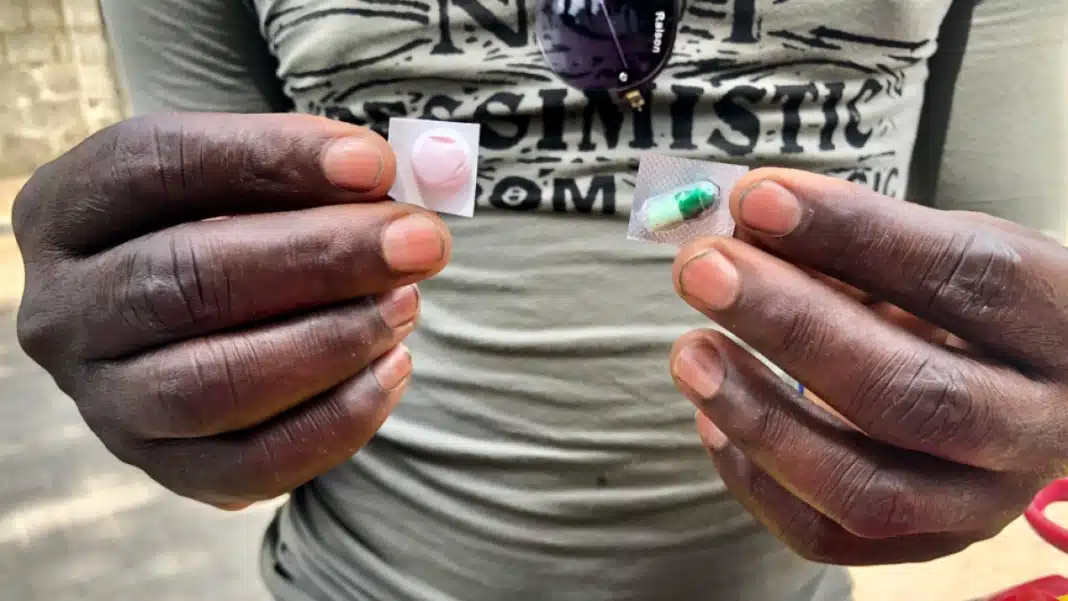
The blister packs arrive looking like any ordinary painkiller. But investigators say the India-West Africa opioid pipeline behind them has evolved into one of the region’s most dangerous synthetic drug supply chains.
Labelled neatly, sometimes stamped “Harmless Medicines for Human Consumption,” the tablets travel from pharmaceutical factories in Gujarat and Madhya Pradesh through ports and postal routes before flooding the streets of Freetown, Accra and Lagos.
But the India-West Africa opioid pipeline they belong to is anything but harmless.
A joint investigation by Bellingcat and Newslaundry published in April 2026, drawing on records from trade data provider 52wmb and cross-checked against ImportGenius, found that more than 1,400 consignments of tapentadol worth almost USD $130 million were sent from India to West Africa between January 2023 and December 2025.
That figure represents a stunning acceleration. The value of tapentadol sent to the region rose from about $27 million between 2020 and 2022, to almost $130 million from 2023 to 2025. Analysts tracking the India-West Africa opioid pipeline say the surge reflects growing demand for stronger synthetic opioids across West African cities.
In total, Indian companies shipped more than 320 million synthetic opioid pills to West Africa, where they have not been approved by regulators, over the past three years.
The Drug at the Centre of It All
Tramadol long dominated West Africa’s opioid crisis, but the India-West Africa opioid pipeline has now shifted toward stronger substances like tapentadol.
Tapentadol, the synthetic painkiller at the heart of the India-West Africa opioid pipeline, is a serious step up in potency. Tapentadol is a painkiller two to three times more potent than tramadol.
India’s own domestic regulations cap instant-release tapentadol at 100mg and slow-release at 200mg. Yet the Bellingcat investigation found that where dosages were listed, more than half the pills were in powerful strengths of 200mg or more, dosages that are not even approved in India.
The export of this drug to West Africa was never legal to begin with. Tapentadol has not been approved for use in most West African countries, where some nations are grappling with an escalating opioid abuse epidemic.
Ghana’s Food and Drugs Authority was unambiguous on this point. Ghana’s FDA told Bellingcat it had “never issued any permit” for the manufacture or importation of tapentadol, in any strength, to any importer or to any country. The statement underscored how much of the India-West Africa opioid pipeline operates outside recognised regulatory approval systems.
On the streets of Accra, the drug is sold under the name “Red.” In Ghana, tapentadol, known on the street as “Red,” is driving a surge in abuse, with users slipping into zombie-like states at high doses.
Where the Shipments Are Going
The most tapentadol pills sent between 2023 and 2025 had the coastal nations of Sierra Leone and Ghana listed as their declared destinations, with the two West African countries collectively marked as the destination for more than 80 per cent of the total value of tapentadol sent to the region.
The declared export figures, where available, show Sierra Leone received approximately $60 million worth and Ghana approximately $48 million worth during this period. Benin and Senegal trailed with around $8 million and $6 million respectively.
Both countries have sizeable ports and sit in the middle of a wider trafficking route that has become central to the India-West Africa opioid pipeline.
Import data, however, tells a more complicated story. Import data for Ghana shows that no tapentadol entered the country between 2023 and 2025, which supports Ghana’s Narcotics Control Commission’s position that the drugs are being concealed and falsely declared.
The Companies Behind the Pipeline
The India-West Africa opioid pipeline is not the work of shadowy black-market operators. It runs through licensed pharmaceutical companies with registered factories, export documentation and official paperwork.
Of the more than 60 suppliers that exported at least 32.1 crore pills to West African countries, three Indian companies, Syncom Formulations, Puizer Pharmaceuticals and Twin Impex, were listed as the biggest suppliers by cost, their exports collectively accounting for half of all tapentadol shipments analysed during this period.
Syncom Formulations, based in Indore, Madhya Pradesh, leads the list. The company along with its subsidiaries Vincit Biotech International and Synmex Pharma shipped nearly Rs 390 crore worth of tapentadol to Sierra Leone, Ghana, Senegal and Benin since 2023, according to trade data.
The company did not categorically respond to queries about tapentadol exports but insisted that it abided by all norms, saying: “We manufacture and operate all our products strictly as per our licensed business activities and in full compliance with applicable norms. We rely on the representations by our importers and distributors regarding compliance with their domestic regulations in their own country.”
After Syncom, Puizer Pharmaceuticals and Twin Impex rank next among Indian firms by tapentadol export volumes, each exporting over Rs 100 crore worth of the opioid between January 2023 and mid-2025.
Investigators say the India-West Africa opioid pipeline increasingly relies on formally registered exporters operating through legal trade channels.
The paper trail did not stop there. AFP matched tablets seized in West Africa directly to their Indian manufacturers. Tapentadol tablets seized in Sierra Leone marked “Made in India” had a manufacturing licence number that corresponds to Gujarat Pharmaceuticals, a company based in Godhra, Gujarat.
A second licence number on tablets seized in a Guinean operation corresponds to Merit Organics, another Gujarat-based company. Senegalese authorities seized high-strength 250mg tapentadol tablets with a licence number registered to McW Healthcare, a Madhya Pradesh-based company.
The Regulatory Gap That Made It Possible
On paper, the rules should have stopped the India-West Africa opioid pipeline before it began.
Indian health ministry guidance documents issued in July 2024 placed the onus squarely on exporters, requiring anyone applying for an export No Objection Certificate (NOC) to give an undertaking that the medicines “will comply with all the requirements of the importing country including quality standards.” In March 2025, the Union Health Minister said in Parliament that regulatory approval in the importing country was a prerequisite for export NOCs.
In practice, the oversight collapsed. According to a detailed investigation, only two firms were granted approval to manufacture tapentadol for export, but neither was among the 60 exporters identified.
India’s drug regulator, the Central Drugs Standard Control Organisation (CDSCO), came under direct scrutiny. The CDSCO’s Ahmedabad and Bengaluru offices acknowledged issuing 49 and two export NOCs respectively in 2024, but neither disclosed the names of the companies granted these permissions nor the specifics of the countries for which these exports were allowed.
Critics argue the India-West Africa opioid pipeline expanded because enforcement mechanisms failed to match the scale of exports.
When a BBC investigation in early 2025 exposed the damage caused by one particularly toxic combination product in Ghana, India’s response was partial at best. New Delhi declared a “zero-tolerance” crackdown on illegal drug trading in February 2025, banning export of tablets that mixed tapentadol with the muscle relaxant carisoprodol after the BBC investigation exposed the damage they were doing in Ghana.
India’s drug regulator, the CDSCO, later said it was withdrawing all export clearances for “combinations of tapentadol which are not approved by an importing country.” But the main trade was always in pure tapentadol tablets, say researchers. Shipment records reviewed by AFP show that millions of dollars worth of the high-strength pills are still being exported from India to West Africa every month.
Some companies pressed on regardless. A fourth company, PRG Pharma, made several shipments after New Delhi’s ban in February 2025, labelling them as “harmless medicines.”
How Tapentadol Became Kush
The India-West Africa opioid pipeline does not end when the tablets cross the border.
In Sierra Leone and across the sub-region, tapentadol is being processed, mixed and smoked as part of a synthetic drug cocktail known as kush, which has become one of the most destructive substances on the African continent. The India-West Africa opioid pipeline now feeds directly into the production of kush and other synthetic drug mixtures.
Ansu Konneh, director of mental health at Sierra Leone’s social welfare ministry, described the tapentadol addition to kush as “very alarming,” and said bodies were being picked up from “the streets, markets and slums on a daily basis,” with more than 400 corpses collected over three months in the capital Freetown alone.
Konneh confirmed that 90 per cent of those admitted to the country’s few official rehab centres had smoked kush mixed with tapentadol or other powerful opioids such as nitazenes.
Freetown-based public health researcher Ronald Abu Bangura told AFP that dealers grind and mix tapentadol into kush, with the opioid “being misused all over the place.”
What exactly is in kush has been the subject of rumour for years. A 2025 report by the Global Initiative against Transnational Organised Crime conducted the first known forensic testing of the drug and settled several questions. The report found that kush contained either nitazenes or synthetic cannabinoids, and that one of the nitazenes detected was 25 times more potent than fentanyl.
The authors described kush as “the first case of nitazenes penetrating West Africa’s drug markets,” stating that this reflected global trends showing nitazenes and associated fatalities surging globally since late 2022.
Regarding the long-circulating claim that human bones are an ingredient, the Global Initiative’s report was careful to state that researchers uncovered no evidence of either tramadol or human bones while testing various samples, though a study published in the journal Public Health Challenges noted that some sources have reported the presence of cannabis-like substances and other drug substances like fentanyl, tramadol, formaldehyde and possibly ground-down human bones mixed by local criminal gangs, with the texture and content known to differ by location and by producer.
The Global Initiative’s findings also indicated that China, the UK and the Netherlands are the key exporters of kush and its ingredients.
Originally shipped as a finished product, the report found that increasingly precursor chemicals are ordered from China via online sites and then combined in labs in Sierra Leone’s capital Freetown, where the psychoactive liquid is sprayed onto plant material intended to be smoked and sold as kush.
A National Emergency Declared
The scale of the India-West Africa opioid pipeline forced governments into emergency action.
Sierra Leone’s President Julius Maada Bio declared a national emergency in 2024 over rampant drug abuse and branded kush a “death trap.” The declaration was a measure typically reserved for pandemics or armed conflict.
Liberia followed suit. Leaders of both Sierra Leone and Liberia, in an unprecedented decision, declared national emergencies over drug use in 2024.
The India-West Africa opioid pipeline has pushed the region’s already overstretched health infrastructure to breaking point. For more than a decade, a sizable chunk of West Africa, including Ghana, Sierra Leone, Senegal, Nigeria and Ivory Coast, has been gripped by an opioid abuse epidemic that has devastated families, killed thousands and strained an already overburdened healthcare system.
The demographic being destroyed is specific. Young men between 18 and 25 make up the bulk of users. The economics of addiction require almost no barrier to entry. A single tapentadol tablet costs less than a meal in the poorer districts of many West African cities.
Medical anthropologist Axel Klein of the Global Initiative Against Transnational Organized Crime told AFP that tapentadol is used as a performance enhancer to enable market porters and gold miners from Lagos to Mali to push through the pain of long hours of hard physical work.
Femi Babafemi of Nigeria’s NDLEA anti-drug agency said his agency seized two billion high-strength pills in 2023 and 2024 alone, and that kidnappers, terrorists and bandits use these drugs to carry out criminal activities, with police noting that jihadist fighters like Boko Haram also take it “for courage.” The pills are also used as a form of currency in ransoms for kidnappings, Babafemi said.
Security officials increasingly view the India-West Africa opioid pipeline as both a public health and national security threat.
The Wider Opioid Landscape
West Africa’s relationship with synthetic opioids is not new, but the India-West Africa opioid pipeline has dramatically intensified the crisis.
About 30 per cent of West Africa’s population has been found to use tramadol and codeine, making these prescription opioids among the most widely abused substances in the region. Once primarily a transit zone linking Latin American cocaine routes to European markets, the region has now become a primary consumer market in its own right.
Nigeria’s problem extends beyond kush. A synthetic cannabinoid and opioid mixture known as “Colorado” is circulating widely, mimicking the effects of high-potency cannabis but carrying a far greater risk of lethal toxicity.
The root of addiction in these countries is no different than anywhere else: poverty, unemployment and weak governance have created a vulnerable youth who turn to substance abuse during trying times.
As far as researcher Thakur is aware, India’s pharmaceutical industry has not taken appropriate responsibility and action on the matter, noting that converting raw materials into pill formulations requires skills in medicinal and process chemistry that are largely available in India.
What Comes Next
Seizures have happened. Authorities in Sierra Leone intercepted illegal tapentadol last July when the National Revenue Authority said it thwarted a smuggling operation near its north-west border with Guinea. Ghana’s FDA destroyed 230 cartons of illegally imported tapentadol last April and seized 7,700 tapentadol tablets at a border crossing last August.
But seizures alone have not slowed the India-West Africa opioid pipeline. The volume is simply too large, and too many actors, both licensed and unlicensed, are involved on the supply side.
Officials across the region say the India-West Africa opioid pipeline now operates at a scale that overwhelms existing anti-trafficking systems. Whether India’s regulators respond with the kind of structural reform that situation demands remains to be seen.
Kars de Bruijne, senior research fellow at the Clingendael Institute, noted that the presence of nitazenes in kush means the drug is “part of a global threat, and not only a West African challenge,” and is “likely just the first of a growing range of synthetic drugs targeting the region.”
For Freetown, Accra and Lagos, the India-West Africa opioid pipeline is no longer a distant threat. The blister packs keep arriving.
AfricanQuarters previously reported on kush addiction and recovery in Sierra Leone. Related coverage: Kush Addiction in Sierra Leone: A Recovery Story


