



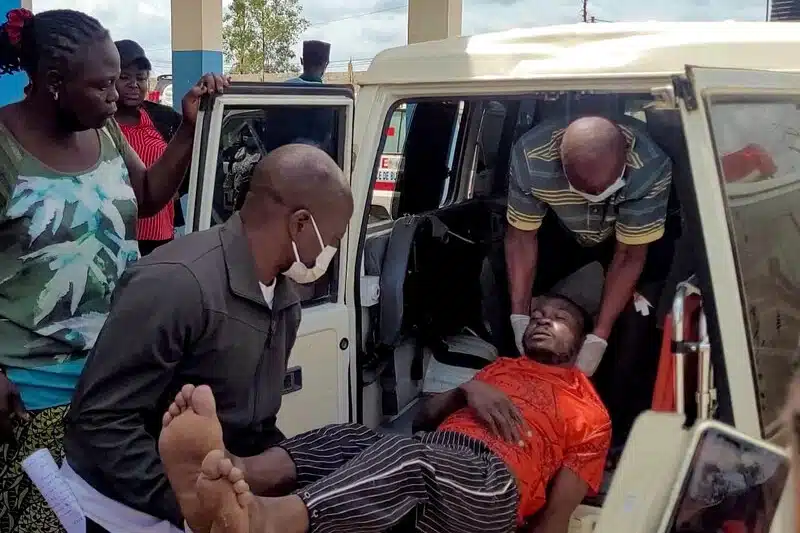

The new case matters less for where it was found than for how it got there. The acting governor of Sud-Ubangi, Jean-Rene Galekwa Vundawe, said the patient first developed symptoms in Kisangani. That is the capital of Tshopo province. He had passed through Rwanda, Uganda and Ituri, the outbreak’s original epicentre, according to Al Jazeera.
From Ituri, he moved west through Tshopo and Mongala. He then boarded a boat on the Congo River that carried him into Sud-Ubangi, where he later died. Thirty-eight people who had contact with him have since been placed in quarantine, Galekwa said. He warned that both the man’s route and the boat’s journey had exposed communities. Those communities lie along North-Ubangi, Tshopo and Mongala.
Sud-Ubangi borders the Central African Republic and the Republic of Congo, known as Congo-Brazzaville. That geography puts this DR Congo Ebola crisis within reach of two more nations.
For four months, this Ebola outbreak in DR Congo stayed largely confined to the country’s east and northeast. A single infected traveller has now carried it hundreds of kilometres west. He reached a province with no history of the virus and two international borders within easy reach.
Laboratory analysis by DRC’s national research institute in Kinshasa confirmed the presence of the Bundibugyo strain. It is the same rare variant driving this DR Congo Ebola crisis. Local transmission has not yet been confirmed in Sud-Ubangi itself. So the province has not formally joined the six others already on the outbreak’s official list. That distinction offers little comfort, given how the virus arrived there in the first place.
Government figures place the toll at 6,942 confirmed cases and 3,349 deaths this week, according to the World Health Organisation, underscoring the scale of the DR Congo Ebola crisis. That already exceeds the 2,299 deaths recorded during DRC’s 2018 to 2020 outbreak, previously the country’s deadliest.
The WHO has gone further, warning that the current outbreak is out of control. It says the crisis is on course to overtake the 2014 to 2016 West Africa epidemic. That earlier outbreak killed more than 11,325 people across Guinea, Liberia and Sierra Leone.
There is a bitter irony sitting underneath the numbers behind this DR Congo Ebola crisis. Ervebo, the vaccine credited with helping bring earlier Zaire strain outbreaks under control, offers no proven protection against Bundibugyo. No licensed vaccine or treatment exists for this variant. Trials are under way in Tshopo, Haut-Uele and Bas-Uele, with Ituri expected to follow shortly. Health workers are being vaccinated as a precaution. The frontline itself, though, remains largely unprotected.
The pattern of spread tells its own story about this DR Congo Ebola crisis. New infections have started easing in Ituri. That is where the outbreak began, after being declared on 15 May. But they are climbing sharply in North Kivu and Haut-Uele. Weak health infrastructure and the region’s remoteness have slowed containment efforts. So has ongoing armed conflict near DRC’s borders with South Sudan, Uganda and Rwanda. What should be localised flare-ups keep turning into a moving front.
Sud-Ubangi now sits at the edge of that front. Beyond it lie two more countries with their own fragile health systems. Whether this DR Congo Ebola crisis stays a domestic emergency, or becomes a regional one, may depend on what happens next along a river that has already carried the virus further than anyone expected.


