



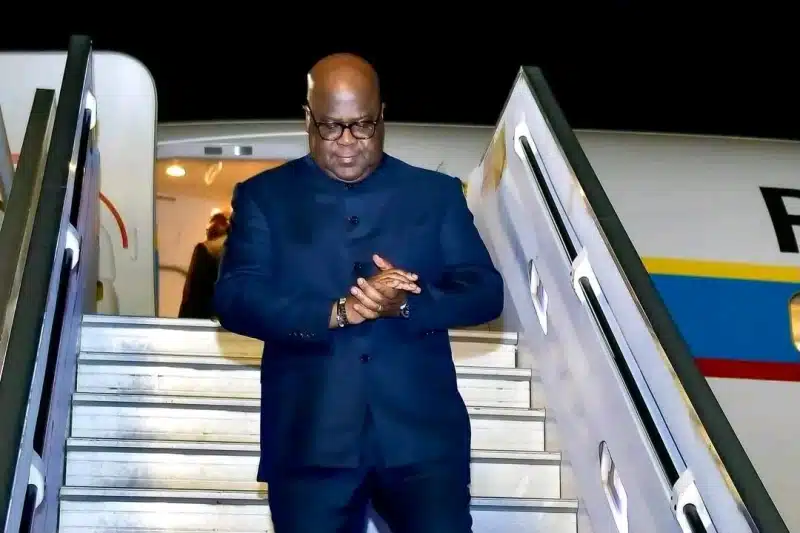

Belgian police searched homes linked to members of Congo’s first family on Wednesday, 14 October. A day later, Kinshasa ordered the presidential staff to stop communicating directly with Belgium’s embassy.
The Tshisekedi money laundering probe began as a complaint on a prosecutor’s desk in Brussels 15 months ago. On Wednesday 14 October, it turned into a police operation.
Belgium’s federal prosecutor’s office confirmed searches at several addresses in Brussels and its suburbs. It said they stem from a money laundering investigation opened after NGOs filed complaints in July 2025. It would not say who lives at those addresses.
Two lawyers behind the complaint told Reuters the targets include relatives and associates of President Félix Tshisekedi. The president himself is not identified as a target of the investigation, according to the lawyers behind the complaint. The reported focus on relatives reflects the legal and jurisdictional complications of pursuing allegations involving a sitting head of state.
Belgian nationality and financial connections to Belgium may provide investigators with a route to examine alleged money laundering involving people close to the Congolese president. The precise jurisdictional basis will depend on the individuals and transactions under investigation.
The complaint runs to 80 pages. Lawyers Bernard and Brieuc Maingain lodged it on 8 July 2025 for Katanga civil society groups and four former directors of Gécamines, Congo’s state mining company.
It names nine people and alleges corruption, embezzlement and money laundering tied to mines in Lualaba and Haut-Katanga. At the heart of the Tshisekedi money laundering probe is a claim that relatives of the president took lucrative subcontracts on mining waste, known as tailings.
La Libre Belgique says the nine include the first lady, Denise Nyakeru Tshisekedi, several of the president’s brothers, a cousin and two of his children. The prosecutor has confirmed none of that, so the names stay unofficial for now.
Jean-Pierre Muteba, who speaks for the complainants, goes further. He alleges billions of dollars may have left the public treasury. Lawyer Hervé Diakese says the case is about “the capture of resources by Belgian citizens” and the laundering of what came from it.
Those are allegations. Nobody has proved them.
Witnesses cited by La Libre describe a recurring pattern: operators are pushed off a mining site, replacement crews move in, and the Republican Guard provides security.
Several travelled to Brussels in secret to testify. One told the paper that going home would be impossible if Kinshasa found out.
The money trail is the Belgian angle. For the Tshisekedi money laundering probe, investigators wrote to Belgian banks asking for account details from January 2018 to January 2025, La Libre reports. That window opens a year before Tshisekedi took office in January 2019 and runs well into his term. Boxes were carried out and cars seized, according to the paper.
The family rejects everything. Its lawyers call the allegations “entirely unfounded, false and defamatory”. No one has been charged, and the prosecutor cites secrecy and the presumption of innocence.
Kinshasa’s reaction to the Tshisekedi money laundering probe came fast. A circular numbered 26/004, signed on 15 October by chief of staff Anthony Nkinzo Kamole, bars the presidency’s staff from direct or indirect contact with Belgium’s embassy “until further notice”. Anything truly necessary must go through the foreign ministry.
The circular gives no reason. The presidency has not linked it to the searches. It does not cut diplomatic ties either. The timing raises questions about whether the searches and the restrictions on embassy contact are connected, although the circular does not establish such a link.
The Tshisekedi money laundering probe also lands on a president already under strain. Reuters notes he faces an armed rebellion now led by his predecessor, Joseph Kabila, a deadly Ebola outbreak and opposition anger over alleged third-term plans. La Libre adds that the searches came barely a day after Kabila launched a new political movement in Goma.
Belgium is not a random venue. The president’s father, Étienne Tshisekedi, died in Brussels in 2017. Belgian media have reported that the president and first lady rent a home in Uccle and that their five children attend school in Belgium. A family base can double as a weak point.
Then there is the money itself. Congo is the world’s top producer of cobalt, a metal used in electric vehicle batteries, and its mining sector has long faced questions over corruption and transparency. The complainants want any recovered funds spent on the country’s development.
Do not expect a quick ending. It took 15 months to get from complaint to raids, and the Tshisekedi money laundering probe has not produced a single charge.
Immunity covers the president. It does not cover his family’s bank statements.


