




A signature on a State Department memo. That is all it took on Tuesday night to put an unknown number of South African officials on a list they cannot get off easily as US visa restrictions on South Africa entered a new phase.
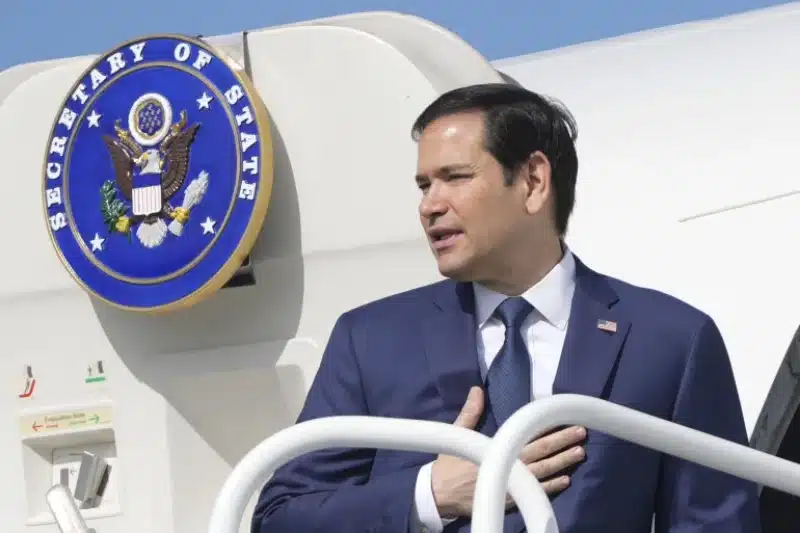
Secretary of State Marco Rubio announced a new policy on 15 September 2026 restricting visas for foreign nationals accused of enabling land seizures without compensation, race-based discrimination or incitement of violence against minority groups in South Africa.
The US visa restrictions on South Africa apply under Section 212(a)(3)(C) of the Immigration and Nationality Act, a provision that lets the Secretary of State bar entry to anyone whose presence would carry “potentially serious adverse foreign policy consequences” for the United States.
Rubio did not name names. But he made clear the net is wide, signalling that the US visa restrictions on South Africa could affect a broad range of officials beyond those directly involved in land policy.
The policy covers officials “responsible for, or complicit in” laws or policies that enable uncompensated land seizures, race-based discrimination, or incitement of imminent violence against minority ethnic or racial groups. Family members of those officials could also be barred.
The United States will not allow such behaviour to go unchecked,” Rubio said in the statement, adding that the measures “directly undermine peace, economic stability, and the rule of law.”
This is not a standalone move. The US visa restrictions on South Africa build on groundwork laid nineteen months earlier.
In February 2025, President Trump signed Executive Order 14204, “Addressing Egregious Actions of the Republic of South Africa.” That order halted US foreign aid to Pretoria and prioritised the resettlement of Afrikaner refugees, a policy later widened to cover all racial minorities in the country.
The order followed close behind South Africa’s own legislative move. In January 2025, Pretoria signed the Expropriation Act into law, a statute that permits the state to acquire property for public purpose or public interest, including, in narrow circumstances, at nil compensation.
For Washington, the legislation sits at the centre of the dispute that ultimately led to the US visa restrictions on South Africa, even as Pretoria argues the law contains significant safeguards.
Here is the contrast that defines this whole dispute.
Washington reads the Act as a licence for confiscation.
Pretoria reads it as a tightly bounded legal mechanism.
The nil compensation clause applies only to specific scenarios: unused land held purely for speculation, abandoned land, unused state land acquired for nothing, or land whose market value does not exceed what the state has already spent subsidising it.
It is not, on its face, a blanket seizure tool. Whether that distinction survives legal scrutiny is now a live question.
AfriForum and the Democratic Alliance have filed a constitutional challenge against those provisions in the Western Cape High Court, a case still pending as the US visa restrictions on South Africa take effect.
President Cyril Ramaphosa has repeatedly rejected claims that his government is confiscating land or persecuting white citizens. Responding to footage of inflammatory rally chants that Washington has cited as evidence of incitement, Ramaphosa told reporters that individual speeches do not reflect state policy.
“We have a multiparty democracy in South Africa that allows people to express themselves,” he said, insisting government policy stands “completely” against the sentiments in the video.
That is the tension sitting underneath every diplomatic cable on this issue. One side treats a chant at a rally as evidence of a broader political climate. The other argues that isolated political speech should not be conflated with state policy.
Previous friction between Washington and Pretoria stayed largely rhetorical: aid suspensions, statements, a resettlement scheme. Visa restrictions are personal. They hit named individuals, potentially their spouses and children, and they carry the kind of reputational weight that outlasts a single news cycle.
Rubio was blunt about the reasoning. “The South African government has not adequately addressed the previously laid out concerns,” he said, framing the visa policy as the consequence of eighteen months of what Washington views as inaction.
Pretoria, for its part, has shown no sign of retreating from the Expropriation Act or softening its account of events. Both governments are now negotiating from fixed positions, and the gap between an executive order signed in Washington and a court case still open in Cape Town is where this story will actually be decided.
The immediate impact of the US visa restrictions on South Africa remains unclear, but the measure marks one of Washington’s most direct actions against Pretoria in years.
Diplomacy rarely moves at the speed of a press statement. This one might have to, because the consequences of the US visa restrictions on South Africa are likely to shape relations between Washington and Pretoria long after the current dispute reaches the courts.


