



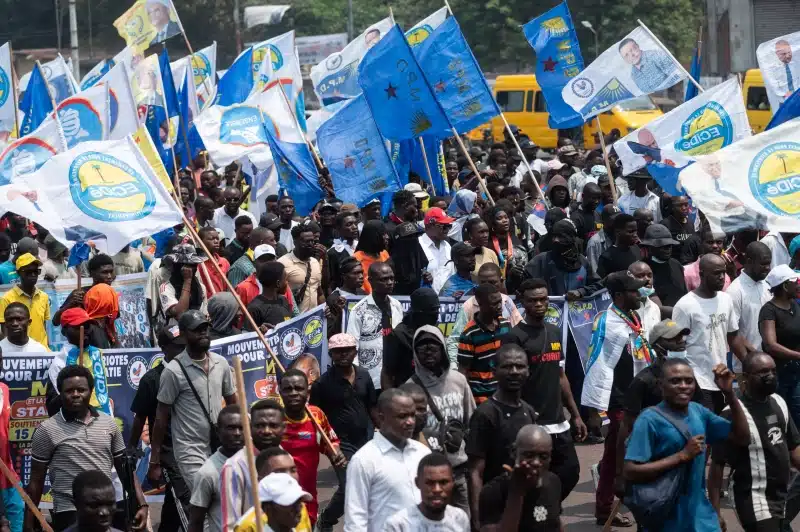

Tear gas drifted across Boulevard Lumumba in Kinshasa on Tuesday. A few kilometres away, parliament reopened for its September session. Lawmakers filed into the Palais du Peuple. Riot police fired canisters at marchers outside.
That contrast captures what the DRC third term protests have become, nearly four months after they began. This is no longer one demonstration. It is a slow standoff over how long one man can hold power in Central Africa’s largest country.
The trigger sits in a single clause. Congo’s constitution bars any revision of presidential term limits, full stop. But a proposal now advancing through parliament would allow lawmakers to waive that protection during a “major dysfunction” paralysing state institutions, potentially followed by a referendum.
Critics describe it as a loophole designed to open a path to an additional presidential term. The DRC third term protests exist because many believe President Felix Tshisekedi intends to use it.
Tshisekedi has not helped his own case. Last month he told supporters he had not asked for a third term. Then he added a line opposition leaders keep repeating. If the Congolese people wanted him to continue, he said, he would accept.
He was first elected in 2018 and returned in 2023, serving what the constitution treats as his final term. That one sentence reopened a fight many assumed was settled by law. It also gave the DRC third term protests their sharpest slogan yet.
The opposition responded by doing something it rarely manages. In May, rival parties led by Martin Fayulu, Moise Katumbi and Jean-Marc Kabund set aside years of rivalry. They formed the C64 coalition, named after the constitutional article obliging citizens to resist any unconstitutional seizure of power. That unity produced the first wave of DRC third term protests within weeks.
June 12 marked the point where words turned physical. Security forces used tear gas and batons in Kinshasa to stop protesters reaching a sit-in outside parliament, according to Human Rights Watch. The rights group said members of a group linked to the ruling party assaulted demonstrators while police failed to intervene.
A day later, rival groups clashed again at a C64 rally. Video verified by Al Jazeera showed opposition leader Fayulu bleeding from the face after being caught in the fighting. Fellow opposition figure Prince Epenge was also hurt. Those two days set a pattern that has held since.
Government supporters mobilise near opposition marches. Police reach for tear gas early. Each fresh round of the DRC third term protests draws a harder response from provincial authorities than the last.
Tuesday proved the point on a national scale. Roughly five thousand marchers left Kinshasa’s Echangeur de Limete after midday. They moved along Boulevard Lumumba towards Fayulu’s party headquarters under police escort. It was the largest single showing the DRC third term protests have produced so far.
Near the ruling UDPS party’s own offices, youth aligned with the party set up barriers. Stones were thrown from both sides. Police fired tear gas to force the crowds apart.
Outside the capital, the response was blunter. Authorities used tear gas and arrests to pre-empt or break up gatherings in Kananga, Lubumbashi, Uvira, Mbandaka, Bandundu, Kikwit and Kisangani. Officials cited public order concerns. Opposition organisers called the bans unconstitutional.
Here is the tension beneath the tear gas, and it is the part the DRC third term protests keep pointing back to. Congo is already fighting a war it has not won. Rwanda-backed M23 rebels control large parts of the east. Tshisekedi himself has argued there can be no elections in 2028 unless that conflict is resolved first.
His government now wants the country to consider constitutional change in the middle of that crisis. It insists a newly launched national dialogue is about peace, not a path to a third term. Opposition figures see the timing differently.
They argue a country distracted by war is the country least able to defend its own constitution. That is exactly why the DRC third term protests have refused to fade.
The contrast writes itself. A president who says he never asked to stay in power. A coalition that formed specifically because it does not believe him. A parliament reopening under normal ceremony, streets away from tear gas fired at citizens invoking the very constitution parliament is meant to protect.
Congo has lived through contested transitions before. It has rarely faced one with a war on its border and a referendum bill on the table at the same time. The DRC third term protests mark the first time both crises have collided so directly.
Nothing has been signed into law yet. The National Assembly and Senate have moved the referendum proposal forward, not finished it. Tshisekedi’s five-year mandate does not legally expire until 2028.
That gap, between where the process sits now and where its harshest critics fear it is heading, is the real story behind Tuesday’s headlines. It is why Kinshasa, Kananga and Kisangani are unlikely to stay quiet for long.
The DRC third term protests are ultimately asking one question. Will Congo’s institutions uphold the constitutional limits now in place, or will political pressure reshape the country’s path before 2028?


