



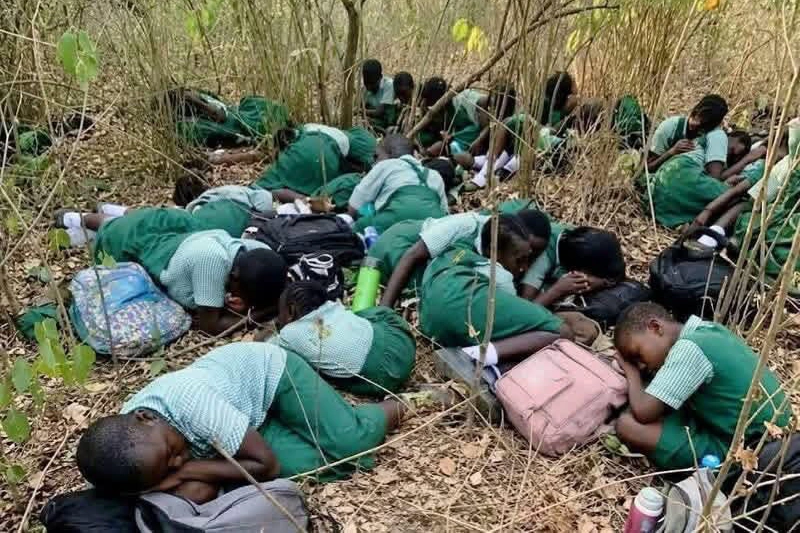

As the world marks the United Nations International Day of Innocent Children Victims of Aggression on Wednesday, Nigeria finds itself grappling with a painful contradiction.
While young innovators were building mobile applications to solve Africa’s problems, dozens of other Nigerian children remain in the hands of armed groups, weeks after being dragged from their classrooms.
The contrast could not be sharper.
Abuja’s Young Builders
Nigeria’s next generation of technology innovators took centre stage in Abuja last month as the Odyssey Educational Foundation hosted the Technovation Regional Pitch Event 2026, showcasing mobile applications designed by young Nigerians to tackle pressing social challenges.
Held at the headquarters of the Nigerian Society of Engineers, the two-day event attracted over 270 participants, with 64 teams presenting ideas focused on healthcare, housing, safety, education, and community development.
Engr. Stella Uzochukwu-Denis, Executive Director of the Odyssey Educational Foundation and the event’s Technovation Chapter Ambassador, told participants that technology must be a working tool, not just a talking point. She said giving young Nigerians digital and entrepreneurial skills was the only credible path to solving Africa’s problems from within.
Seven teams advanced to the semi-final stage of the competition, with representatives from the Association of Professional Women Engineers of Nigeria, the Nigerian Society of Engineers, and other bodies addressing participants.
These young Nigerians represent the hopeful face of a nation’s future.
But they were coding and pitching on the very day their peers in Oyo and Borno were being marched into the bush at gunpoint.
The Day Schools Were Attacked
On 15 May 2026, gunmen riding motorcycles descended on three schools almost simultaneously in the Oriire Local Government Area of Oyo State: Baptist Nursery and Primary School in Yawota, Community Grammar School, and L.A. Primary School in Esiele.
They shot sporadically during morning assembly. Teachers, students, and Vice Principal Mrs Alamu Folawe were dragged away into the forest. An Assistant Headmaster, Mr Adesiyan, was killed during the attack.
About 46 schoolchildren and teachers were abducted from the three schools in Oriire Local Government Area alone.
On the same morning, hundreds of kilometres away in the northeast, children victims of aggression were being counted in Borno State.
Militants, suspected to be members of the jihadist group Boko Haram, stormed the Primary and Junior Government Day Secondary School in Mussa-Biri community in Askira-Uba Local Government Area.
Senator Mohammed Ali Ndume, who represents Borno South, confirmed that 32 students were seized from classrooms and another ten from nearby homes.
In a single day, more than 80 Nigerian children and their teachers were taken from their classrooms.
The attacks transformed ordinary pupils into children victims of aggression, highlighting how insecurity continues to target education across Nigeria.
Still Waiting
As Nigeria entered June, those children victims of aggression were still missing.
The Nigeria Union of Teachers ordered the withdrawal of services of all primary and secondary school teachers in Oyo State with effect from 1 June 2026, until further notice, as members joined nationwide protests demanding the unconditional release of kidnapped colleagues and students.
In Borno, teachers under the Nigerian Union of Teachers picketed the Government House in Maiduguri carrying placards bearing the words “Education is Not a Crime” and “Bring Back Our Students.”
A northern coalition accused the federal government of unequal treatment, stating that the Oyo incident received swift high-level visits while the victims and communities in Borno had been largely abandoned to silence and neglect.
President Bola Tinubu, in a statement marking Nigeria’s Children Day, addressed the kidnapped children directly, saying: “To those children, their parents, and their teachers, I say this as a father and your President: you are not forgotten. You are not abandoned.”
A Wider Pattern
The attacks did not occur in a vacuum.
Nigeria has recorded over 20 major school kidnapping incidents since the 2014 Chibok abduction, with more than 1,700 students and staff taken in that period.
The United Nations established the International Day of Innocent Children Victims of Aggression in 1982 to acknowledge the suffering of children affected by armed conflict and promote measures for their protection. The day now carries a grim resonance in Nigeria.
Human rights advocates argue that the growing number of children victims of aggression reflects the urgent need for stronger protection of schools and communities.
According to recent UN statistics, 536 million children live in countries affected by conflict or disasters, and about 50 million children have been displaced from their homes. The children victims of aggression in Nigeria are counted among them.
Two Nigerias
The Technovation event in Abuja offered a vision of what Nigerian children can achieve when given safety, tools, and encouragement.
The abductions in Oyo and Borno are a reminder of what is stolen when children victims of aggression are denied all three.
Maiduguri-based security analyst Alhaji Modu Ali warned that the Borno attack highlights ongoing vulnerabilities in the northeast, saying: “I believe both the government and security forces have relaxed in the fight against insecurity, which may have allowed such an incident to happen again after many years.
On this International Day of Innocent Children Victims of Aggression, Nigerian schools stand as both the nation’s greatest hope and its most visible wound.
The children building apps deserve to be celebrated.
The children still in captivity deserve to come home.


