



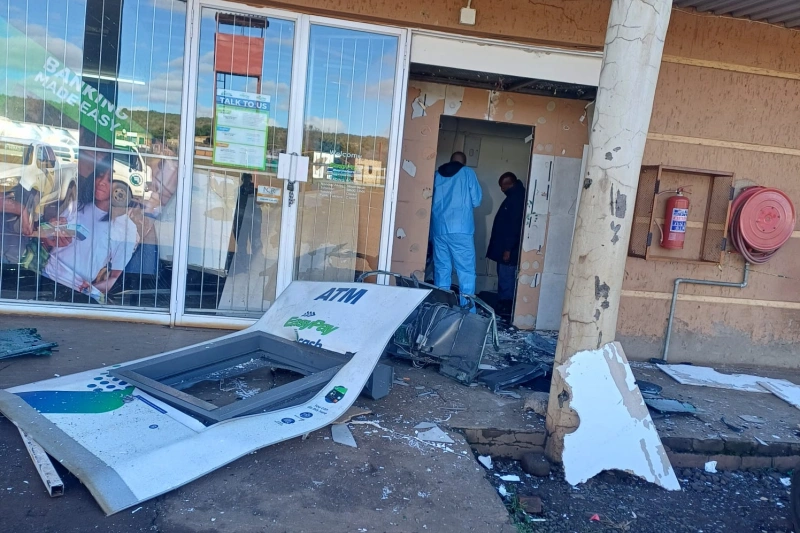

NORTH WEST, SOUTH AFRICA – The latest ATM bombing in South Africa did not end at the blast site.
What began in the early hours of Wednesday in the village of Dinokana, near Zeerust in North West Province, ended kilometres away in Magogae Village with three suspects dead, five arrested, and a serving South African Police Service officer in handcuffs.
The case has become something far weightier than a crime story.
How It Started: An Intelligence-Led Pursuit
This was not a routine patrol stumbling onto a crime scene.
North West Acting Police Commissioner Major General Ryno Naidoo confirmed that investigators had been tracking the suspects following the ATM bombing in South Africa North West Province. The cell was already under surveillance when the bombers moved.
The pursuit carried officers from Dinokana across open rural terrain to Magogae Village near Mmabatho, where the situation turned violent. Suspects opened fire. By the time the shooting stopped, three of them were dead and five, including the serving SAPS officer, were in custody.
Major General Naidoo described the officer’s alleged role as “a betrayal of the oath to serve and protect.”
The Scale of Force Deployed
The units assembled for this operation tell their own story.
The National Intervention Unit, the Tactical Response Team, K9 units, detectives, Crime Scene Management teams, provincial traffic officers and emergency services were all on the ground. That is not the configuration for a routine arrest warrant.
It is, however, the configuration South African police now routinely prepare when responding to ATM bombing syndicates, groups that move armed with assault rifles, deploy counter-surveillance teams, and have a documented history of engaging officers in direct firefights rather than surrendering.
What an ATM Bombing in South Africa Actually Involves
An ATM bombing in South Africa is an organised criminal enterprise, not a crime of opportunity.
These syndicates operate with commercial-grade or military explosives, often stolen from mines. They use cloned or stolen vehicles, encrypted communications, carefully planned escape corridors and insider intelligence. The technical expertise required to breach a reinforced ATM safe is not amateur work, syndicates maintain what investigators describe as specialist “blaster” operatives.
North West Province has emerged as a particularly vulnerable theatre. Its proximity to the Botswana border, extensive rural terrain, limited surveillance infrastructure and the presence of illegal mining networks have made it a natural staging ground for overlapping criminal operations.
SAPS themselves confirmed that connection: the National Intervention Unit deployed in this case had already been engaged in illicit mining operations in the province. That detail is not incidental.
Illegal mining syndicates, cash-in-transit gangs, ATM bombers, vehicle theft rings and firearms traffickers in the region share logistics networks, weapons suppliers, safe houses and money laundering pipelines. What presents as one category of crime on the surface is often a single limb of a much larger structure.
The Arrest That Changes Everything
The involvement of a serving SAPS officer is the detail that shifts this story from violent crime to institutional crisis.
A corrupt police officer embedded inside an ATM bombing network is not merely a criminal addition, he is a strategic asset. Access to patrol patterns, radio frequencies, response times, roadblock schedules, police databases and operational intelligence dramatically increases a syndicate’s ability to strike and escape undetected.
South Africa has confronted allegations of law enforcement infiltration for years, particularly in cases involving illegal mining, firearms trafficking and cash heists. But an active officer connected to an ATM bombing in South Africa carries a specific alarm: it suggests that criminal groups may have direct visibility into the tactical policing systems designed to hunt them.
The questions that follow are serious. Was intelligence being passed before the Dinokana bombing? Were previous operations in the area compromised? Is this officer acting alone, or is he part of a broader network of insiders?
SAPS has confirmed that investigations are ongoing and additional suspects remain at large.
Why North West Province Keeps Appearing
The province has quietly become one of South Africa’s most strategically exposed security zones.
Illegal mining conflicts, Botswana border smuggling routes, economic decline, rural policing shortages and rising organised violence all converge here. The Dinokana corridor sits close to crossing points long associated with the movement of weapons, stolen currency and suspects between countries.
That cross-border reach is a force multiplier for syndicates. It enables them to move explosives, launder proceeds, relocate personnel and source weapons through regional networks that South African law enforcement cannot easily pursue across jurisdictions.
It is precisely why intelligence-driven policing in the province has grown more aggressive in recent years.
The Pressure Now Facing SAPS
The South African Police Service is managing compounding institutional pressure.
Corruption allegations, accusations of political interference, slow response times and repeated officer-related scandals have steadily eroded public confidence. Each time a serving member appears on the wrong side of an ATM bombing investigation in South Africa, it reinforces the perception that organised crime has partially embedded itself within state structures.
Major General Naidoo’s swift public condemnation of the implicated officer appears designed to signal the opposite, that SAPS leadership is not protecting rogue members, and that internal compromise will be confronted openly rather than absorbed quietly.
Whether that message holds will depend significantly on what the investigation uncovers.
The Broader Pattern Across the Region
The ATM bombing problem in South Africa does not exist in a regional vacuum.
Across Southern Africa, security analysts say the rise in ATM bombing in South Africa reflects the growth of hybrid criminal networks, formations that blend organised crime, political corruption, illicit mining, cross-border smuggling and armed violence into structures that resist conventional policing approaches.
South Africa’s economic infrastructure; its banking system, cash distribution networks, transport corridors and mining operations, makes it a priority target for precisely these formations.
In that context, an ATM bombing in South Africa is about more than the cash inside a machine. It is a demonstration that organised crime networks can strike critical financial infrastructure with near-military precision, withdraw through shared criminal logistics chains, and in some cases, depend on protection sourced from within the institutions mandated to stop them.
The fatal shootout at Magogae Village closed one chapter of this case. The investigation into how far the network reaches is only beginning.


