



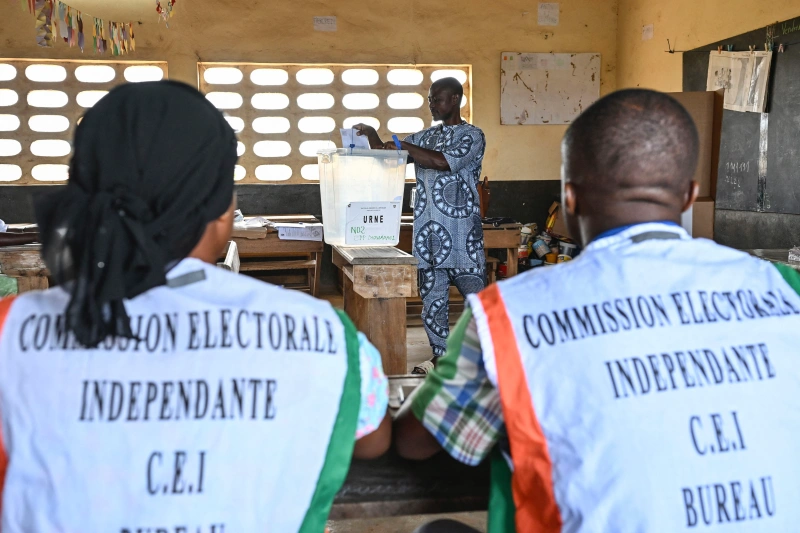

The body at the heart of the country’s worst political violence is gone. What replaces it will define whether Ivory Coast moves towards genuine reform or deeper instability.
AfricanQuarters.co | 7 May 2026
The Ivory Coast electoral commission has been dissolved. President Alassane Ouattara’s cabinet approved the decision on Wednesday, scrapping the Independent Electoral Commission, known by its French acronym CEI, after more than two decades at the centre of the country’s fiercest political battles.
Government spokesperson and Communications Minister Amadou Coulibaly announced the move at a press conference following a cabinet meeting, saying the decision followed “repeated disputes over the commission’s independence and its handling of elections.”
The announcement was short on detail but long on consequence.
What the Government Said
“In view of the reservations expressed about this institution, as well as the criticism it has faced, the Council of Ministers has decided to dissolve it,” Coulibaly told reporters.
He framed the move as a confidence-building exercise, saying the aim was “to ensure, in a lasting way, the organisation of peaceful elections by creating greater trust and reassuring all Ivorians and the political class.”
But when journalists pressed him on what comes next, Coulibaly offered no blueprint. “I cannot tell you at this stage what this new mechanism will be, which will certainly be discussed and put in place at the government level,” he said.
That gap between the announcement and any concrete plan is precisely where the risk lies.
Twenty-Five Years of Controversy
The Ivory Coast Electoral Commission was created in 2001 and has overseen all of Ivory Coast’s elections since the end of military rule in 2000. Its main role was to ensure the strict application of the electoral code.
In practice, it became something else entirely: a political battlefield.
The commission has been at the centre of nearly every major electoral dispute, including the 2010 presidential election, whose contested outcome triggered months of deadly violence.
That 2010 crisis remains the defining trauma in Ivorian political memory. After the runoff vote in November of that year, the CEI announced Ouattara as the winner with 54 per cent of the vote. Then things fell apart.
The Constitutional Council, at the behest of then-incumbent Laurent Gbagbo, discounted a portion of the results, declared Gbagbo the winner with 51 per cent of the vote, and most of the international community, including the United Nations which had overseen the voting process and certified the results, maintained that Ouattara was the rightful winner.
Both men were sworn in. The country fractured.
The dispute led to a tense political power struggle that the United Nations said had killed more than 170 people by the end of 2010. The violence ultimately escalated into a second civil war before Gbagbo was forcibly removed from office in April 2011.
The CEI sat at the heart of that catastrophe. For many Ivorians, it never fully recovered its credibility.
The Election That Made Dissolution Inevitable
The timing of Wednesday’s decision is not accidental.
Ivory Coast last held a presidential election in October 2025, when President Ouattara won a fourth term with nearly 90 per cent of the vote after several prominent opposition figures were barred from running, prompting criticism from opposition and civil society groups over the inclusiveness of the process.
Major opposition parties, including the Democratic Party of Ivory Coast led by Tidjane Thiam and the African Peoples’ Party-Ivory Coast headed by former president Laurent Gbagbo, were barred from contesting the election due to legal and nationality-related issues.
A 90 per cent result, with most credible challengers excluded, handed the opposition a unified grievance. Ivory Coast Electoral Commission, having presided over that process, became the natural target.
Political tensions in Ivory Coast have remained high since constitutional reforms in 2016 allowed Ouattara to seek a controversial third term, a move heavily criticised by opposition groups. That election was largely boycotted and triggered unrest in parts of the country.
Dissolving the Ivory Coast electoral commission now, months after the 2025 vote and before the next electoral cycle begins, gives Ouattara room to reset the conversation.
Opposition Voices: Relief Mixed With Suspicion
The initial reaction from opposition figures was not outright rejection. But the welcome came wrapped in conditions.
Former Prime Minister Pascal Affi N’Guessan, who served in that role from 2000 to 2003 and whose presidential candidacy was rejected ahead of the October 2025 election, was among the most vocal. Writing on his X account, he described the dissolved commission as the body “of electoral crises and death” and called on the government to open dialogue immediately.
Affi N’Guessan called on the government to “open a dialogue with political and civil society organisations to rebuild the electoral system, in the name of peace and stability.”
Danielle Boni Claverie, president of the Republican Union for Democracy, said her party “takes note of this dissolution” while urging caution, adding that judgement would be reserved until it was clear what form the new structure would take and whether it would meet the opposition’s demands.
Ebrin Yao Rémi, president of a coalition of 37 civil society organisations known as the Pec-CI, called the dissolution of Ivory Coast Electoral Commission, “the best news of 2026” and praised Ouattara for what he described as a courageous decision.
Not everyone agreed. Samouka Diabaté of the African Party Against Injustice said his group was “surprised by this decision,” arguing that consultation should have come before dissolution, noting that his party had participated in establishing the original commission.
The Question Nobody Has Answered
The central anxiety, across the political spectrum, is not whether the Ivory Coast electoral commission needed to change. Most people accept that it did.
The question is who controls what comes next.
Some observers are already asking whether the country is witnessing a quiet return to the pre-CEI model, where elections were organised directly by the Interior Ministry under the administration of the Democratic Party of Ivory Coast. That system was long criticised by the opposition of the time for lacking neutrality.
Boni Claverie noted that since 2020, opposition parties have been proposing that election management be handed to civil society, and said that these proposals were renewed in 2025. She also raised what she described as “rumours” of a possible placement of the future commission under the Interior Ministry.
If that scenario materialises, the government’s language about restoring public trust will come under serious pressure.
Why This Matters Beyond Ivory Coast
Ivory Coast is one of West Africa’s largest economies and has long been presented, particularly by French and international partners, as a relative anchor of stability in a region under severe democratic strain.
Across the Sahel, military governments have seized power in Mali, Burkina Faso and Niger. Constitutional changes have extended presidential tenures in several countries. Trust in electoral institutions across the region has declined sharply.
In that context, what Ivory Coast builds to replace the Ivory Coast electoral commission will be watched closely: by ECOWAS, by the African Union, and by the populations of neighbouring countries who have seen their own democratic processes hollowed out.
Reform carried out through genuine consensus could make Ouattara’s late-term legacy one of institutional strengthening. Reform designed around the ruling coalition’s interests risks producing exactly the kind of legitimacy crisis his government says it wants to prevent.
What Happens Next
Coulibaly confirmed that government-level discussions will determine the structure and legal framework of whatever replaces Ivory Coast Electoral Commission. No timeline was given. No independent body has been tasked with designing the replacement. No guarantee of opposition inclusion has been made.
Both the Democratic Party of Ivory Coast and the African Peoples’ Party-Ivory Coast did not comment when contacted by AFP following the announcement.
Their silence may be the most telling signal of all.
The dissolution of Ivory Coast electoral commission is the easier task. The harder work, building something that everyone trusts enough to lose to, has not yet begun.
This story draws on reporting from Al Jazeera, Africanews, Daily Post Nigeria, Vanguard, Omega TV UK, Malijet and Connectionivoirienne, as well as historical records from Encyclopaedia Britannica and the Centre for Strategic and International Studies.


