



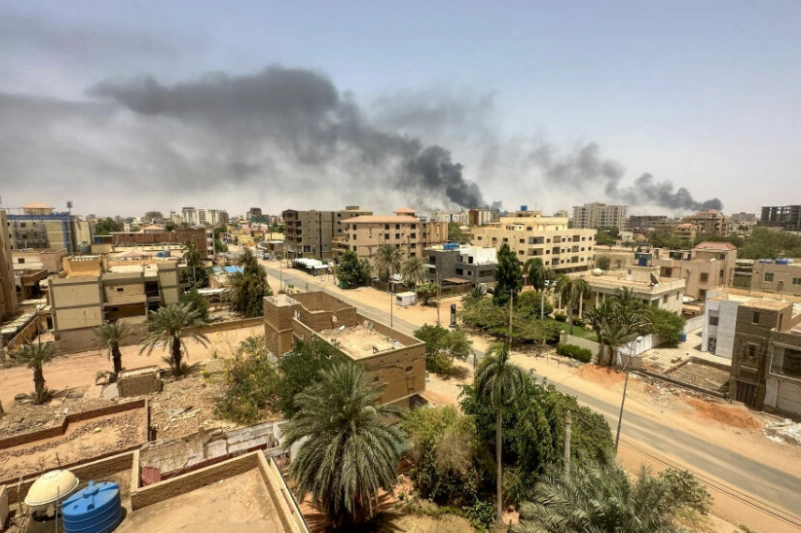

Khartoum, 6 May 2026 – A wave of drones tore into Khartoum International Airport on the night of 4 and 5 May 2026, ripping apart what had been presented as a tentative return to normality in Sudan’s besieged capital and igniting the most dangerous diplomatic crisis the Nile Basin has seen in years.
The drone attack on Khartoum airport did not happen in isolation. Within hours, Sudanese authorities were pointing fingers not at the Rapid Support Forces alone, but at a neighbouring government, Ethiopia and, by extension, at Abu Dhabi.
One Week After the First Flight in Three Years
The timing was loaded with symbolism.
Just seven days before the strikes, Khartoum International had received its first international flight since 2023, a milestone the Sudanese Armed Forces had trumpeted as proof that the army’s partial recapture of the capital in early 2025 was translating into real stability.
That narrative was shattered in a single night.
Sudan’s Foreign Ministry confirmed the drone attack on Khartoum airport also struck the Signal Corps base in Khartoum North and the Al-Markhiyat training camp in Omdurman, suggesting a coordinated campaign against military and logistics infrastructure rather than a random strike according to Reuters.
Khartoum Names Ethiopia. Recalls Its Ambassador.
Sudan’s response was immediate and pointed.
Foreign Minister Mohieddin Salem told reporters that Khartoum holds “definitive evidence” the drones were launched from Bahir Dar airport in Ethiopia, making this far more than an internal chapter of the country’s civil war.
The government recalled its ambassador to Ethiopia, a diplomatic step that signals a rupture well beyond routine protest.
At the centre of Sudan’s evidence is a downed drone carrying the serial number S88, which military spokespeople say belongs to the United Arab Emirates. Sudanese officials say the aircraft was tracked entering Sudanese airspace from Ethiopian territory, placing both Addis Ababa and Abu Dhabi in the frame simultaneously.
Reports also indicate that Ethiopia has upgraded its Asosa airport and that the facility has been used to host training camps for the RSF, effectively providing what analysts describe as a rear logistics base for aerial operations against the Sudanese army.
Ethiopia Hits Back. The UAE Stays Silent.
Addis Ababa rejected the allegations as “baseless.”
Ethiopian officials countered that it is Khartoum that is in violation of sovereignty, accusing Sudan of sheltering Tigrayan rebel fighters and interfering in Ethiopian internal affairs. The tit-for-tat framing has transformed what began as a military incident into a two-front diplomatic confrontation.
The UAE, which has consistently denied arming the RSF throughout the war, has not addressed the specific S88 serial number claim. The identification of that drone, if independently verified, would place Abu Dhabi’s fingerprints directly on the drone attack on Khartoum airport in a way that previous denials have not had to contend with.
Egypt Draws Its Own Red Line
Cairo was watching.
Egyptian officials condemned the strikes in terms described by regional analysts as unusually sharp, warning that the conflict risked spreading across the region. Egypt’s position as a long-standing strategic partner of Sudan’s army means its condemnation carries a weight that goes beyond diplomatic formality.
For Cairo, the prospect of a Sudan destabilised by Ethiopian-backed forces is not a distant concern. Egypt and Ethiopia are already locked in a prolonged and unresolved dispute over the Grand Ethiopian Renaissance Dam on the Blue Nile, a project Cairo regards as an existential threat to its water security.
Egyptian officials said the strikes on Khartoum undermined the United States-led International Quad process aimed at brokering a ceasefire, and that any perception of Ethiopia and the UAE as active combatants would hollow out the idea of a Sudanese-led political settlement entirely.
Why the Drone Attack on Khartoum Airport Matters
Khartoum International is not simply an airport.
It functions as both a civilian transport hub and a military logistics node. Its reopening had become the single most visible symbol of the government’s claim to restored state authority over the capital.
Destroying that symbol sends a precise message: there is no safe return to normal. Airports in modern conflicts operate as psychological and economic pressure points as much as physical ones, and the drone attack on Khartoum airport was calibrated to land on all three levels.
From Civil War to Regional Crisis
Military analysts note that the shift from ground combat to long-range, cross-border drone strikes represents a qualitative change in the war’s character.
What was for two years described as a brutal but contained internal conflict now carries the open accusation of state-level involvement. Sudan is publicly naming a neighbouring government as a combat enabler. Egypt is publicly warning of regional spillover.
That combination, diplomats and analysts note, is the precise sequence through which local wars become regional ones.
The border areas between Sudan and Ethiopia are already described by security sources as increasingly militarised. If Khartoum’s allegations about Bahir Dar airport are borne out by independent investigation, the legal and diplomatic pressure on Addis Ababa would intensify considerably, and Cairo’s calculus about how directly to support the Sudanese army could shift.
The drone attack on Khartoum airport may yet be remembered as the moment this war crossed a threshold it cannot walk back from.
AfricanQuarters will continue to follow developments in Sudan and the wider regional response.


