



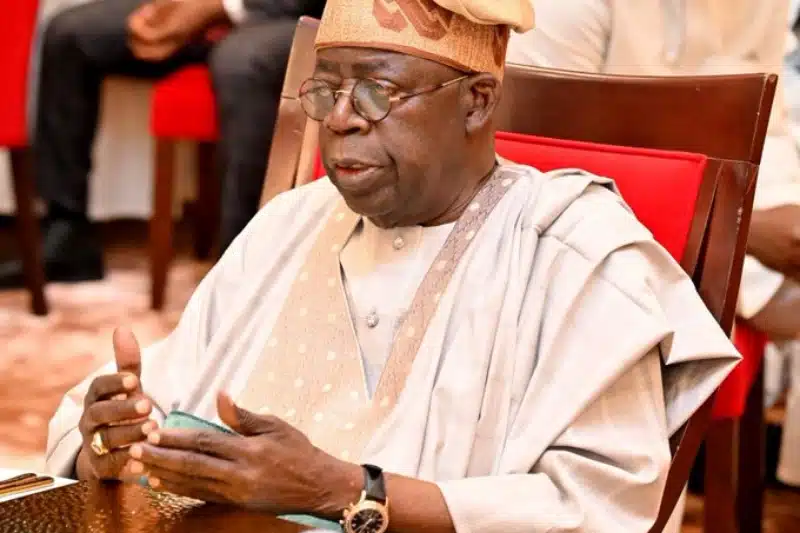

President Tinubu has asked the Senate to approve fresh borrowing from Deutsche Bank to build sections of a 1,000-kilometre highway. The timing could not be more fraught.
AfricanQuarters.co | 23 April 2026
A letter arrived on the floor of Nigeria’s Senate on Thursday, and its contents set off a conversation that will outlast any debate on the chamber floor.
President Bola Tinubu has asked the Senate to approve external borrowing of $516,333,070 for the Sokoto-Badagry Superhighway loan to fund sections of the proposed Sokoto-Badagry Superhighway, a flagship project under his administration’s infrastructure drive.
The Sokoto-Badagry Superhighway loan, if approved, will come from Deutsche Bank, structured as a syndicated facility.
It sounds like progress. It sounds like progress. In many ways, it is. But the numbers sitting alongside the Sokoto-Badagry Superhighway loan tell a harder story.
What the Highway Promises
The 1,000-kilometre highway would run from Illela in Sokoto State through Kebbi, Niger, Kwara, Oyo and Ogun states, terminating in Badagry, Lagos State. Upon completion, Tinubu said travel time from Sokoto to Lagos would drop by more than 70 per cent, cutting a 13-hour journey to approximately six hours.
The highway is designed to open up Nigeria’s northwest-southwest economic corridor, linking production zones to markets and ports. It is also expected to enhance north-south connectivity, reduce logistics costs and travel time, facilitate trade, strengthen food security, and promote national integration.
Senator Mohammed Adamu Aliero of Kebbi Central gave the project some historical weight when he told his colleagues that the project had been in the making for 55 years, adding that he had inspected it and was “highly impressed” by the progress made.
Senate President Godswill Akpabio went further, describing the project as a major economic game changer capable of saving lives and boosting national productivity, and arguing that borrowing for critical infrastructure is justified where investments yield long-term economic benefits.
The Senate President later referred the request to the Senate Committee on Local and Foreign Debts, directing it to report back within one week.
What This Sokoto-Badagry Superhighway Loan Actually Covers
Here is where the scale of the ambition meets the limit of the money.
The Sokoto-Badagry Superhighway is expected to cover about 1,000 kilometres in total, while the current phase spans approximately 120 kilometres. That is roughly 12 per cent of the road.
The financing structure includes a syndicated loan backed by a partial risk guarantee from the Islamic Corporation for the Insurance of Investment and Export Credit, the insurance arm of the Islamic Development Bank, while the Federal Government would provide counterpart funding of ₦265.5 billion for land acquisition, compensation and related infrastructure.
That counterpart funding is real money leaving real budget lines, at a moment when Nigeria’s fiscal space is shrinking fast.
The Debt Burden Already in the Room
Before the Sokoto-Badagry Superhighway loan is even approved, Nigeria is already carrying a heavy debt load.
Nigeria’s total debt servicing rose by ₦2.98 trillion year-on-year to ₦15.81 trillion in 2025, driven largely by a sharp increase in domestic interest payments and sustained external obligations, according to data from the Debt Management Office.
On the external side, Nigeria spent $5.21 billion on external debt service in 2025, accounting for over 72 per cent of the country’s total international payments, according to data from the Central Bank of Nigeria.
The scale of the Sokoto-Badagry Superhighway loan becomes clearer when placed against these existing obligations.
Fitch Ratings, the credit rating agency, has been candid about what this means. Fitch warned that high-interest costs, weak revenue performance, and limited fiscal space remain significant concerns, projecting that the federal government interest-to-revenue ratio would remain at nearly 50 per cent.
In plain terms, close to half of every naira the federal government earns is already spoken for before a single road is built or a teacher is paid.
Why the Loan Terms Matter
The Sokoto-Badagry Superhighway loan carries terms that reflect the current global borrowing environment.
The interest rate is benchmarked to SOFR, the Secured Overnight Financing Rate, plus 5.3 per cent. The loan runs for nine years, with a three-year grace period before principal repayments begin.
That grace period may sound generous. But interest payments alone already represent about 95.7 per cent of Nigeria’s total domestic debt service, compared to about 95.4 per cent in 2024, indicating that the burden remains heavily skewed towards servicing interest rather than repaying principal.
Adding a new commercial facility at a floating benchmark rate introduces another variable to an already volatile repayment environment. If global interest rates rise, so does the cost of this loan.
The Phasing Dilemma
There is also a structural problem in how this project is being financed.
The 120 kilometres covered by this Sokoto-Badagry Superhighway loan is only the first phase of a much longer road. The Minister of Works, David Umahi, confirmed that work on 120 kilometres in Sokoto and 256 kilometres in Kebbi is already ongoing, with the government funding 30 per cent of costs and 70 per cent coming from loans.
That ratio means more borrowing rounds will follow. Each one will come at the interest rate conditions of its time.
Debt obligations begin the moment contracts are signed. Economic returns from a highway take years, sometimes decades, to materialise through trade volumes, reduced transport costs and tax revenues. The gap between those two timelines is where fiscal pressure accumulates.
What Everyday Nigerians Feel
The connection between the Sokoto-Badagry Superhighway loan and the price of tomatoes at any local market is not always obvious. But it is real.
The Programme Manager of the Sustainable Nigeria Programme at Heinrich Böll Stiftung, Ikenna Ofoegbu, warned that revenue is being swallowed by debt payments, noting that debt servicing had consumed between 60 and 90 per cent of government revenue in recent years, though it has since moderated.
When that share of revenue is locked into debt repayment, governments have less room to respond to inflation shocks, fund subsidy buffers or adjust wages. The consequence is not abstract.
As of March 2025, Nigeria’s public debt totalled approximately $97.32 billion, equivalent to ₦149.3 trillion, according to the Debt Management Office. The Sokoto-Badagry Superhighway loan would add to that total, in foreign currency, repayable in dollars.
Any further weakening of the naira increases the naira cost of every dollar repaid.
A Road Nigeria Has Waited 55 Years For
None of this is an argument against building the highway. Senator Aliero’s point that Nigerians have waited 55 years for this road carries moral weight that spreadsheets cannot easily dismiss.
When the Federal Government flagged off construction, Minister Umahi stated that the first phase of the project would be completed in 2027, and that the highway’s central median would be reserved for future rail integration and utility corridors.
That vision, a high-capacity road corridor doubling as a future rail spine, reflects serious long-term planning. The economic case for connecting agricultural zones in the north-west to the port city of Lagos is not in question.
The question is timing, terms, and what gets crowded out in the meantime.
Where This Leaves Nigeria
The Sokoto-Badagry Superhighway loan sits at the centre of a genuine dilemma.
Delay risks higher project costs later, as construction prices and interest rates rarely move in a borrower’s favour over time. Proceeding now adds to debt obligations that are already consuming nearly half of federal revenue.
President Tinubu described the superhighway project as a flagship initiative under his Renewed Hope Agenda, designed to enhance national connectivity, reduce travel time, and improve the movement of goods across key economic corridors.
That vision is coherent. Whether Nigeria’s current fiscal position can absorb another nine years of commercial debt repayment, while completing the remaining 880 kilometres still to be financed, is the harder conversation the Senate committee will need to have before it reports back next week.
Ultimately, the long-term impact of the Sokoto-Badagry Superhighway loan will depend on how these trade-offs are managed.
The Senate Committee on Local and Foreign Debts is expected to submit its report within seven days.


