



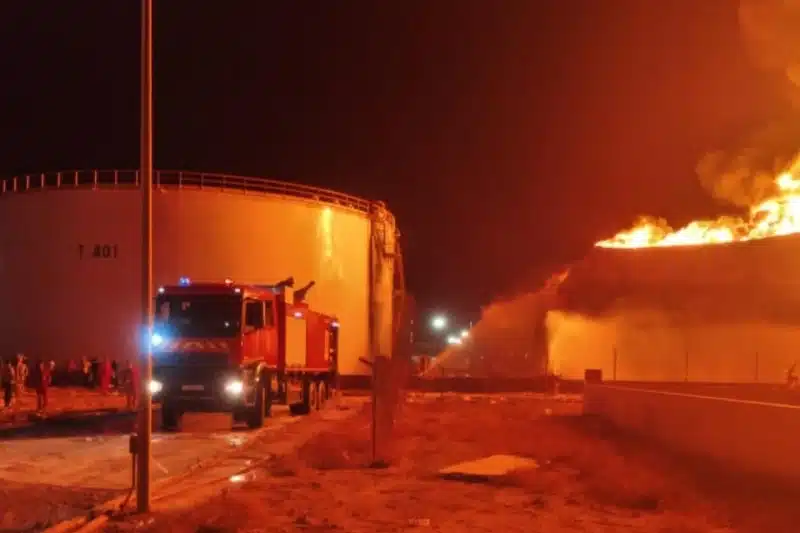

Firefighters in western Libya were still working on Tuesday to put out the last of a blaze caused by a drone strike on the Zawiya oil refinery a day earlier. The Zawiya refinery drone strike destroyed a fuel storage tank holding roughly 4.5 million litres of petrol, according to Libya’s National Oil Corporation (NOC).
The NOC said in a statement that the fire started at tank 402-T, which belongs to Brega Oil Company, after a drone hit it directly on Monday evening. The blaze spread fast, and the tank eventually gave way under the heat and collapsed.
Libya’s Ambulance and Emergency Service said there were no serious injuries from the fire, though a few people were treated for smoke inhalation, the agency said in its Tuesday update.
Monday’s attack was not a one-off. The Zawiya refinery drone strike came a day after a drone hit a desalination plant on the same site, and two days after another drone struck a naphtha tank on Saturday, the NOC said. That works out to three separate drone attacks on the facility within 48 hours.
While crews were still dealing with the gasoline tank fire, a further drone came down near an oil blending and filling plant run by the Zawiya Oil Refining Company, though the NOC said this one caused no casualties or damage.
Zawiya is Libya’s largest working refinery, with a processing capacity of about 120,000 barrels of oil a day, and it sits close to the coast, around 40km west of Tripoli. The NOC has now warned that if the Zawiya refinery drone strikes continue, it may have no choice but to declare force majeure and suspend operations completely. Brega Oil Company, for its part, called on all sides in Libya’s conflict to stay away from oil sites, describing them as shared national infrastructure that all Libyans have a stake in protecting.
No group has come forward to say it carried out the Zawiya refinery drone strike, or the attacks that came before it, and that silence has left officials in Tripoli and analysts alike guessing at who is behind the campaign.
Libya has been split between rival administrations since 2014, three years after a NATO-backed uprising ended Muammar Gaddafi’s rule. On one side is the UN-recognised government in Tripoli, led by Prime Minister Abdul Hamid Dbeibah. On the other is an eastern administration aligned with military commander Khalifa Haftar.
Dbeibah met senior officials in Tripoli on Tuesday, including the interior minister and commanders of several armed groups, to go over the latest security developments after the strike, and he called for firm measures against anyone found to be threatening critical facilities.
Libya’s parliamentary energy and natural resources committee also weighed in, condemning the attack and describing the refinery as one of the country’s most important economic assets, while calling for tighter protection of oil sites going forward.
This is not the first time Zawiya has come under fire this year, and the latest incident adds to growing concern about the safety of Libya’s oil infrastructure. The country relies heavily on oil exports for state revenue, and repeated attacks near production sites raise the risk of longer disruptions to output.
For now, crews at the site are focused on clearing what remains of the fire and assessing the damage to tank 402-T. Who was behind the Zawiya refinery drone strike, and why, remains unclear.


