



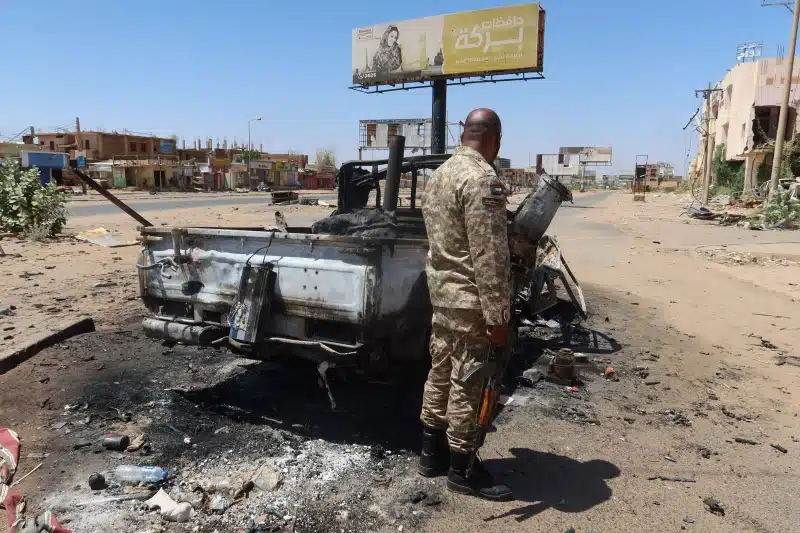

Fighting along the Sudan-Ethiopia border escalated on Tuesday. Paramilitary forces struck a town in Sudan’s Blue Nile state. An army source described it as the latest assault launched from inside Ethiopian territory.
Local authorities in Geissan, also known as Qaisan, said the attack came from the Rapid Support Forces (RSF) and an allied faction of the Sudan People’s Liberation Movement-North. They hit the town and surrounding farmland on Tuesday morning, catching many residents mid-harvest.
Arab News, citing AFP, reported that a military source said Sudanese troops along the Sudan-Ethiopia border were “confronting them” and had inflicted losses on the attacking force. That claim has not been independently verified, and the RSF had not responded by the time of publication.
The Qaisan governorate went further. It called the assault “a full-fledged war crime” that targeted farmers’ livelihoods during the harvest season, according to Anadolu Agency. No casualty figures were confirmed at the time of writing.
This is not an isolated event along the Sudan-Ethiopia border. A near-identical attack on the areas of Deim Saad and Yara, both in Qaisan governorate, was repelled by the Sudanese army on 10 July. That suggests a pattern rather than a one-off skirmish.
Sudan’s army-aligned government has for months accused Ethiopia of allowing the RSF to stage operations from its side of the Sudan-Ethiopia border, a charge Addis Ababa firmly denies. In May, Khartoum went further still. It accused Ethiopia of facilitating drone strikes launched from Ethiopian territory against several Sudanese states, including attacks on Khartoum itself and its airport.
The RSF and the SPLM-N faction led by Abdelaziz al-Hilu jointly control much of southern Blue Nile. That territory borders both Ethiopia and South Sudan, which is precisely what makes the Sudan-Ethiopia border such a volatile flashpoint. Whoever holds that ground controls movement, supply routes and, increasingly, the narrative around who is arming whom.
There is a second front making Tuesday’s attack harder to isolate. Fighting broke out in Ethiopia’s own Tigray region on 1 and 2 August, concentrated around Shererina in the west. Al Jazeera described it as the most serious escalation since the 2022 Pretoria peace agreement ended the Tigray war. The clashes reportedly involved heavy artillery and drone strikes between the Ethiopian National Defence Force and fighters linked to the Tigray People’s Liberation Front.
Within days, hundreds of Ethiopian civilians had crossed the Sudan-Ethiopia border near the town of Hamdayet. That group included wounded TPLF fighters, according to Sudanese security and medical sources cited by The New Arab. Some of the wounded were treated at a health centre before being moved to al-Hashaba, a settlement roughly 15 kilometres inside Sudan. The settlement already hosts thousands displaced by the earlier 2020-2022 Tigray war.
Ethiopia’s government and the TPLF have traded blame for the renewed violence. Ethiopian minister Abraham Belay accused the TPLF leadership of triggering the clashes, while urging dialogue over further confrontation. The TPLF, in turn, accused Addis Ababa of intensifying what it called a large-scale infantry offensive.
Reporting from Ad-Damazin, the capital of Sudan’s Blue Nile state, Al Jazeera correspondent Osama Sayed Ahmad said the security tensions along the Sudan-Ethiopia border cannot be separated from the fighting inside Tigray. Both, he noted, are unfolding within kilometres of each other, along the same porous frontier.
That overlap along the Sudan-Ethiopia border worries regional observers most. Analysts quoted by Agenzia Fides have warned the situation could evolve into a proxy dynamic. Rival Sudanese factions could be drawn into backing opposing sides of Ethiopia’s internal conflict, further destabilising a Horn of Africa region with little capacity left to absorb another war.
Sudan is already almost three and a half years into a conflict that erupted in April 2023. Any spillover from Tigray adds pressure to a country already hosting the world’s largest displacement crisis, with tens of thousands killed and around 11 million people forced from their homes.
Blue Nile state was once a comparatively quiet corner of that war. It has increasingly become one of its most active fronts, fought less with front-line infantry than with drone strikes and rapid cross-border raids.
Ethiopia’s federal government has not formally responded to Tuesday’s Geissan attack, nor to renewed accusations that RSF elements are operating from its territory. The African Union and neighbouring states have yet to issue a joint statement on either the Blue Nile clashes or the Tigray flare-up. Civilians on both sides of the Sudan-Ethiopia border continue to pay the immediate cost.


