



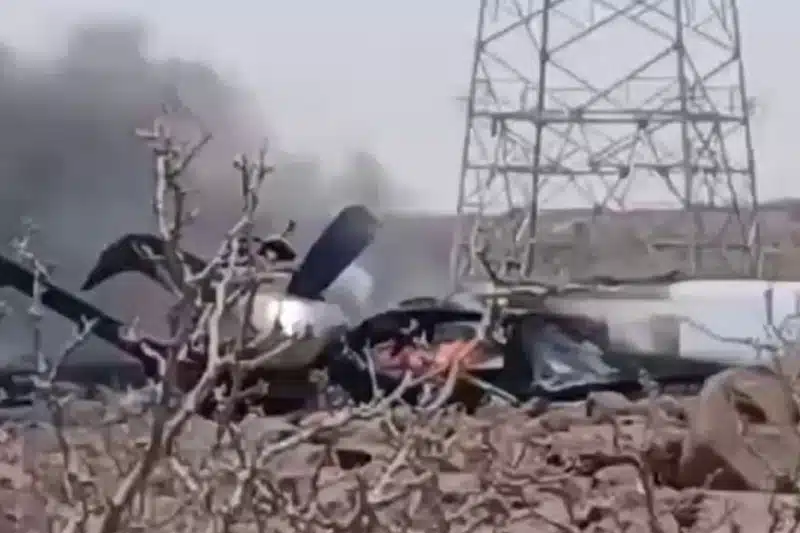

A United States military drone has crashed close to Chabelley Airfield in Djibouti. The Djibouti drone crash triggered a security alert from the US Embassy and renewed scrutiny of American operations in the Horn of Africa.
The Djibouti drone crash happened on Sunday, 9 August 2026, shortly after the aircraft took off from Chabelley Airfield. The airfield sits a short distance from Camp Lemonnier, the only permanent US military base on the African continent.
According to the US Embassy in Djibouti, officials were tracking an aircraft in distress in Djiboutian airspace before news of the incident spread. The embassy urged residents to stay away from the area surrounding Chabelley airbase until further notice.
Open-source reports and regional outlets, including Garowe Online, later identified the aircraft as a US Air Force MQ-9A Reaper. The wreckage came down near Chabelley Cemetery, close to the airfield’s perimeter fence.
No injuries or damage to property on the ground have been reported so far in connection with the Djibouti drone crash. Djiboutian and American authorities are said to be working together to secure the site and establish what went wrong.
A US military official confirmed to Defense News that the downed aircraft was an MQ-9 and stated it had not been shot down. The comment pushed back against speculation that spread quickly across Arab-language media after word of the crash broke.
That speculation centred on the Houthi movement in Yemen, which sits directly across the Bab el-Mandeb Strait from Djibouti. Houthi forces have downed dozens of American MQ-9 Reapers since 2017. Some estimates place the toll at around 28 aircraft lost over Yemeni territory and the wider Red Sea corridor. Analysts following the Djibouti drone crash say the group’s track record explains why the theory spread so fast, even without evidence.
The group’s drone and missile campaign has expanded well beyond Yemen in recent months. In July 2026, a strike attributed by some reports to Houthi forces damaged a liquefied natural gas terminal at Egypt’s Damietta port. It was a sign that the conflict has begun to touch infrastructure far from the group’s home territory.
Chabelley Airfield has served as the US Air Force’s largest remotely piloted aircraft hub in Africa. Drone operations were moved there from Camp Lemonnier in 2013. That relocation followed concerns raised by Djiboutian officials about flying unmanned aircraft so close to a civilian airport. The base now supports MQ-9 missions across the Horn of Africa and the Red Sea region. That is why any Djibouti drone crash draws immediate attention from regional security watchers.
Camp Lemonnier itself remains central to US counter-terrorism operations in East Africa. It hosts the Combined Joint Task Force-Horn of Africa. From there, surveillance flights monitor al-Shabaab activity in Somalia, instability in Sudan, and shipping threats along one of the world’s busiest maritime routes.
Media inquiries on the crash have been directed to United States Africa Command, which has not yet released a detailed statement on the cause. Investigators from both countries are expected to examine the wreckage and flight data before drawing firm conclusions.
This is not the first Djibouti drone crash linked to the base. The US relocated its entire drone fleet away from Camp Lemonnier in 2013 after a string of mishaps alarmed Djiboutian civil aviation authorities. The concern then, as now, centred on the airfield’s closeness to Djibouti-Ambouli International Airport.
For now, officials on both sides say the priority is securing the debris field and confirming there is no risk to nearby communities. Further details are expected as United States Africa Command and Djiboutian authorities complete their initial assessment of the crash.


