



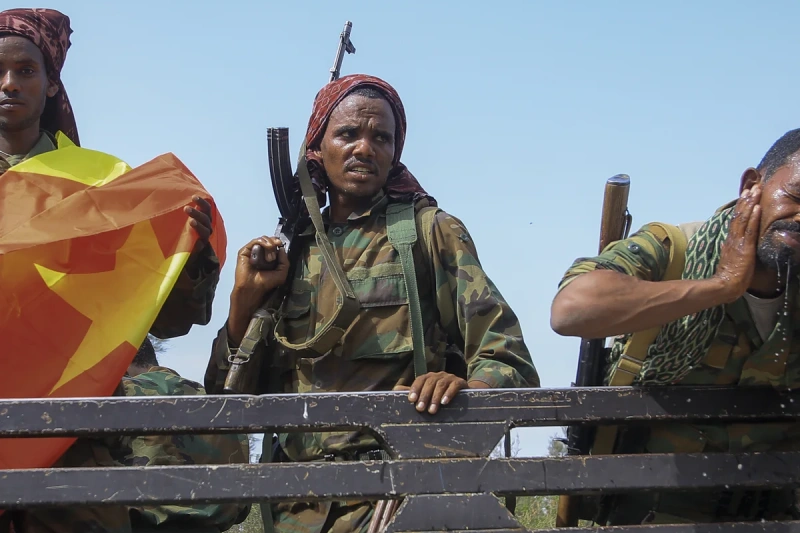

Analysts say the fragile peace deal that ended Ethiopia’s brutal two-year civil war is now under severe strain, and the latest clashes are the most serious test yet of whether the Tigray conflict can still be contained.
Fighting broke out early on Saturday, 1 August, near Shererina in western Tigray, close to the border with Sudan, according to a report by the Ethiopia Observer, which cited local and security sources.
The report said armed clashes involving heavy artillery and drone strikes began around 6am and lasted for several hours before easing by around 5pm the same day.
The Tigray People’s Liberation Front, known as the TPLF, accused the Ethiopian federal government of launching what it called an “open war” against the region, according to a statement carried by Addis Standard.
The TPLF-led regional administration said the assault followed months of blockades, sieges, drone strikes and what it described as attacks by proxy forces.
It called on Tigrayan youth, security forces, civil society groups and religious institutions to mobilise for what it termed the region’s “national survival.”
According to a situation report by the European External Programme with Africa, the clashes involved a TPLF militia unit called Army 70, which is based across the border in Sudan, fighting Ethiopian federal troops backed by mechanised units and drones.
Two Ethiopian government officials disputed the TPLF’s version of events, the report said, accusing Tigrayan forces of starting the confrontation by attacking positions held by the Ethiopian National Defence Force.
The federal government had not issued an official public response to the TPLF’s allegations as of the latest reports, according to Voice of Emirates.
This latest flare-up adds to a deepening Tigray conflict that has simmered since the 2022 Pretoria Agreement formally ended two years of war between Addis Ababa and Tigrayan forces.
That agreement, signed in Pretoria, South Africa in November 2022, was meant to end one of the deadliest conflicts in Africa’s recent history and open a path to lasting peace in the north.
But the settlement has never fully held. Human Rights Watch reported in its 2026 World Report that Tigrayans continued to face forced displacement from western Tigray despite the ceasefire, while Eritrean troops still occupying parts of the region were accused of sexual violence against women. The rights group’s findings suggest the Tigray conflict never truly ended for many civilians, even after the guns fell silent in 2022.
Tensions inside Tigray itself have also complicated the picture. The region is currently split between two rival administrations, a dynamic that has weakened its ability to speak with one voice to Addis Ababa.
An interim administration led by Tadesse Worede holds official recognition from Ethiopia’s National Electoral Board, while the TPLF-led regional government issuing Saturday’s mobilisation call lacks that recognition, according to Borkena.
Analysts at the Rift Valley Institute’s Peace Research Facility have warned that the Pretoria deal’s political provisions were always thin, noting that the African Union’s monitoring mechanism covered security arrangements but had no strong guarantor for the underlying political settlement. Their research suggests the roots of the Tigray conflict run far deeper than any single week of fighting.
Prime Minister Abiy Ahmed had already signalled rising friction weeks before the latest clashes. On 7 July, he accused unnamed regional actors of conspiring against Ethiopia, while Tigrayan officials separately declared that the Pretoria Agreement had effectively collapsed, according to Voice of Emirates.
A risk assessment published by SafeExpat in March described Ethiopia as entering a renewed high risk phase, citing unresolved territorial, institutional and external fault lines that could trigger a fresh Tigray conflict or spread instability into neighbouring regions.
The assessment flagged growing friction between Addis Ababa and Eritrea as a further complication, warning that public accusations between the two governments could increase the risk of troop movements being misread.
For millions of civilians already displaced by earlier fighting, the fresh clashes have revived old fears that the Tigray conflict is entering a new and unpredictable phase.
For now, the guns around Shererina have fallen silent, but residents and observers describe the calm as fragile.
Local sources told the Ethiopia Observer that no clear casualty figures had emerged from Saturday’s fighting.
With mobilisation calls issued inside Tigray and blame still being traded over who fired first, the risk of a wider Tigray conflict remains firmly on the table for the Horn of Africa’s most fragile peace.


