



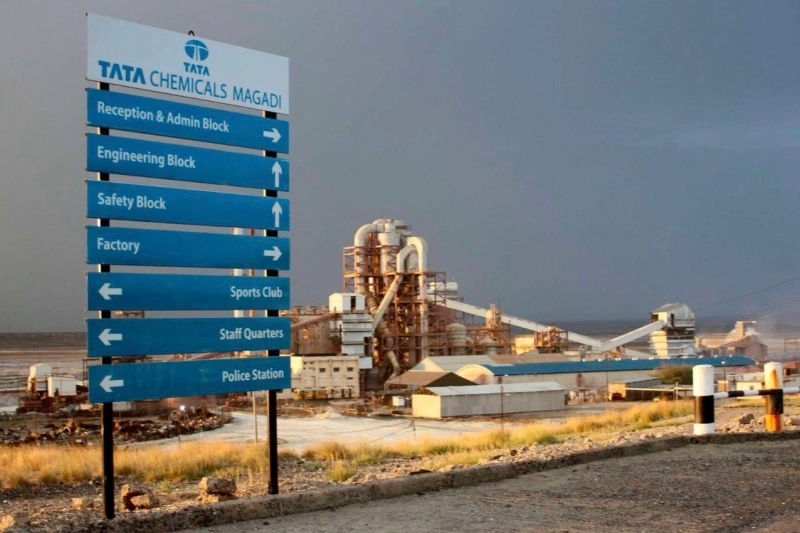

NAIROBI, Kenya. President William Ruto has ordered Tata Chemicals Magadi to leave Lake Magadi. The directive sharpens a mining dispute that has run for more than a month.
Ruto issued the order on Thursday during a development tour of Oloiren in Kajiado County. He accused Tata Chemicals Magadi of failing to build factories or create enough jobs for local residents. The firm has mined soda ash at the lake for close to a century.
“They have not constructed anything in Kajiado, including even employing people here,” Ruto said. “I recently told them to vacate and get out of this country. Let them go. They have been taking our resources to India.”
Tata Chemicals Magadi has processed trona from Lake Magadi into soda ash since 1911. That was when the Magadi Soda Company began operations under a colonial-era lease. Ownership later passed to Britain’s Brunner Mond. India’s Tata Chemicals bought the business in 2005. Today, the firm is Africa’s largest soda ash producer. It ships more than 350,000 tonnes a year to markets in Southeast Asia, India and the Middle East.
Ruto’s order follows action the government had already taken. The Ministry of Mining, Blue Economy and Maritime Affairs suspended Tata Chemicals Magadi’s mining licence on 28 July. Cabinet Secretary Hassan Joho cited unresolved obligations under the Mining Act. These included outstanding royalty reconciliation and payment issues, weak local value addition and gaps in Community Development Agreements. The ministry also flagged insufficient employment and skills transfer for Kenyan workers.
Kenya’s High Court later declined to lift the suspension. The court ruled that the ministry’s decision had already taken effect before the firm moved to challenge it.
Tata Chemicals Magadi disputes the government’s account of events. In a statement issued on 17 August, it said it had submitted all the information and documentation the ministry had requested. It added that about 500 employees and their families depend directly on its operations. Roughly 30,000 people across the wider Magadi community rely on its water, health and education programmes.
Ruto said a new investor will take over the Lake Magadi concession once the firm departs, though on different terms. The incoming operator must build a glass manufacturing plant and a separate chemicals processing plant in Kajiado. It must do this before it can be granted a mining licence, rather than simply exporting raw soda ash as Tata Chemicals Magadi has done for decades.
“We will bring in a new company, and the condition for that company is that it must establish a major glass manufacturing plant here in Kajiado County, as well as another company to manufacture chemicals,” Ruto said.
No timetable or compensation framework has been made public. The government has not named the investor it intends to bring in. Kajiado Governor Joseph Lenku has backed the president’s position. The opposition Democracy for Citizens Party has demanded an immediate and unconditional reversal, arguing the closure order was timed to suit Ruto’s Kajiado tour.
The standoff fits a wider pattern across Africa. Governments are pressing foreign mining and mineral firms to process raw materials locally instead of exporting them unrefined. For Kajiado County, the coming months will decide something important. Will more than a century of soda ash extraction finally produce factories, jobs and revenue that stay inside Kenya?


