



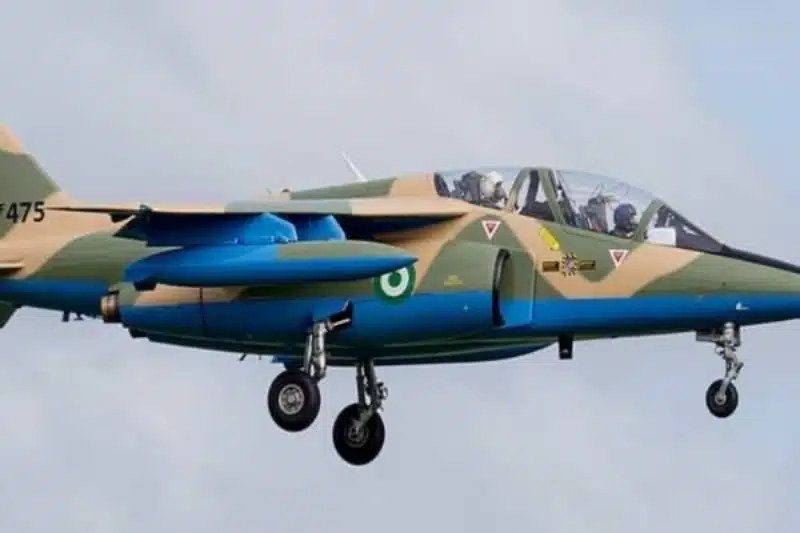

Fresh Lake Chad airstrikes have severely wounded a senior commander of the Islamic State West Africa Province. Four of the group’s fighters were killed in the same operation.
Nigeria’s Air Component of Operation Hadin Kai carried out the strikes near Arege on Wednesday, 5 August. Military sources describe the attack as part of a sustained air interdiction campaign around the Lake Chad Basin.
Field assessments from the Lake Chad airstrikes named the wounded commander as Ba Ari Hisbah. He is identified as head of ISWAP’s Police Wing operating around the Lake Chad islands.
Counter-insurgency expert Zagazola Makama, citing military sources, said Hisbah sustained severe injuries to both legs when the aircraft struck the location. He is understood to have survived but remains out of action.
One of those killed in the Lake Chad airstrikes was a long-serving fishing tax collector for ISWAP. The sources cited by Makama said the man formed part of the group’s revenue collection network.
That network has for years relied on illegal levies imposed on fishermen and farmers. The levies are collected across the Lake Chad islands and surrounding communities.
Makama’s sources said the strikes disrupted ISWAP’s movement and logistics in the area. Surviving fighters were forced to withdraw from the affected location.
Military officials said the Lake Chad airstrikes followed weeks of intelligence, surveillance and reconnaissance work. Analysts tracked the movement of terrorist elements before the strikes were authorised.
Nigeria’s military has increasingly targeted ISWAP’s finances rather than combat formations alone. The reasoning is simple. Cutting off income weakens the group’s ability to sustain fighters and replace weapons.
The Institute for Security Studies has documented how ISWAP taxes farmers and fishermen across the Lake Chad Basin. Fixed levies are charged per field harvested and per bag of fish caught. The proceeds fund the group’s expansion into new parts of northern Nigeria.
Research published by Good Governance Africa found ISWAP’s annual proceeds from the Lake Chad economy far exceed the tax revenue collected by Borno State itself. That gap explains why the loss of a tax collector carries weight beyond the immediate casualty count.
Military sources said Operation Hadin Kai would continue similar missions in coordination with ground troops. The stated aim is to deny ISWAP freedom of movement and disrupt its command and logistics structures.
Recent Lake Chad airstrikes have killed or wounded several other ISWAP figures across the Basin. These include commanders linked to the group’s Police Wing, its arms procurement network and its propaganda unit.
The Lake Chad islands have long served as a rear base for ISWAP. They provide the group with a staging ground for attacks and a source of income through taxation of local economic activity.
Analysts tracking the insurgency say the fight for the islands has increasingly resembled a contest over resources and trade routes. Whichever faction holds the islands also controls the taxes levied on fishermen, farmers and herders who depend on the lake for their livelihoods.
For communities along the shoreline, the latest Lake Chad airstrikes offer some relief from a group that has extracted levies from residents for years. Security analysts caution that battlefield losses alone rarely dismantle an insurgent economy built over a decade.
Sustained pressure on ISWAP’s finances, alongside continued military operations, is likely to shape how quickly the group’s grip on the islands weakens in the months ahead.


