



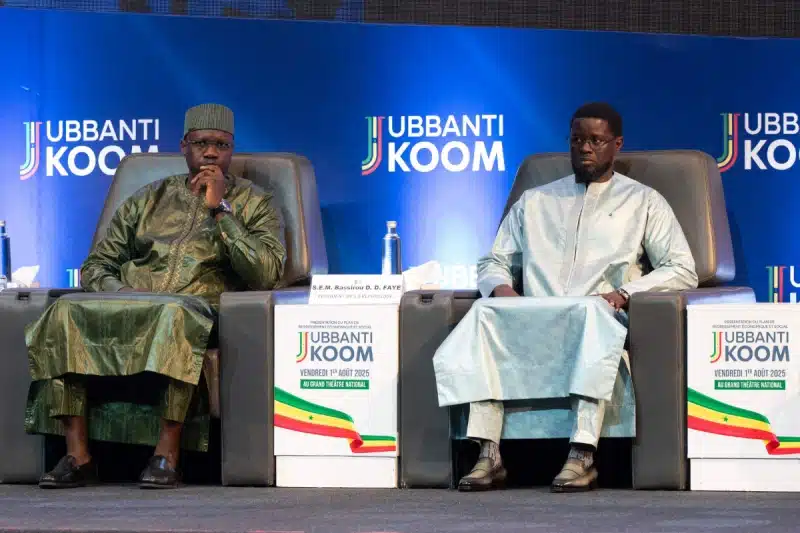

Senegal’s President Bassirou Diomaye Faye has sacked Prime Minister Ousmane Sonko in a dramatic late-night broadcast, unleashing the Faye sacks Sonko bombshell after months of tensions inside the ruling PASTEF movement. A move that deepens uncertainty for a country already in the grip of a severe debt crisis.
Faye sacks Sonko through a decree read on state television late Friday by Oumar Samba Ba, secretary-general of the presidency, who said the president had “ended the duties of Ousmane Sonko… and consequently those of the ministers and secretaries of state who are members of the government.” All ministers were dismissed, though the outgoing cabinet was tasked with handling day-to-day affairs until a new government is formed. No replacement prime minister was named.
The alliance that swept them to power
The decision carries particular weight because of how inseparable the two men once appeared.
Sonko, a charismatic politician with a strong following among Senegal’s youth, had backed Faye in the 2024 election after being barred from running himself due to a defamation conviction. Their PASTEF party won outright in the first round on a promise of sweeping political reform, vowing to fight corruption while inheriting an economy already mired in debt. Their campaign slogan was blunt: Diomaye is Sonko.
That unity is now broken.
A $13 billion debt crisis drove them apart
The roots of the split lie in a financial crisis the new government did not create but has found impossible to manage together. Analysts say at the moment Faye sacks Sonko saga could reshape Senegal’s IMF negotiations and economic recovery plans.
The International Monetary Fund suspended a $1.8 billion lending programme for Senegal after the discovery of previously misreported debt figures, which pushed the country’s estimated end-2024 debt burden to 132 per cent of gross domestic product. A government audit had found that the budget deficit under former President Macky Sall was potentially at least twice as high as previously reported, with billions of dollars in public debt accumulated without disclosure.
Sonko and Faye diverged sharply on how to respond. Sonko opposed any restructuring of the debt, estimated at $13 billion, which he said the IMF was advocating. Faye has been less vocal on the issue. Finance Minister Cheikh Diba told parliament on Friday, hours before the dismissal, that Senegal expects to resume IMF talks in the week of 8 June and hopes to reach agreement on key points by 30 June. Diba also warned the country’s fuel subsidy bill could exceed its 2026 budget allocation by as much as 1.15 trillion CFA francs ($2 billion) if oil prices rise to $115 per barrel, and confirmed that Sonko had rejected his request to raise fuel prices.
The rupture had been visible for months
The decision that Faye sacks Sonko did not arrive without warning. In March, Sonko said publicly that he was considering withdrawing his party from the government and returning to opposition if disagreements with Faye persisted.
Observers had noted Faye systematically removing figures closely connected to Sonko from senior positions, with some describing the approach as “de-Pastefising” the government. A notable step was the replacement of Sonko loyalist Aïda Mbodj, with Faye appointing former Prime Minister Aminata Touré to lead the ruling coalition instead.
Sonko responds with calm defiance
The now-former prime minister did not meet the news with anger, at least not publicly. Shortly after the announcement, Sonko posted on Facebook: “Alhamdulillah (praise be to God). Tonight I will sleep soundly in the Keur Gorgui neighbourhood,” referring to the Dakar district where he lives.
Supporters gathered outside his home in protest. Senior figures in the presidential camp also moved quickly to declare loyalty. Assane Mbengue, director general of national transport company Dakar Dem Dikk, posted unconditional support for Sonko on social media within minutes of the announcement.
What the split means for Senegal
The moment Faye sacks Sonko raises immediate questions about the ruling PASTEF party’s cohesion, the fate of IMF negotiations, and Senegal’s economic recovery. As recently as April, hundreds of workers and opposition supporters marched in Dakar to protest broken government promises and a worsening cost of living.
Senegal’s constitution grants the president sweeping authority over the government, allowing Faye to dismiss his prime minister by decree. But that legal power does not resolve the political consequences.
Sonko remains one of the country’s most popular politicians, particularly among young people. Whether he now takes PASTEF into outright opposition will determine how severe this rupture truly becomes. How Faye sacks Sonko may yet become one of the most consequential political ruptures Senegal has seen in years.


