



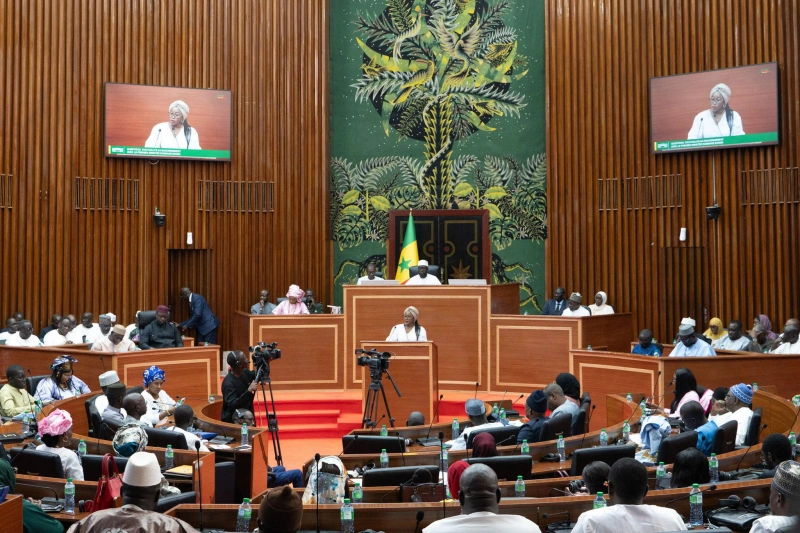

Senegal’s lawmakers have branded their own president’s decree an act of aggression. The same day, the president told his ministers to start spending.
Dakaractu reported that 128 MPs voted in favour of a resolution in the National Assembly on Wednesday, nine opposed it and two abstained, out of 139 participating members. The resolution demands the withdrawal of Decree No. 2026-2416, which put the revised finance law into force even though the same chamber had rejected it on 3 November.
The revised finance law is meant to patch a battered budget. Its fate now turns on a harder question: who holds the national purse?
Pastef group leader Mohamed Ayib Salim Daffé, quoted by Dakaractu, told colleagues the decree was “a usurpation of the budgetary competence of the legislative power”. Pastef holds 130 of the 165 seats, so the outcome was never in doubt. The real question is what the vote is worth.
The quarrel has a history. President Bassirou Diomaye Faye sacked Ousmane Sonko as prime minister on 22 May. Four days later, Sonko was elected Speaker of the Assembly. The two men who rose together in 2024 now sit on opposite sides of the budget.
The presidency says it filed the revised finance law on 18 September. Committees rejected it in October. On 3 November, the full chamber killed it with a procedural motion tabled by Pastef MP Amadou Ba, and the corrected count showed 126 votes against. Africa Briefing reported that on 18 November MPs also voted down the first part of the 2027 budget, by 128 votes to 18.
Faye signed the decree the next day. The presidency invokes Article 68 of the Constitution, which allows a finance bill to take effect by decree if it has not been definitively voted on within 60 days. Its argument is that the provision applies because the revised finance law had not been adopted when the deadline expired, despite parliament’s earlier rejection.
Pastef reads the same article the other way. Article 68, Daffé’s side says, covers delay, not defeat, so it cannot rescue the revised finance law after a no vote. Opposition MP Abdou Mbow dismissed the session as a farce and insisted a resolution cannot cancel a decree.
The text goes further than protest. It asks for all spending under the revised finance law to stop, and wants the 2026 settlement law to audit every revenue, expense and loan made on its basis. MP Cheikh Omar Bamba Diop warned public accountants and spending officers that they could face action later, with 2029 named as a possible deadline.
Outside the chamber, the pressure points the other way. Africa Briefing quoted Cheikh Diop, who leads the CNTS-FC union, calling the decree a “huge relief for the labour sector”. The government has warned that delay could threaten electricity supplies, payments to contractors and teachers’ salary arrears.
The numbers explain the urgency. The revised finance law cuts the 2026 growth forecast to 2.7 per cent from about 5 per cent. It lifts the expected deficit to 7.6 per cent of GDP, up from 5.4 per cent. Debt troubles worsened after officials uncovered billions of dollars in previously misreported borrowing under the previous administration.
Then there is the International Monetary Fund. Senegal reached a staff-level agreement in September on a programme worth about $2.2bn over three years. The IMF board has yet to approve it. On 12 November, spokeswoman Julie Kozack said progress depended on completing agreed steps on the budget framework, correcting the misreporting of public debt and securing financing assurances from Senegal’s partners. She declined to comment directly on the dispute between the president and parliament, saying implementation of the programme must follow Senegal’s own legal and institutional framework.
Faye was unmoved. At Wednesday’s Council of Ministers, Dakaractu said, he ordered the prime minister and the finance minister to act without delay. They must carry out the programmes in the revised finance law and honour Senegal’s international commitments.
A clock is also running. The two-year constitutional bar on dissolution is due to expire on 2 December. After that, Article 87 would allow Faye to dissolve the Assembly, following consultation with the prime minister and its president. No dissolution has been announced.
Whether a resolution can undo a decree is itself unsettled. For now, both readings of Article 68 stand, and the revised finance law is being executed while the chamber that rejected it demands a halt.
Senegal now has a budget that is law by decree and rejected by vote. Within days, it may learn which one counts for more.


