



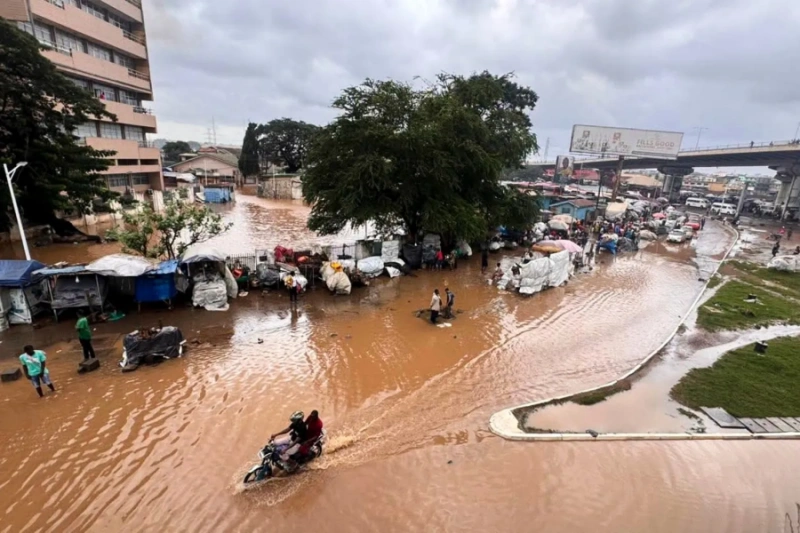

Flooding in West Africa has claimed dozens of lives since May, with Côte d’Ivoire, Ghana, Togo and Nigeria all reporting deaths as the rainy season reaches its peak.
At least 59 people have died in Côte d’Ivoire since the rainy season began in mid-May, while 13 have been killed in Ghana and five in Togo. Benin and Nigeria are also being watched closely as floodwaters continue to rise across the region.
Ivorian government spokesperson Amadou Coulibaly gave the update after a cabinet meeting in Abidjan. He said the highest toll was recorded in Attécoubé, where around 20 people died, and noted that some residents had returned to high-risk sites from which they had previously been relocated. Flooding in West Africa has also hit Cocody, Bingerville, Songon and Treichville, cutting off major roads and damaging homes across Abidjan.
Flooding In West Africa has displaced thousands and stretched emergency services thin in Ghana. Greater Accra Regional Fire Commander Rashid Kwame Nisawu said responders rescued more than 400 people in a single day.
In response, Ghana’s Ministry of Finance released GH¢350 million from the national Contingency Fund on 2 July to support humanitarian relief and urgent infrastructure repairs.
Nigeria has not escaped the flooding either. In Lagos, persistent rainfall forced the Transmission Company of Nigeria to declare force majeure at two transmission substations. TCN said the Oworonshoki substation was knocked out of service after floodwaters submerged two transformers, cutting power to communities served by Eko Electricity Distribution Company. The Lekki substation stayed operational, with engineers pumping out water around the clock to keep it running.
Beyond the power outages, flooding in West Africa is raising sharper concerns for Nigeria’s food supply. The Federal Government’s 2026 Annual Flood Outlook has placed 33 states and the Federal Capital Territory on high flood alert, warning that 266 local government areas and more than 14,000 communities face a high risk of flooding this year. Many of the states on that list, including Kogi, Benue, Adamawa and Bayelsa, sit along Nigeria’s most productive farming corridors.
That matters because past flood seasons show how directly rising water damages Nigeria’s harvests. The 2026 Humanitarian Needs and Response Plan found that flooding in 2024 alone displaced a million people and destroyed 1.3 million hectares of crops nationwide. Destroyed or inaccessible farmland tends to push up food prices and strip families of income just as recovery becomes harder.
The timing could hardly be worse. Northern Nigeria is already grappling with what the World Food Programme has called its worst hunger crisis in nearly a decade, with millions facing acute food insecurity during the current lean season. Flooding in West Africa, layered on top of that existing shortage, threatens to squeeze food supply further just as farming communities most need a stable harvest.
Nigerian authorities say they are trying to get ahead of the crisis this year rather than only reacting once floods hit. The National Economic Council approved N83.2 billion in June under an Anticipatory Action Task Force aimed at cushioning the impact of expected flooding and other climate-related emergencies. Whether that funding reaches at-risk farming communities before the rains peak in August and September will determine how much of this year’s harvest survives.
Officials across the region are urging residents in flood-prone areas to cooperate with evacuation orders as authorities continue assessing the damage. Flooding In West Africa continues to threaten vulnerable communities as meteorological agencies forecast further heavy rainfall in the weeks ahead. With weeks of rain still forecast, the risk of further flooding in West Africa remains high, and the pressure on Nigeria’s food security is likely to build before it eases.


