




The missing metal did not vanish. It left by motorbike, truck and cargo flight, and part of it moved through ground held by the Rapid Support Forces.
That is the RSF gold trade at its simplest. Gold goes out unrecorded, and the cash comes back as wages and weapons.
The arrangement is older than the war. The US Treasury says the RSF took the Jebel Amer mine in North Darfur in 2017. Gold has been a vital source of revenue for the Dagalo family ever since, and the RSF gold trade grew from there.
The RSF gold trade has become one of the most closely watched parts of Sudan’s war economy because it provides revenue outside the formal banking system and helps sustain military operations despite sanctions.
Washington named the vehicle in June 2023. Al Junaid Multi Activities is a holding company controlled by RSF commander Mohamed Hamdan Dagalo, known as Hemedti, and his brother Abdul Rahim. It runs 11 subsidiaries, including in gold mining. Britain listed it in July.
Then the war began, and the RSF gold trade found fresh loot. Reports said RSF forces seized the state gold refinery in Khartoum in April 2023, after which at least 1.5 tonnes of bullion was reported missing. The RSF denies involvement, and details of the raid remain disputed.
Today the RSF holds most of the goldfields in Darfur and Kordofan, while the army oversees the north and east. The RSF gold trade therefore spans the west of the country.
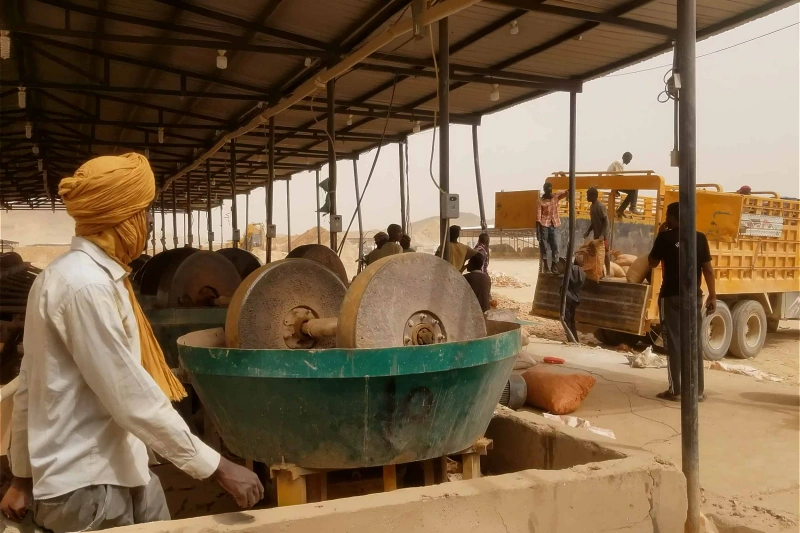
It does not work the way most people imagine. Researcher Joshua Craze of Noria Research says the RSF rarely digs. At Songo in South Darfur, around 100,000 local miners pay security fees, often to several different RSF actors. The force then buys much of the gold in what he calls ‘coercive capture’.
Craze also reports foreign hands in the RSF gold trade. A plant at Songo recovers gold from mining waste, he says, and is run by RSF and Russian personnel for Al Junaid. His sources are people who asked not to be named.
The pits do a second job. The young men with few options who dig gold are also the ones the RSF recruits, Craze argues. In his reading, the RSF gold trade doubles as a system of labour control.
Gold also works as money. When the army-led government issued new banknotes in late 2024, RSF officers and traders bought gold, and the price at Songo jumped, according to Craze.
Then the metal has to leave. Swissaid, the Swiss group that tracks African gold flows, says RSF-linked gold exits through Chad, Libya, the Central African Republic, South Sudan and Uganda. Gold from army-held areas goes through Egypt.
In Juba, a trader told Sudan Tribune how the paperwork changes. Raw ingots arrive from Darfur and South Kordofan, are resmelted and recast, and receive documents saying they came from South Sudanese mines. Then they fly to the UAE.
The trader claimed two flights carried about 115 kilograms in March. Sudan Tribune could not verify that.
The destination of the RSF gold trade is rarely in doubt. Trade data cited by Swissaid shows the UAE imported 29 tonnes directly from Sudan in 2024, up from 17 tonnes the year before. Another 18 tonnes came from Chad, 27 from Egypt and nine from Libya.
‘It is conflict gold,’ said Marc Ummel, Swissaid’s head of commodities.
The Sentry, a US investigative group, mapped how the RSF gold trade becomes hard currency in Dubai. Its October 2025 report found more than a dozen RSF-linked firms in the UAE, including gold trading companies. Its alert was blunt: ‘The RSF cannot wage war without money.’
The UAE rejects the charge that it backs the RSF. A UN fact-finding mission reported on foreign support to the war in early September. The UAE’s mission to the UN replied that it is ‘not involved in the civil war in Sudan’.
Pressure on the RSF gold trade is rising regardless. On 13 July the EU banned buying, importing or transferring gold from Sudan, and exporting mercury and cyanide to the country. The Council said: ‘Gold has become a key source of revenue sustaining the conflict in Sudan.’
Three days later Britain sanctioned 11 individuals and entities linked to both sides of the war. They included Abu Dharr Abdul Nabi Habiballa Ahmmed, described as an RSF financier, and front companies in Dubai.
Foreign Secretary Yvette Cooper said Sudan was paying for a war ‘fuelled not only by guns and fighters, but by illicit flows of gold’.
Switzerland followed on 10 September, with a ban that also covers Sudanese gold shipped through third countries. Yet Swissaid notes that Switzerland imported 420 tonnes of gold from the UAE in 2025, almost three times the year before. It warns that Sudanese metal can still arrive through Dubai, the hub the RSF gold trade has long depended on.
The army-backed government is tightening its own grip. Its central bank became the sole legal buyer and exporter in September 2025. On 28 September, the minerals minister said new legislation would criminalise holding gold without papers, Sudan Tribune reported.
None of those rules reach the RSF side. Its allied Tasis administration declared a parallel government in Nyala in July 2025. In May it named a former central bank governor, Hussein Yahya Jangol, to run a central bank of its own. The African Union has rejected the parallel government. The RSF gold trade now has a political address, and a bank of sorts.
The ground is shifting too. In September the army and allied forces pushed deeper into North Kordofan and cut RSF supply routes to Darfur. Local sources said an RSF convoy arriving from Darfur then raided an artisanal gold mine at Umm Bader, beating workers and taking machinery, equipment and cash. The RSF was not immediately available for comment.
It is one incident. Even so, it hints at how the RSF gold trade behaves when the front line moves. Gold is not only revenue. It is also loot.
Sanctions have so far reached the Dubai front companies and the refinery paperwork. They have not reached the pits at the heart of the RSF gold trade, where miners keep digging and the fees keep being collected.
Sudan’s gold keeps leaving the country through routes that have survived years of war and sanctions. The question now is whether buyers, refiners and transit hubs will continue to accept it.


