



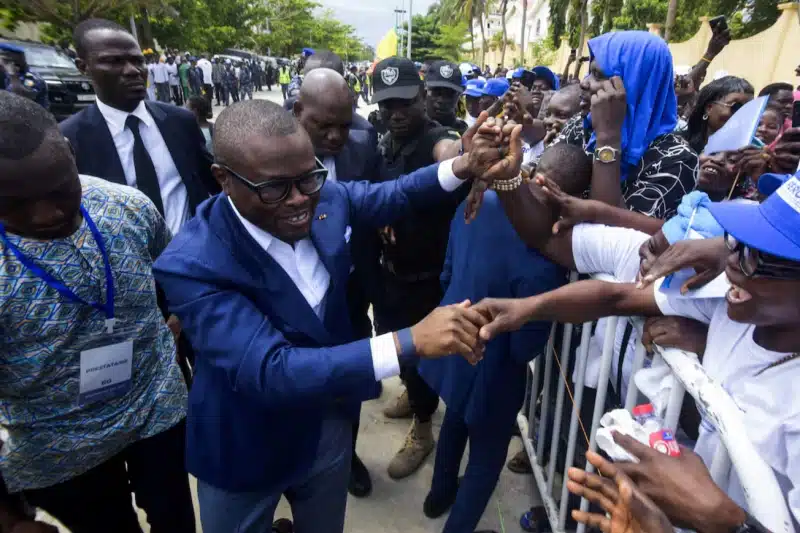

Benin presidential Election 2026 could not have commenced at a more awkward time, a moment of quiet tension over the country’s democratic credentials. It is still seen as a model in West Africa, but the current reality feels more tightly controlled, with a worsening security situation adding pressure.
For years, the country stood out for orderly transitions and relative stability. That image has not disappeared entirely, but it is no longer unquestioned. What is unfolding now feels different, less open, more managed, and harder to read at first glance.
That image has not disappeared entirely, but it is no longer unquestioned, with Benin’s declining democratic ratings reflecting growing concerns.
A Transition That May Not Mean Change
At the centre of the Benin presidential election 2026 is President Patrice Talon, who is stepping down after two terms. On paper, that is a routine democratic milestone. In practice, the picture is more complicated.
The leading candidate, Romuald Wadagni, is not just another contender. He is closely tied to Talon’s reform agenda and widely seen as the continuity option. His campaign leans on economic credibility, but the subtext is political inheritance.
There is also the question of what happens after Talon leaves office. The newly established Senate, populated partly by establishment figures, has triggered quiet debate in policy circles. Some see it as institutional balance. Others suspect it could become a platform for continued influence.
Either way, the transition does not feel like a clean break. It feels managed.
A Narrow Field, By Design or By Outcome?
The shape of Benin presidential election 2026 itself has become part of the story.
New electoral rules require candidates to secure endorsements from a share of elected officials. In isolation, that may sound procedural. In reality, given that pro-government parties dominate parliament, it changes everything.
The effect is visible in the candidate list.
Paul Hounkpè remains the only major challenger, but even his presence has not shifted the balance in any meaningful way. Several more prominent opposition figures never made it onto the ballot at all, blocked by legal rulings, administrative hurdles, or simply pushed out of the system.
So the question is not just who is running. It is who is not, and why.
Northern Insecurity Is No Longer Peripheral
Away from the political centre, another pressure is building, and this one is harder to manage.
Northern Benin, particularly areas bordering Burkina Faso and Niger, is seeing increased jihadist activity spilling over from the Sahel. What used to feel distant now feels close.
Attacks have become more frequent. Not constant, but persistent enough to shift the national conversation.
Wadagni’s proposal to create locally recruited municipal police units reflects that urgency. It is a practical idea on the surface, to reinforce security where the state is stretched. But it also raises difficult questions.
- Who controls these forces?
- How are they integrated into national command?
- What happens in communities already under strain?
There are no easy answers here, only trade-offs.
The reported coup plot in late 2025 adds another layer. Whether exaggerated or real, it points to unease somewhere within the system.
Growth on Paper, Pressure in Reality
Economically, the story is both solid and incomplete.
Benin’s macroeconomic performance has been strong. Growth has held steady, agricultural output, especially cotton, remains a key pillar, and reforms have improved the investment climate. These are real achievements, and Wadagni is right to foreground them.
But elections are not decided on macro indicators.
For many voters, especially younger ones, daily reality tells a different story:
- Food prices are rising
- Jobs are scarce
- The sense of inclusion is uneven at best
This is where Hounkpè is focusing his campaign, on what is often called the “stomach vote.” It is less about statistics and more about survival.
That gap between growth and lived experience can matter more than any policy paper.
The Real Question Is Not Who Wins
As the Benin presidential election 2026 approaches, one thing seems relatively clear, the likely outcome.
What is less clear, and far more important, is how that outcome will be received.
Nearly eight million voters are registered. But turnout, on its own, will not tell the full story.
- A low turnout could signal quiet disengagement
- A strong turnout might not erase doubts about competitiveness
- Insecurity in the north could skew participation entirely
So the real test is legitimacy.
Not just whether the process is completed, but whether it is believed.
A System Under Quiet Pressure
Benin is not in crisis, but it is under pressure.
Political control has tightened. Security risks are rising. Economic gains are unevenly felt. None of these factors alone defines the moment, but together, they shape it.
The Benin presidential election 2026 sits at that intersection.
It will produce a winner. That part is almost certain.
What it may not immediately produce is clarity, about the strength of institutions, the depth of public trust, or the direction of the country’s democracy.
And that uncertainty may be the most important outcome of all.


