



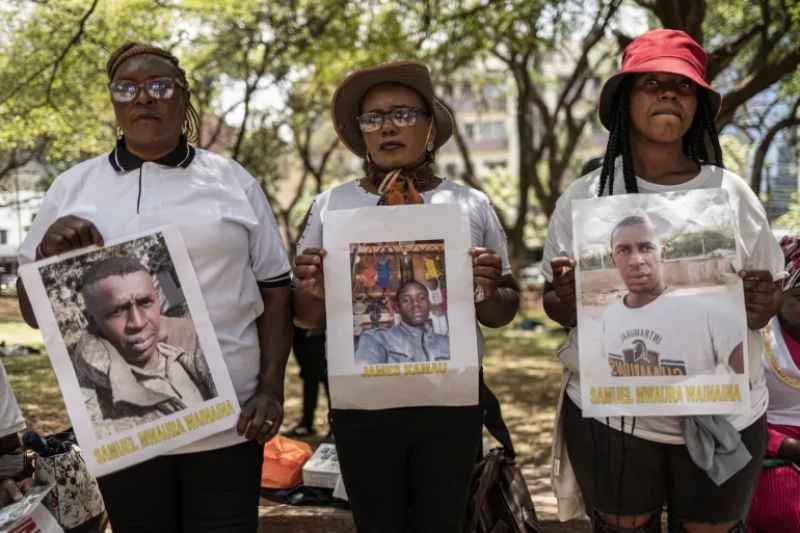

Kenya’s Foreign Minister Musalia Mudavadi told a Senate committee on Thursday, 7 May 2026, that 19 Kenyans recruited to fight in Ukraine are confirmed dead and 32 remain missing after being sent to the frontlines of the Russia-Ukraine war.
The figures, the most precise the government has publicly acknowledged, lay bare the human cost of what Nairobi describes as a predatory recruitment operation that has ensnared hundreds of young Kenyans desperate for income.
The crisis involving Kenyans recruited to fight in Ukraine has rapidly escalated into a national political and diplomatic issue for Nairobi.
“Forced enlistment” or a brutal economic bet?
The Kenyan government and its National Intelligence Service have framed the crisis largely as forced enlistment and human trafficking. The reality, as intelligence reports and survivor accounts suggest, is more layered than that.
Recruiters have been dangling monthly salaries of between 2,000 and 3,000 US dollars at young Kenyans in a country where youth unemployment remains one of the most pressing national challenges. For many, the salary offer is not abstract. It represents a life-changing sum against the near certainty of financial hardship at home.
The pitch often does not begin with soldiering at all. Many recruits initially believe they are accepting civilian roles as drivers, security guards, or construction workers. It is only on arrival at training camps in Russia or occupied Ukraine that they are pressured into signing military contracts written in a language they do not understand.
Over 1,000 believed recruited
Mudavadi’s figures to the Senate represent only the documented cases involving Kenyans recruited to fight in Ukraine.
Intelligence estimates suggest more than 1,000 Kenyans have been recruited through a network of rogue agents and travel agencies that routinely use transit hubs such as Istanbul and Dubai to sidestep scrutiny at Nairobi’s airports.
Officially, 291 cases have been recorded. Of those, 53 have been repatriated and two are held as prisoners of war by Ukrainian forces. The confirmed dead stand at 19, with 32 still missing.
The gap between the 291 documented cases and the estimated 1,000 recruited is, by any reckoning, significant. Rights groups and opposition legislators have argued the government is working with incomplete information.
Mudavadi flew to Moscow in March
The scale of the problem has triggered direct diplomatic intervention. In March 2026, Mudavadi travelled to Moscow specifically to demand that Russia halt the recruitment of Kenyan nationals. Russia has maintained that those who joined did so as volunteers.
The Kenyan government has pushed back firmly against that characterisation. Officials have described the men as cannon fodder, sent to high-casualty frontline positions with minimal training and little prospect of support if wounded or captured.
The issue of Kenyans recruited to fight in Ukraine has now become one of the most uncomfortable diplomatic challenges in Nairobi’s foreign relations, sitting at the intersection of economic desperation at home and a distant war Kenya has no stake in.
Why young Kenyans keep going
The story of Kenyans recruited to fight in Ukraine is, at its core, a story about poverty and predatory opportunism rather than kidnapping in the conventional sense.
When the formal economy offers little and the prospect of earning a Russian-funded salary feels like the only available ladder, the gamble of war becomes thinkable. Recruiters understand this and work it methodically, using social media, informal networks and front-facing travel firms to identify and approach targets.
The route is typically the same: a legitimate-sounding job offer, a flight through a neutral transit city, and then a camp where the exit options narrow sharply.
Until the economic conditions that make such offers attractive are addressed, advocates warn, the pipeline of Kenyans recruited to fight in Ukraine is unlikely to dry up simply because Mudavadi has raised the matter in Moscow or in the Senate chamber.


