



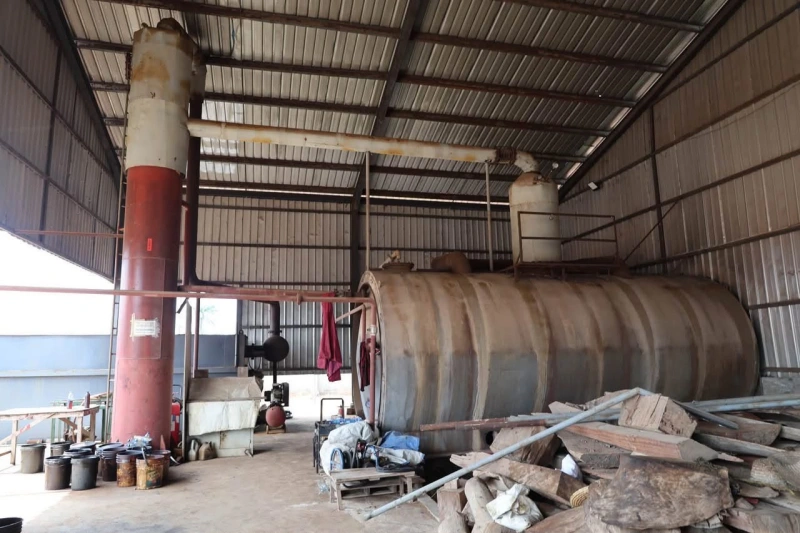

Two underground tanks in Ogun State still held suspected diesel. The people who filled them had gone.
That is what the Economic and Financial Crimes Commission says it found at an illegal oil refinery in Ogun State on Saturday 31 October. Operatives from its Lagos Zonal Directorate 2 raided the site at Ogere, acting on intelligence and surveillance.
Nobody was there to arrest. The commission found waste from the refining process, plus underground tanks it believes were used to heat and process sludge oil. Two of the tanks it inspected held what it suspects is automotive gas oil, the formal name for diesel.
The EFCC spokesman, Dele Oyewale, set out the account in a statement on Tuesday 3 November. He said the operators sourced sludge oil, also called black sludge, from Warri in Delta State and Port Harcourt in Rivers State. They then moved it to Ogere.
According to the commission, the operators subjected the sludge to intense heat, allowing lighter petroleum components to pass through a series of chambers and filters. The EFCC believes the process produced diesel intended for sale in Nigeria.
The route is the unusual part. Sludge oil is waste, and this batch came from two of the best-known oil hubs in the country before travelling hundreds of kilometres to a state that borders Lagos. Illegal refining is usually pictured in creeks and bush camps. The illegal oil refinery in Ogun was a processing site with underground tanks, chambers and filters.
So who ran it? The EFCC says the operators were Chinese. But that account rests on security personnel at the site, who told investigators the operators “never disclosed their identities nor the name of the company behind the facility”. No arrest has been announced.
The discovery came eight days after an earlier operation in the same area. On 23 October, the EFCC detained 14 Chinese nationals and one Nigerian at four lithium processing plants in Ogere.
Bags of lithium rocks, 18 mobile phones, four laptops and a trailer truck were recovered. The commission says the suspects will be charged once investigations end. It has not established any connection between those suspects and the abandoned refinery.
Ogere has been here before. In May 2025, the EFCC arrested two Chinese nationals and six Nigerians in the same area and recovered three trucks carrying suspected ground lithium powder. That makes three EFCC operations in Ogere in about 18 months, and the illegal oil refinery in Ogun is the latest.
The EFCC has not named any Nigerian official in connection with the illegal oil refinery in Ogun, and its statements have not identified any government involvement.
Someone held the land. Someone moved the sludge across state lines. Someone bought the diesel. The EFCC says it is working to establish who owns the facility and how far the activity went, and it is treating the case as possible economic sabotage.
Online, rumours have also emerged around the lithium operations in Ogere. Anonymous posts on a public forum allege that Ogun State Governor Dapo Abiodun sold ancestral land to Chinese interests. No documentary evidence supporting that allegation has emerged, and neither the EFCC statements nor reports reviewed establish any involvement by the governor or the state government in the illegal oil refinery in Ogun.
However, the claims raise questions about how land was acquired or allocated to the foreign-linked businesses operating in the area, who approved the arrangements and what oversight was exercised by state authorities. Those are questions that deserve answers, independently of whether the specific online allegation can be substantiated.
The licensing rules are not vague. The petroleum regulator, NMDPRA, has told the industry that nobody may run a midstream or downstream petroleum activity “except with an appropriate licence, permit or authorisation”. The EFCC calls the site illegal. It has not said what licence, if any, the illegal oil refinery in Ogun held.
The environmental cost is unmeasured. The EFCC has published no assessment of soil or groundwater at the site, and no test results from the illegal oil refinery in Ogun have come out.
A 2019 study by Nigerian researchers in the Okarki community in the Niger Delta found significantly elevated levels of hydrocarbons and heavy metals in soil and water around illegal refineries. Ogere is a different place with a different feedstock, so that finding is a warning rather than a verdict.
An earlier EFCC prosecution involving Chinese nationals and a company with premises in Ogun State offers another indication of the enforcement challenges surrounding illegal mineral activities. In March 2025, the Federal High Court in Ilorin convicted Yang Chao and Wu Shan Chuan, alongside their company, Crius Chemical Nigeria Limited, after they pleaded guilty to dealing in solid minerals without lawful authority.
The court sentenced both men to two years in prison, with an option of a N1 million fine each, imposed an additional N1 million fine on the company and ordered N14 million in royalties to be paid to the federal government. Solid minerals recovered from the company’s premises at Omi, Ogun State, were also forfeited.
A raid is not a conviction. The illegal oil refinery in Ogun has given up its tanks, its waste and its suspected diesel. It has not given up a single name.


