



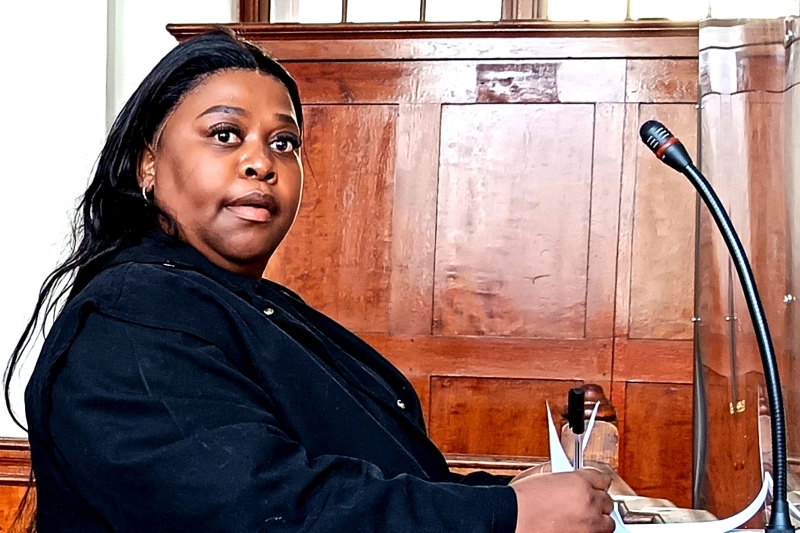

South Africa’s opposition uMkhonto weSizwe Party is facing fresh embarrassment after its most senior parliamentary officer appeared in court on fraud charges linked to allegations that staff were forced to surrender portions of their salaries.
Mmabatho Mokoena-Zondi – the chief whip of the MK Party and one of its three representatives on Parliament’s Impeachment Committee, appeared at the Cape Town Magistrate’s Court on Thursday, 28 May 2026.
The MK Party chief whip fraud case centres on allegations that stretch back to late 2024.
According to the Hawks, the Directorate for Priority Crimes Investigation, Mokoena-Zondi recruited four individuals into the party as parliamentary researchers between August and December 2024 and, during their employment, demanded payments under the pretext that the money was for the legal costs of party president Jacob Zuma.
Hawks spokesman Warrant Officer Zinzi Hani said the researchers were forced to pay between 50% and 60% of their salaries, with the total alleged fraud amounting to approximately R233,317.99.
Prior Fraud Conviction Emerges in Court
The court proceedings took a significant turn before her bail application had properly begun.
Prosecutor Noloyiso Damba informed the court that new information had emerged regarding a previous fraud conviction against Mokoena-Zondi dating back to 2016.
Her defence lawyer sought to contextualise that history. As reported by SABC News, her attorney Sankqela told the court that Mokoena-Zondi “is not a menace to society” and that the circumstances surrounding the previous conviction were “more intricate” and would be addressed “at the opportune time.”
The Cape Town Magistrate’s Court ultimately granted her bail of R30,000.
The matter returns to court on 18 June.
Nkandla Allegation Adds Political Dimension
The MK Party chief whip fraud case took on a wider political dimension through Mokoena-Zondi’s own account of what happened to the money.
In her affidavit, Mokoena-Zondi argued that the contributions were part of a voluntary initiative towards the upkeep of Zuma’s Nkandla home, which she described as a gesture of appreciation and solidarity. She denied enriching herself personally.
The prosecution’s position, however, points in a different direction. The Hawks have said the money was intended to help pay Zuma’s legal fees, presumably related to his ongoing arms deal case, and prosecutors allege Zuma never actually received the funds.
That gap between what the money was said to be for, what it was actually used for, and whether the employees genuinely consented, lies at the heart of the criminal case.
Why Nkandla Remains Politically Sensitive
The mention of the Nkandla homestead in KwaZulu-Natal immediately carries political weight in South Africa. The MK Party chief whip fraud case has also revived scrutiny of political fundraising practices linked to Zuma-associated projects.
During Zuma’s presidency, hundreds of millions of rand in state funds were spent on what were described as security upgrades at his private residence. The Constitutional Court later found that Zuma had failed to uphold the Constitution in relation to the Public Protector’s findings on the matter. The Nkandla scandal became one of the defining controversies of his presidency.
Any allegation involving money being channelled towards Nkandla, for whatever stated purpose, therefore draws intense scrutiny from the media and from Zuma’s political opponents.
Promoted Despite Party Disciplinary Finding
Details emerging around the MK Party chief whip fraud case also reveal uncomfortable internal party history.
Former MK Party national prosecutor Prince Mokotedi revealed on social media platform X that he had previously initiated an internal disciplinary process against Mokoena-Zondi over these same allegations. A three-member disciplinary panel found her guilty on 12 charges and explicitly recommended her expulsion. MK Party national officials chose to promote her instead.
Mokoena-Zondi was appointed chief whip in February 2026, replacing Colleen Makhubele, who was removed in January. Makhubele has since left the MK Party to join talk radio station Power FM as a presenter.
MK Party Chief Whip Fraud Case Not an Exception
The MK Party chief whip fraud case is not an isolated incident within the party’s leadership.
Former president Jacob Zuma and leader of MK party, remains embroiled in his long-delayed arms deal corruption trial, with the Pietermaritzburg High Court recently ordering an end to his legal delaying tactics and setting a firm trial date of 1 February 2027.
Zuma’s daughter, Duduzile Zuma-Sambudla, stepped down as an MK Party member of Parliament in November 2025 following a Hawks investigation into allegations that she fraudulently recruited 17 South African men to fight as mercenaries in Russia’s war against Ukraine. She is also currently standing trial in the Durban High Court for incitement to commit terrorism linked to the deadly July 2021 unrest.
In April 2026, MK Party MP Visvin Reddy pleaded guilty to inciting public violence after threatening a civil war ahead of the 2024 elections, which resulted in a R30,000 fine.
Party’s Response
The MK Party issued a brief public statement after the arrest. As quoted by the African News Agency, party spokesperson Sifiso Mahlangu said the party “acknowledges the charging of its Chief Whip in the National Assembly” and noted that she “voluntarily presented herself to law enforcement authorities,” adding that the MK Party “reaffirms its commitment to constitutionalism and the rule of law.”
The party said it was reviewing the MK Party chief whip fraud case before issuing a fuller statement.
Mokoena-Zondi has not been convicted of the current charges, and she is entitled to the presumption of innocence. The case resumes at the Bellville Commercial Court in Cape Town on 18 June 2026.


