



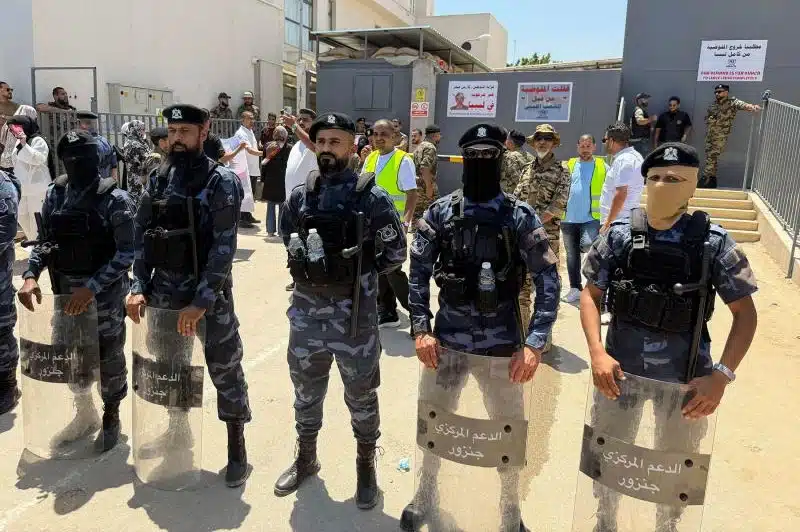

The London-based rights group said on Tuesday that both the Tripoli-based Government of National Unity and the rival eastern-based Libyan Government, allied to the Libyan Arab Armed Forces, have been driving racially discriminatory mass arrests, arbitrary detention, and unlawful collective expulsions backed by open xenophobic rhetoric from officials.
Libya is one of the busiest departure points along the North African coast for migrants risking the Mediterranean crossing to reach Europe.
Thousands arrested and expelled
Between 7,000 and 8,000 migrants were being held in detention in the east and south of the country by 24 May 2026, according to Amnesty International, with at least 4,500 of them foreign nationals, including Sudanese who had been expelled without any opportunity to challenge their removal or claim asylum.
The Directorate for Combating Illegal Migration, known as the DCIM, forcibly evicted and arrested dozens of migrants, including children, from informal camps in the Al Serraj area of Tripoli on 18 May. The eastern Tripoli branch of the DCIM separately declared it had summarily expelled over 800 people, including Sudanese nationals, from Mitiga airport since early May.
Amnesty International spoke to a Sudanese asylum seeker arrested on 2 June by the DCIM in the eastern city of Tobruk. He said he was held in a severely overcrowded hangar at the Bab Al-Zaytoun Shelter and Deportation Centre alongside at least 1,000 others, including Egyptians and Bangladeshi nationals. Guards refused his request for insulin and rejected his attempt to claim asylum. He watched as officials removed 400 people from the facility.
Amnesty International argued that the EU Libya migration deal is helping entrench a system in which migrants intercepted at sea are returned to detention centres where abuses remain widespread.
Officials call Libya ‘not for Africans’
The racism has not been subtle. In a statement issued on 2 April, the eastern DCIM told EU officials directly that Libya was not a “land of settlement for Africans”, in a clear targeting of Black sub-Saharan migrants referred to simply as “Africans.”
Between 1 and 10 June, Libya’s House of Representatives issued a string of statements and decisions rejecting what it called the “settlement” of migrants in the country. The parliament cited Law 24 of August 2023, which mandates imprisonment and expulsion for anyone intending to settle in Libya, whether through legal or irregular means.
Saddam Haftar, the second-in-command of the Libyan Arab Armed Forces, announced an extensive campaign of expulsions during the same period. Amnesty International has previously documented collective expulsions, unlawful killings, torture, rape and sexual violence carried out by the Tariq Ben Zeyad armed group that was then under Saddam Haftar’s de facto control.
Critics say the EU Libya migration deal risks legitimising authorities accused of carrying out discriminatory policies against Black African migrants.
Street protests demand UNHCR expulsion
Anti-migrant sentiment has spilled onto the streets. Since April 2026, hundreds of protesters have gathered weekly in the Janzour neighbourhood of western Tripoli, outside the offices of the UN Refugee Agency, UNHCR, demanding the agency’s removal from Libya. The demonstrators, who have called migrants “infiltrators” and blamed them for Libya’s economic troubles, also called on Libyans housing or employing migrants to dismiss and evict them.
One protest ended with demonstrators piling mounds of sand at the UNHCR gates and breaching the exterior gate of the neighbouring compound of the UN Support Mission in Libya.
EU Libya migration deal presses on against odds
The EU Libya migration deal has now moved beyond the internationally recognised western government in Tripoli. A technical arrangement dated 20 May 2026, published by the civil liberties monitoring group Statewatch, confirmed that the EU’s naval mission Operation Irini has begun formal collaboration with Libya’s eastern forces under General Khalifa Haftar, as part of the EU Libya migration deal, including training, support, and the development of a regional migration coordination centre in Benghazi.
Statewatch executive director Alamara Khwaja Bettum said the arrangement was “a deeply alarming escalation in what was already a troubling and dangerous partnership.” Khwaja Bettum said what was being presented as investment in “capacity building” was, in reality, support that enables the abuse, detention and exploitation of migrants.
The plan for an EU-funded Maritime Rescue Coordination Centre in Benghazi, with initial start-up funding of €3 million drawn from the EU’s European Peace Facility budget, was first reported in January 2026 by German journalist Matthias Monroy. Its establishment would give Haftar’s coastguard an operational base and considerable international legitimacy.
EU Migration Commissioner Magnus Brunner had already called for negotiations with Haftar as far back as the summer of 2025, citing concern about Russia’s growing military footprint in eastern Libya. A July 2025 visit by Brunner alongside Italian, Greek and Maltese ministers ended in a diplomatic incident when the European delegation was expelled from Benghazi after refusing to pose for photographs with Haftar’s ministers.
European Commission President Ursula von der Leyen had written in a June 2025 letter to EU leaders that it was necessary to work “with authorities in the West and East of the country” to strengthen border management and combat migrant smuggling.
Libyan coast guard fires on rescue boats
The expansion of the EU Libya migration deal comes against a backdrop of documented violence at sea. The Libyan Coast Guard fired at a Sea-Watch NGO rescue boat on 11 May 2026 in international waters north of Tripoli. It was the third such shooting incident since August 2025, when the humanitarian vessel Ocean Viking was also fired upon.
The shooting incidents have intensified scrutiny of the EU Libya migration deal and its continued support for Libyan maritime authorities. The European Ombudsman opened an inquiry on 6 May into the European Commission’s failure to release documents relating to one of those earlier shootings.
Amnesty International documented that the EU-backed Libyan Coast Guard intercepted at least 26,940 refugees, asylum seekers and migrants at sea in a prior year and forcibly returned them to detention in Libya.
‘Complicity in horrific violations’
Eve Geddie, Director of Amnesty International’s European Institutions Office, said the EU Libya migration deal “amounts to complicity in horrific human rights violations.” Geddie said the EU and its member states were “doubling down, trapping more and more people in abhorrent cycles of abuse” instead of addressing what she called the catastrophic human cost of its migration arrangements in Libya and beyond.
Amnesty International said conditions for those detained in Libya include prolonged arbitrary detention, enforced disappearances, torture, rape, unlawful killings, extortion and forced labour. A United Nations investigation previously found these conditions very likely amount to crimes against humanity.
The rights group called on the EU and its member states to urgently re-evaluate their support for Libyan authorities, suspend any actions contributing to trapping refugees and migrants in the country, and avoid further complicity in what it described as grave human rights violations.
Human rights groups warned that without significant reforms, the EU Libya migration deal could deepen concerns about European complicity in abuses committed against migrants and asylum seekers.


