




Ethiopia has launched a refugee integration roadmap intended to shift the country’s response to mass displacement from short-term relief toward long-term national development.
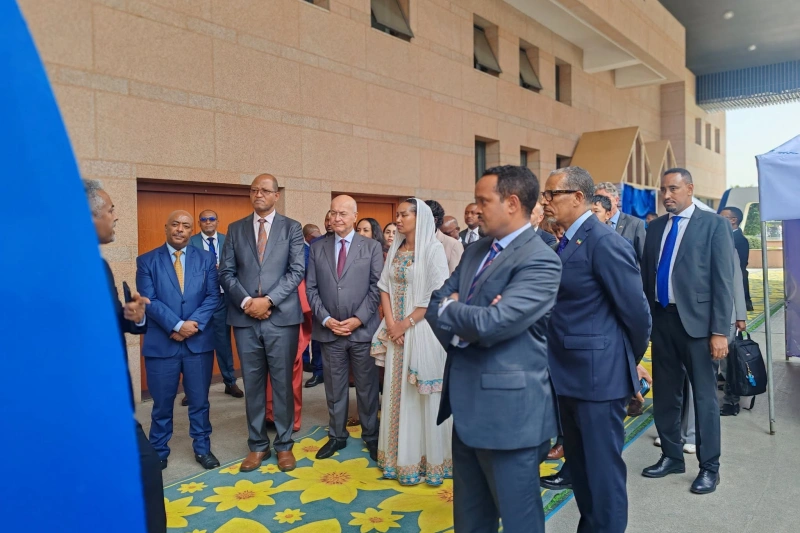
The framework, known locally as the Makatet Roadmap, was unveiled in Addis Ababa on 18 June 2026 at the Adwa Victory Memorial Museum. Ethiopia’s Refugees and Returnees Service led the launch, a move the Intergovernmental Authority on Development described as the product of a nationally owned and consultative process involving federal and regional institutions, UN agencies and refugee representatives themselves.
At its core, the refugee integration roadmap folds refugees into national systems for education, healthcare, documentation and employment, rather than running parallel camp-based services alongside them. House Speaker Tagesse Chafo, who spoke at the launch, called it a landmark national strategy that would expand protection and opportunity for both refugees and the communities hosting them, Fana Broadcasting Corporate reported.
Ethiopia is currently home to more than 1.1 million refugees and asylum seekers drawn from 27 countries, according to figures cited by Xinhua from the launch event. The largest numbers come from South Sudan, Somalia and Eritrea, with Sudanese arrivals rising sharply since conflict broke out there in April 2023.
That Sudan war sits behind much of the urgency driving the refugee integration roadmap. At the Ura settlement in Benishangul-Gumuz, close to the Sudanese border, UN High Commissioner for Refugees Barham Salih met some of the 45,000 families who have crossed into Ethiopia since fighting began, according to a UNHCR account of his visit published by GlobalSecurity.org. Salih toured a primary school there where Sudanese and Ethiopian children study side by side, and met refugee entrepreneurs who had rebuilt businesses lost to the war.
Speaking on the refugee integration roadmap, Salih said refugees needed more than physical safety, adding that “they need the chance to learn, work and rebuild their lives.” He described the initiative as closely aligned with UNHCR’s own “50 by 35” vision, which seeks to halve the number of refugees stuck in protracted displacement by 2035.
Under the refugee integration roadmap, camps are expected to evolve gradually into self-sustaining, urban-style settlements wired into national service delivery, rather than isolated humanitarian enclaves. Refugees granted status under the framework can access work permits, business licenses and biometric national identification, reducing their reliance on humanitarian agencies for day-to-day survival.
African Union Commissioner for Infrastructure and Energy Lerato Dorothy Mataboge, who attended the launch, praised Ethiopia’s approach as a practical example of how African states can translate refugee inclusion commitments into concrete policy, Fana Broadcasting Corporate reported. She linked the roadmap to the African Union’s Agenda 2063 vision of an integrated and inclusive continent.
Ethiopia’s refugee integration roadmap builds on commitments the country first made at the 2016 New York Summit for Refugees and Migrants, when it pledged reforms on education, documentation and livelihoods for displaced people. Those pledges were formalised through a 2019 revision of Ethiopia’s refugee proclamation, though implementation was slowed for years by regional instability, according to an analysis by the Migration Policy Institute.
Funding remains the refugee integration roadmap’s most visible weak point. Ethiopia and 38 humanitarian and development partners rolled out a 577.8 million dollar Country Refugee Response Plan for 2026, Capital Newspaper reported, to support a refugee population that has kept climbing even as international donors scale back assistance.
Gaps in protection persist alongside the new roadmap. The Migration Policy Institute’s analysis found that a significant number of Eritreans living in Addis Ababa remain excluded from its benefits, unable to secure or renew legal status, and facing risks of arrest and deportation as a result.
Even so, officials in Addis Ababa are positioning the refugee integration roadmap as a continental reference point. By linking displaced populations directly to national systems rather than parallel aid structures, Ethiopia is betting that refugee self-reliance can be built into the machinery of the state itself, rather than left to depend on humanitarian funding cycles that have grown increasingly unreliable.


